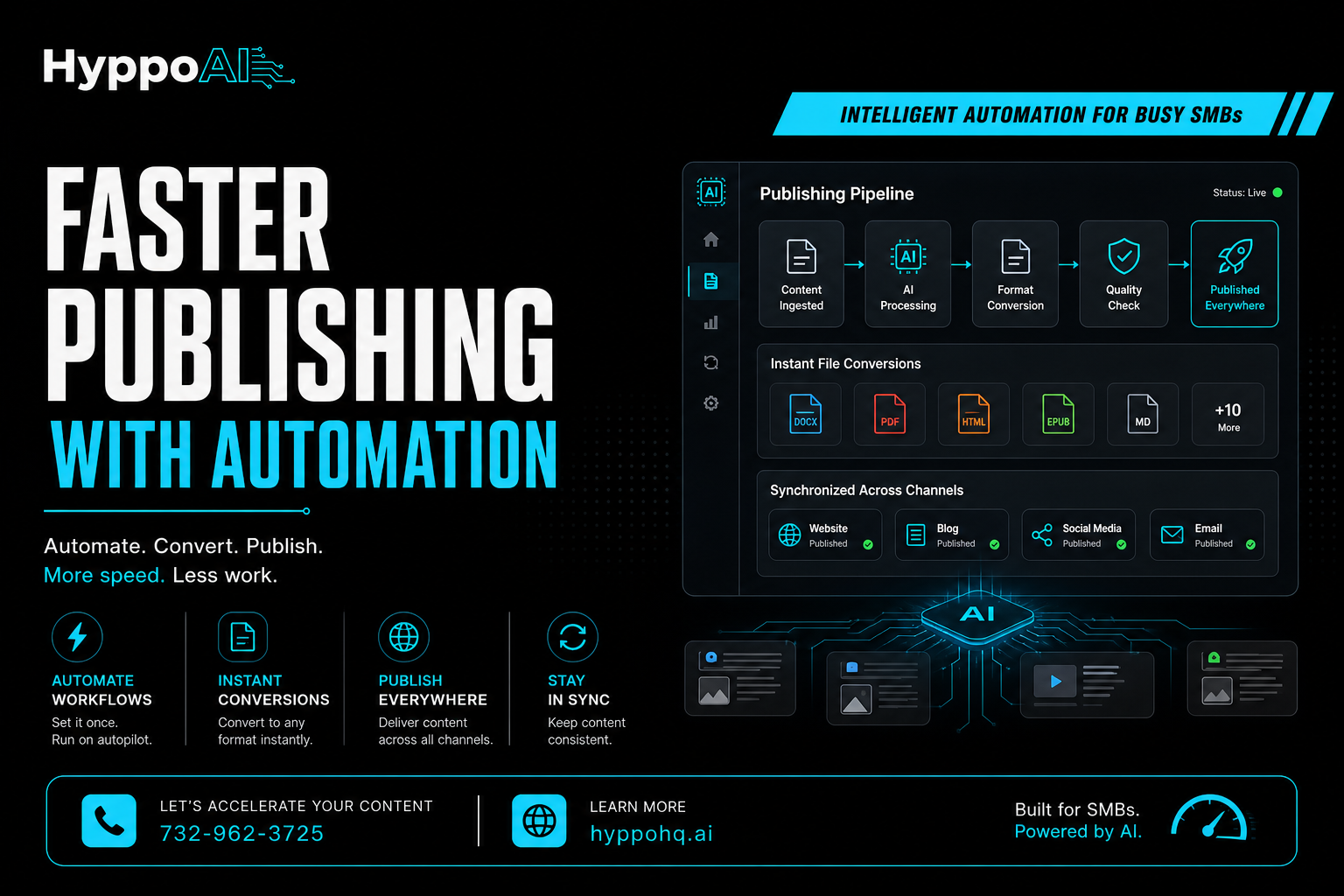
Automated conversions enable faster publishing for SMBs
Publishing speed matters, especially for small and midsize businesses that need to stay visible without adding more manual work. When content gets stuck between formats, approvals, and repetitive edits, momentum disappears.
Automated conversions solve that problem. They help teams move content from one format to another with less friction, so blogs, social posts, emails, captions, transcripts, and web copy can be prepared and published faster.
For SMBs, this is not just a convenience. It is an operational advantage.
What automated conversions actually mean
Automated conversions are workflows that transform content, data, or media from one usable format into another with minimal manual effort.
In publishing, that can include:
- Turning a video transcript into a blog draft
- Converting long-form content into social captions
- Reformatting webinar notes into email copy
- Structuring raw text into CMS-ready content
- Transforming customer FAQs into help center articles
- Converting spoken ideas into written assets for review
Instead of rebuilding the same message over and over, teams create once and adapt quickly.
Why publishing slows down in the first place
Most publishing delays do not come from a lack of ideas. They come from process friction.
Common bottlenecks include:
- Copy pasted content that needs reformatting
- Rewriting the same message for multiple channels
- Manual cleanup of transcripts or notes
- Delays between drafting, editing, and publishing
- Inconsistent structure across content types
- Team members waiting on simple repetitive tasks
For SMBs, these small delays add up fast. A post that should go live today gets pushed to next week. A campaign misses its ideal timing. A useful idea never gets published at all.
The hidden cost of manual conversion work
Manual conversion work often looks harmless because each task seems small. But together, they drain time and focus.
That cost shows up in several ways:
- Slower content velocity
- Higher labor input for routine tasks
- More formatting errors
- Less consistency across platforms
- Reduced ability to respond quickly to trends or customer needs
When your team spends too much time converting content manually, they spend less time improving strategy, messaging, and performance.
How automated conversions enable faster publishing
Automated conversions remove repetitive steps between content creation and publication. That means fewer handoffs, fewer delays, and a shorter path from idea to live asset.
Here is how that plays out in practice.
1. They reduce rework
A single source asset can become multiple publish-ready outputs. For example, one recorded interview can be converted into:
- A blog post
- Several social captions
- An email summary
- Website FAQ content
- Internal sales enablement notes
Without automation, that process requires repeated manual rewriting. With automated conversions, the foundation is generated quickly and then refined as needed.
2. They improve consistency
Publishing faster only matters if quality stays controlled. Automated workflows help standardize structure, formatting, and tone across outputs.
That can include:
- Consistent heading formats
- Reusable content templates
- Predefined output styles for each platform
- Cleaner transitions between draft and review stages
Consistency reduces editing time and makes publishing easier to scale.
3. They shorten the gap between creation and distribution
One of the biggest content problems for SMBs is lag. A team records something useful, but it takes too long to package and publish it.
Automated conversions help close that gap. The faster content moves into usable formats, the faster it can be reviewed, approved, and distributed.
That speed matters when:
- Responding to market changes
- Publishing timely thought leadership
- Repurposing event or meeting content
- Supporting active campaigns with fresh assets
4. They make small teams more productive
SMBs rarely have large content departments. Often, one person is handling strategy, writing, editing, and publishing.
Automation helps that person do more without sacrificing control. Instead of starting from scratch every time, they start with a converted draft or structured output that is already moving in the right direction.
This is where AI-driven workflows become especially valuable. They support production without requiring a larger team.
Real-world publishing use cases for SMBs
Automated conversions are practical because they fit into everyday business workflows.
From meetings to content
Internal calls, sales conversations, and customer interviews often contain strong publishable insights. Automated conversion tools can turn those spoken ideas into written drafts that are easier to review and publish.
From long-form to short-form
A detailed article or transcript can be converted into:
- Social media snippets
- Email teaser copy
- Ad variations
- Short educational posts
This helps businesses extend the value of every content asset.
From raw notes to structured articles
Many teams have useful information trapped in bullet points, voice notes, or rough documents. Automated conversions can organize that material into a more publishable structure.
That means less time spent formatting and more time spent improving the message.
What to look for in an automated conversion workflow
Not all automation is equally useful. The best workflows support speed and clarity without creating more cleanup work.
Look for systems that offer:
- Clean output structure
- Adaptation across multiple content types
- Easy editing after conversion
- Repeatable templates for recurring content
- Integration with your publishing process
- Reliable quality for business use
The goal is not to remove human review. The goal is to remove unnecessary manual steps.
Best practices to publish faster with automation
If you want automated conversions to actually improve publishing speed, keep the process simple.
Start with high-friction tasks
Identify where your team loses the most time. That is usually where automation creates the fastest return.
Examples include:
- Transcript cleanup
- Blog-to-social repurposing
- Formatting content for CMS upload
- Converting calls or recordings into drafts
Build around repeatable content types
Automation works best when the workflow repeats. If you publish weekly articles, recurring emails, or standard social formats, those are strong candidates for automated conversions.
Keep human review focused
Do not waste review time on tasks automation can handle well. Save human attention for:
- Accuracy
- Brand voice
- Strategic messaging
- Final approval
That balance helps teams move quickly without lowering standards.
The bigger advantage: operational speed
Faster publishing is not just a marketing win. It is an operations win.
When automated conversions are part of your workflow, your business becomes better at turning information into action. Ideas move faster. Campaigns launch sooner. Useful content gets published while it is still relevant.
For SMBs, that kind of speed can create a real competitive edge.
You do not need more complexity. You need fewer manual steps between creation and execution.
Final thoughts
Automated conversions enable faster publishing by reducing rework, improving consistency, and helping small teams produce more from the content they already have. For SMBs trying to stay visible and efficient, that matters.
If your team is spending too much time converting, reformatting, and repackaging content by hand, it may be time to streamline the process. Visit https://hyppohq.ai or call +17329623725 to learn how HyppoAI helps businesses use AI-driven automation to publish faster and operate smarter.