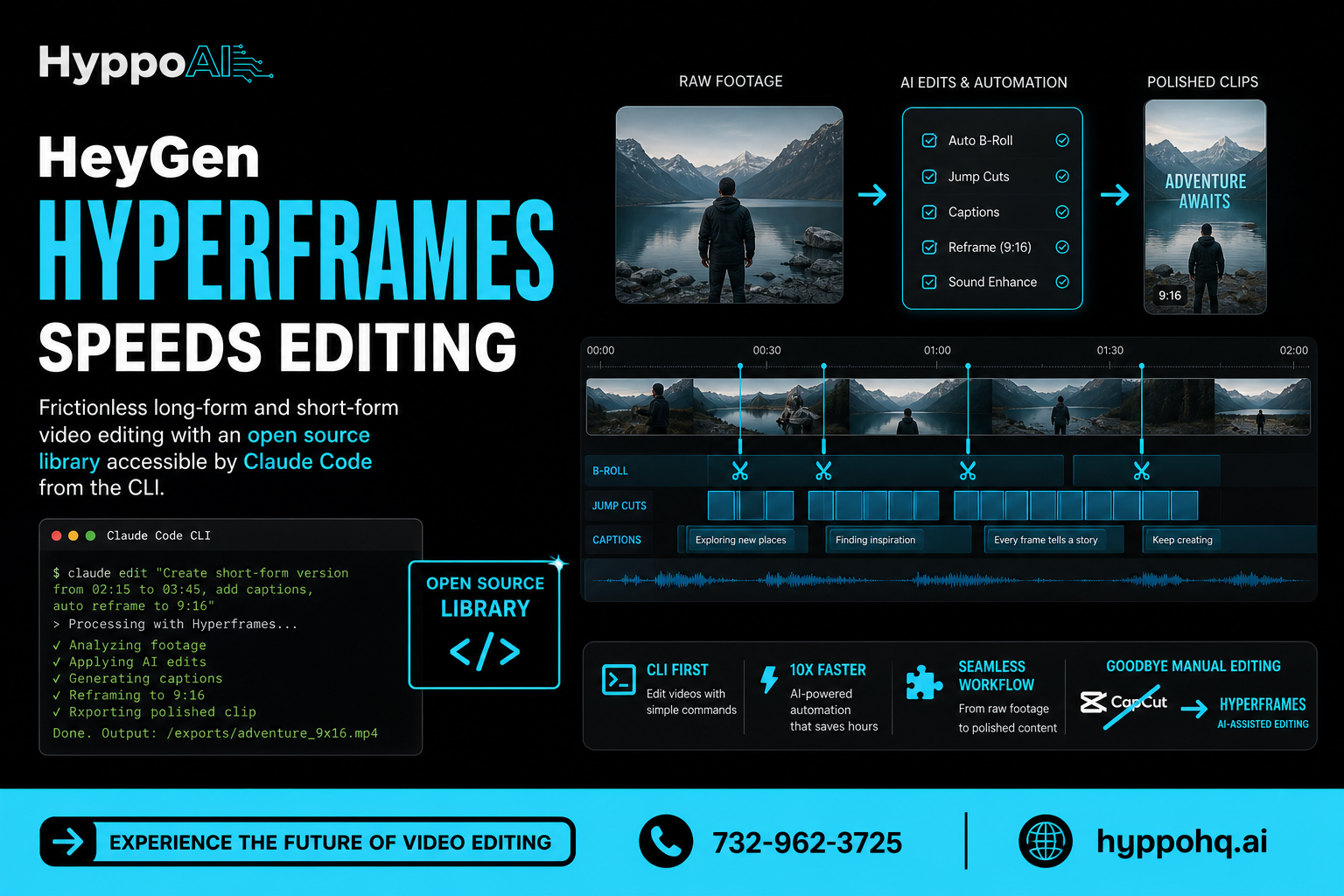
HeyGen Hyperframes makes video editing frictionless
Video publishing usually breaks down in the same place: editing.
Recording is easier than ever. Ideas are everywhere. Distribution is instant. But turning raw footage into polished long-form and short-form content still takes too much time when the process depends on manual timelines, repetitive cuts, and tool switching.
That is why frictionless publishing matters.
And right now, one of the most interesting shifts is HeyGen's Hyperframes tool, which released about three weeks ago. It changes the editing conversation from manual assembly to programmable workflow. Instead of treating editing like a series of clicks inside a traditional app, Hyperframes opens the door to faster, more seamless production that fits into how modern teams already work.
For businesses trying to publish more content without bloating production time, that matters a lot.
The real bottleneck in video publishing
Most teams do not struggle with ideas. They struggle with the gap between recording and publishing.
That gap gets expensive when editing requires:
- Manually trimming clips
- Reframing for multiple aspect ratios
- Rebuilding the same style across videos
- Repeating caption and visual edit workflows
- Exporting and re-exporting for different channels
- Jumping between tools for long-form and short-form versions
Traditional tools like CapCut can be useful, but they still often rely on a human driving every step. That is fine for occasional edits. It becomes a bottleneck when the goal is consistent publishing at scale.
The more content you want to create, the more manual editing starts to work against you.
What frictionless video publishing actually means
Frictionless publishing does not mean "no editing." It means less wasted motion.
It means the path from raw footage to finished content becomes simpler, faster, and easier to repeat.
In practice, frictionless editing looks like this:
- Long-form and short-form outputs can be created from the same source material
- Edits fit into existing production workflows instead of forcing a brand-new process
- Repetitive tasks can be automated or scripted
- Teams can move from concept to publish with fewer handoffs
- Visual polish does not require hours of manual timeline work
That is the bigger story behind Hyperframes.
Why HeyGen Hyperframes stands out
HeyGen's Hyperframes is important because it helps make editing long-form and short-form video seamless.
Instead of thinking only in terms of a traditional editing interface, Hyperframes works as an open-source video editing library that Claude Code can access and perform from the CLI. That changes the workflow in a meaningful way.
Now editing is not just something you do manually inside an app. It can become part of a programmable content pipeline.
A better fit for current workflows
One reason new tools fail is simple: they demand that teams rebuild everything around them.
Hyperframes feels different because it fits into current workflows more easily.
If your process already involves AI-assisted scripting, content planning, asset generation, or developer-style automation, Hyperframes can slot into that environment instead of fighting it.
That means businesses can:
- Keep their current content workflow structure
- Reduce context switching between tools
- Use CLI-based execution where it makes sense
- Build repeatable editing processes instead of one-off manual sessions
- Create both long-form and short-form outputs more efficiently
For SMBs especially, that is a major advantage. Smaller teams do not have time to reinvent production every time they publish.
Hyperframes vs manual tools like CapCut
This is not about saying manual editors are obsolete. It is about understanding where they slow you down.
With a manual-first tool like CapCut, the editor often has to personally handle each decision in sequence:
- Open project
- Import footage
- Scrub timeline
- Cut sections
- Add transitions
- Place text
- Adjust framing
- Export versions
- Repeat for shorts
That process can work. It just does not scale cleanly when you need speed, consistency, and repeatability.
Hyperframes changes the equation by making editing more systemized.
Where the time savings show up
The biggest gain is not one flashy feature. It is the reduction of editing drag.
That includes:
- Less manual timeline labor
- Faster conversion from long-form footage into short-form clips
- Easier repeatability across multiple videos
- Better alignment with AI-assisted and developer-assisted workflows
- Fewer bottlenecks between recording and publishing
For content teams, founders, agencies, and SMB operators, this means less time pushing pixels and more time shipping content.
Why this matters for SMB content strategy
At HyppoAI, we focus on AI for SMB. That perspective matters here.
Most small and mid-sized businesses are not losing because they lack expertise. They lose because production friction keeps them from publishing consistently.
A business might have:
- A strong founder story
- Great customer proof
- Helpful educational content
- Solid service footage
- A clear local market advantage
But if every video takes too long to edit, publishing slows down. Then momentum disappears.
Tools like Hyperframes matter because they reduce the cost of execution.
When editing becomes easier to integrate and less dependent on repetitive manual work, businesses can:
- Publish more often
- Repurpose content faster
- Test more creative angles
- Maintain quality without excessive editing time
- Turn raw footage into usable marketing assets sooner
That is where frictionless publishing becomes a business advantage, not just a production upgrade.
A practical example: from build video to polished content
A good example of this is the kind of content many service businesses need right now.
Soon, I will be publishing a video of myself building a website for American Family Pest Control, with strong visual edits layered in. That kind of content is exactly where seamless editing matters.
You have a longer narrative arc that can live as a fuller piece of content. But inside it, there are also multiple short-form moments:
- Website build highlights
- Before-and-after visuals
- UX decisions
- branding and layout moments
- Fast educational clips for social
In a manual workflow, pulling all of that together can take far too long.
With a more frictionless editing approach, the process becomes much easier to execute consistently. The content can move from raw recording to polished long-form and short-form outputs without the same level of repetitive editing overhead.
The bigger shift: editing becomes infrastructure
This is the real takeaway.
When an open-source video editing library can be accessed by Claude Code from the CLI, editing starts to look less like a standalone creative chore and more like infrastructure.
That opens up a different future for publishing:
- Editing can become more repeatable
- Workflows can become more modular
- Content production can move faster
- Teams can spend more time on message and strategy
- Publishing can happen closer to the speed of ideation
For brands that want to win with content, that is a big deal.
The teams that publish consistently are usually not the teams with the most raw footage. They are the teams with the least friction between idea, edit, and distribution.
Final thought
HeyGen Hyperframes is worth watching because it helps make long-form and short-form editing seamless, cuts down the manual work common in tools like CapCut, and fits into current workflows without demanding a total reset.
That is the direction video publishing is heading: less manual drag, more workflow alignment, and faster output from the same source material.
If your business is trying to create more content without getting buried in editing, this shift matters now.
If you want help building smarter AI-powered content workflows for your business, visit HyppoAI at https://hyppohq.ai or call +17329623725.