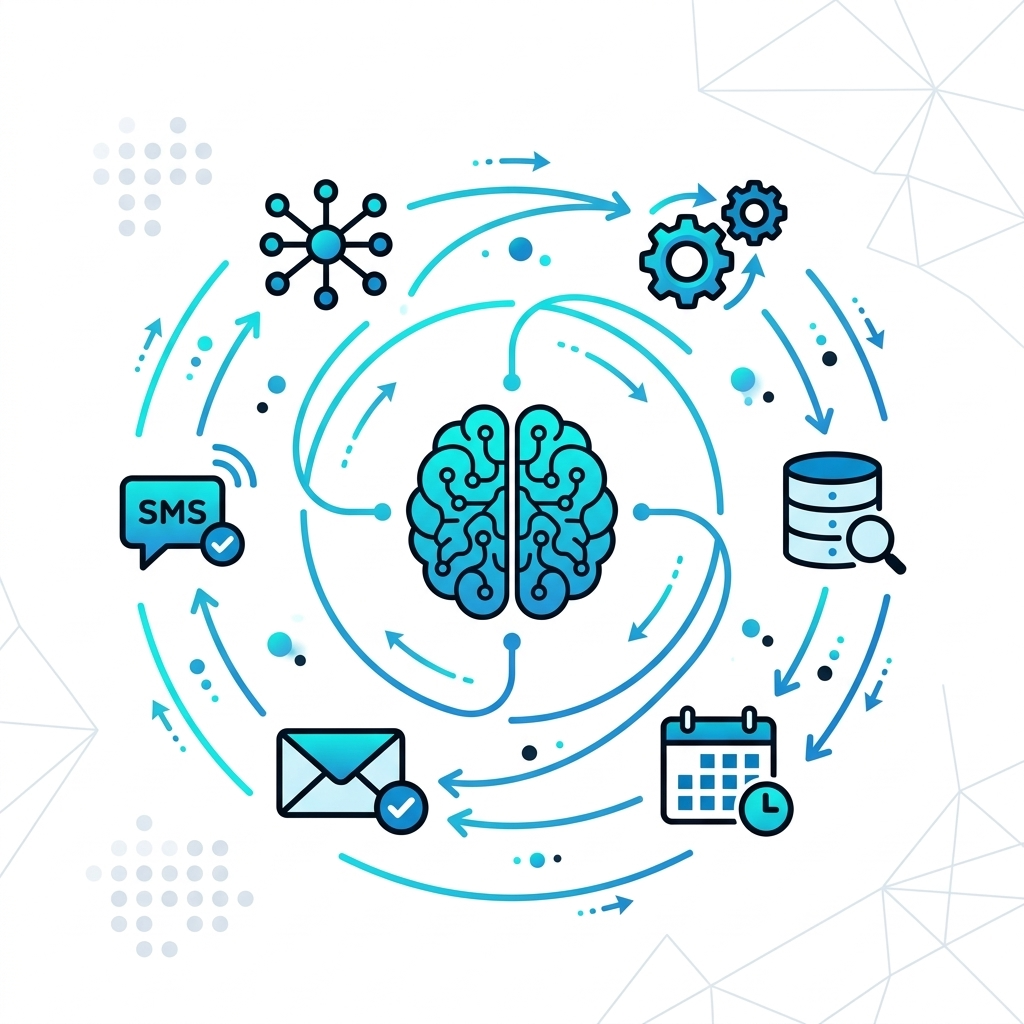
How AI, Automations, Follow-Ups, and APIs Connect
How AI, Automations, Follow-Ups, and APIs Connect in One System
For many service businesses, the hardest part of marketing is not getting attention. It is connecting all the pieces: your ads, your inbox, your CRM, your calendar, your follow-up messages, and your internal workflows. When these systems do not communicate with each other, opportunities can be missed and teams often get buried in manual tasks.
What It Means for Systems to Talk to Each Other
When someone says their systems do not talk, they usually mean data is trapped in one system and not visible in others, teams are retyping the same information in multiple places, or customer communication is inconsistent because tools are disconnected.
A Brief Overview: What Is an API?
An API (Application Programming Interface) is a standardized way for software tools to request and exchange information with each other. In day-to-day business terms, APIs are often the mechanism behind integrations such as creating a new contact in a CRM when someone submits a website form, pulling appointment details from a scheduling tool, or sending a text message when a job status changes.
The Three Layers: AI, Automation, and Follow-Up
AI: Understanding and Decision Support
AI systems are good at interpreting information, recognizing patterns, and generating language. In a service business context, AI can classify incoming leads by intent or urgency, summarize long email threads or call transcripts, draft context-aware responses for review, and identify recurring questions and themes across customer conversations.
Automation: Reliable, Repeatable Processes
Automation handles predictable, repeatable tasks that should not require human attention every time: creating a contact in your CRM when a form is submitted, sending a confirmation message when a booking is made, updating a lead stage based on completed actions, and notifying the right team member when specific conditions are met.
Follow-Up: The Customer Communication Layer
Follow-up is where customers feel the impact of your systems. It includes lead nurturing messages after an inquiry, reminders before appointments, check-ins after work is completed, and re-engagement campaigns for past customers.
How These Layers Interact (and Where APIs Fit)
AI Informs the Automation
Instead of triggering workflows from simple rules, AI can add an interpretive step: reading a lead's message and classifying it as high, medium, or low urgency; detecting whether the person is an existing customer; or identifying the service type from unstructured text. That classification becomes structured data your automation can use.
Automation Controls the Flow
Once AI has added context, automation tools decide what happens next: assigning the lead to a specific team member, triggering a follow-up sequence, creating internal tasks, or updating fields in your CRM. APIs commonly power these handoffs.
Follow-Up Delivers the Experience
When these tools communicate well, the customer experiences communication that feels timely, consistent, context-aware, and predictable.
Common Breakpoints in the Conversation Between Systems
- Data Silos Between Tools: If your various platforms each store their own version of a contact, it becomes difficult for any one system to produce meaningful follow-ups.
- Unclear Ownership of Each Layer: Without clear boundaries, customers can receive duplicate messages, conflicting messages, or no message at all.
- Over-Automation Without Context: If AI-generated messages are sent automatically without appropriate review, customers may receive responses that are off-tone or incomplete.
- Fragile Integrations and Partial Data: Some connections fail quietly, particularly when multiple tools are chained together.
Design Principles for Systems That Communicate Well
- Start from the Customer Journey: Rather than starting from tools, start from the customer's experience at each stage.
- Use AI to Interpret, Not Only to Respond: AI is often most valuable when it helps interpret unstructured information so automations can act on structured context.
- Keep a Single Source of Truth: Choose one system as the primary home for contact and interaction data.
- Make Hand-Offs Visible: Wherever a process moves from AI to automation to a human, visibility matters.
If you want to learn more about how HyppoAds thinks about AI-powered marketing, automation infrastructure, and connected follow-up systems for service businesses, you can reach out at hyppohq.ai/contact.