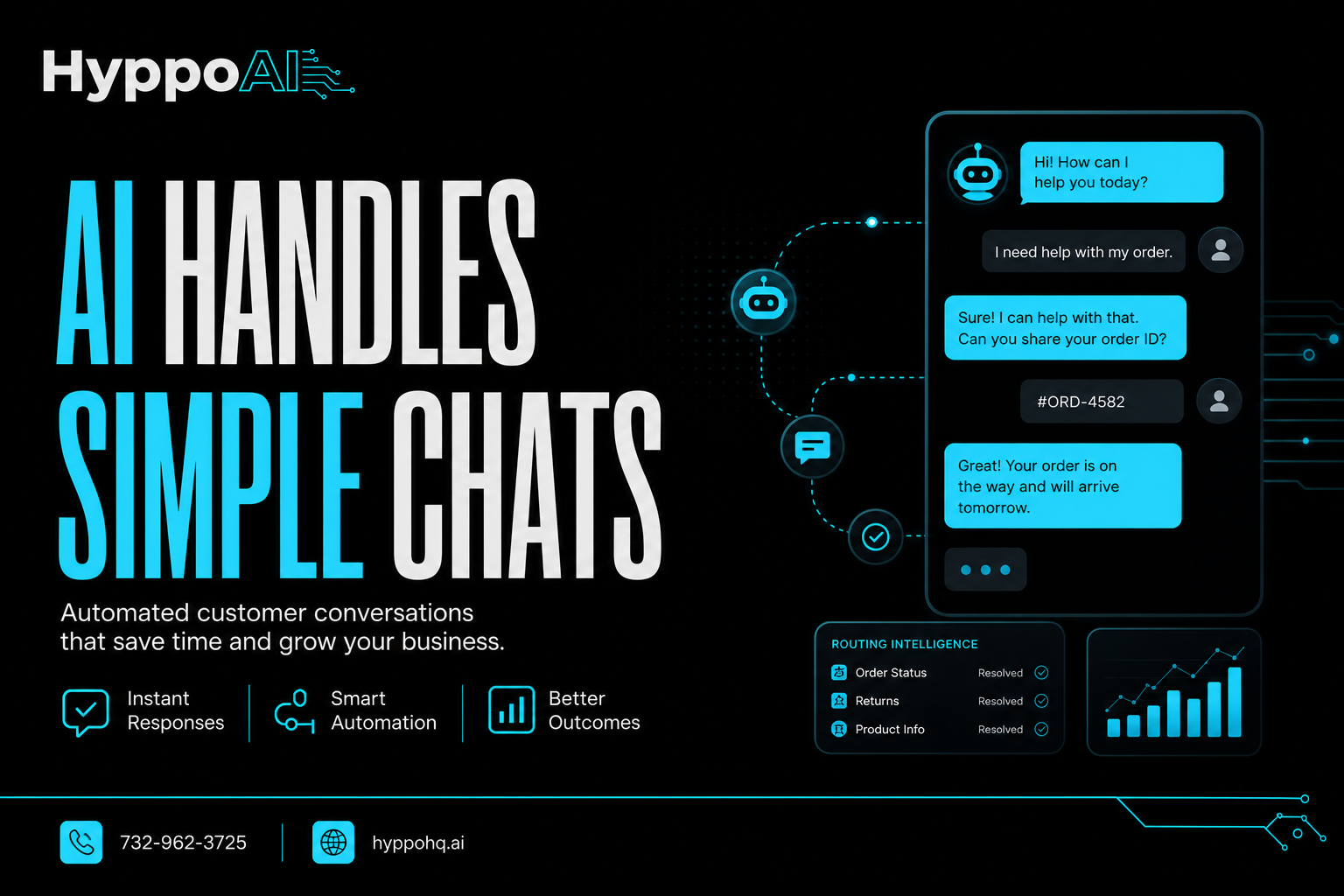
How AI handles simple conversations automatically
Simple conversations eat up more time than most teams realize.
A customer asks for your hours. A lead wants pricing. Someone needs to reschedule. Another person wants to know whether you serve their area. None of these interactions are difficult, but they happen constantly. For small and mid-sized businesses, that volume adds up fast.
This is where AI changes the game.
When implemented well, AI can handle simple conversations automatically, giving customers fast answers while freeing your team to focus on work that actually needs human judgment. The result is better responsiveness, fewer missed opportunities, and a smoother customer experience.
What simple conversations mean in practice
Simple conversations are the repetitive, predictable interactions that follow a common pattern. They usually do not require deep problem-solving or emotional nuance. Instead, they rely on clear information, a structured workflow, or a straightforward next step.
Examples include:
- Answering FAQs
- Confirming business hours
- Sharing service availability
- Collecting contact details
- Booking or rescheduling appointments
- Providing basic pricing guidance
- Qualifying leads with a few questions
- Routing requests to the right person
- Following up after an inquiry
These tasks may seem minor on their own, but they create major operational drag when handled manually all day.
How AI handles these conversations automatically
AI systems are trained or configured to recognize intent, pull from approved business information, and respond in a natural way. Instead of forcing customers through rigid scripts alone, modern AI can interpret common questions and keep the conversation moving.
At a high level, the process usually looks like this:
1. AI identifies what the person wants
When someone sends a message or starts a chat, AI analyzes the wording to determine intent. For example, it can tell the difference between:
- A person asking about pricing
- A customer trying to book
- Someone looking for support
- A lead checking service coverage
This first step matters because it lets the system respond appropriately instead of giving generic replies.
2. AI delivers an immediate response
Once intent is recognized, AI can send a relevant answer based on your business rules, approved FAQs, or workflow logic. That means customers get help right away instead of waiting for a staff member to become available.
Fast responses matter because speed often determines whether a lead stays engaged or moves on.
3. AI gathers missing details
If more information is needed, AI can ask follow-up questions automatically. For example:
- What service are you interested in?
- What day works best for you?
- What is your name and best contact number?
- Is this for a residential or commercial property?
This turns a basic inquiry into a qualified lead or completed task without requiring manual back-and-forth.
4. AI completes the next action or routes the conversation
After collecting the right details, AI can take the next step, such as:
- Scheduling an appointment
- Logging the request
- Sending the lead to a team member
- Triggering a follow-up sequence
- Escalating to a human when needed
The key is not replacing people entirely. The key is removing unnecessary human effort from low-complexity interactions.
Why this matters for SMBs
For SMBs, every missed message has a cost. Every delayed response creates friction. Every repetitive conversation pulls staff away from higher-value work.
AI helps solve this by creating consistency and speed without requiring a larger team.
Key benefits include
- Faster response times: Customers get answers immediately
- Fewer missed leads: Inquiries can be handled after hours and during busy periods
- Better use of staff time: Teams focus on sales, service, and exceptions instead of repetitive admin
- More consistent communication: Responses stay aligned with your business information
- Improved customer experience: People get clear next steps without delays
For many businesses, that combination directly impacts revenue and operational efficiency.
Where AI works best in simple conversations
Not every conversation should be automated. But many should.
AI performs best when the interaction has one or more of these characteristics:
- The question is common and repeated often
- The answer is based on known business information
- The workflow has a clear next step
- The conversation can be guided with a few structured prompts
- Human escalation is available for exceptions
Good use cases often include front-desk style communication, lead intake, appointment handling, and routine support questions.
What AI should not handle alone
Automation works best when boundaries are clear.
AI should not be left alone to manage conversations that involve:
- Sensitive complaints
- Complex negotiations
- Legal or financial advice
- Emotional escalation
- Unique edge cases requiring judgment
The strongest systems know when to hand off to a human. That is what makes automation practical rather than frustrating.
The difference between bad automation and useful automation
A lot of businesses worry that AI will sound robotic or create a poor customer experience. That concern is valid if the system is poorly designed.
Bad automation usually looks like this:
- Generic responses with no context
- Endless loops with no resolution
- No clear path to a human
- Incorrect or outdated business information
- Over-automation of conversations that need nuance
Useful automation is different. It is focused, structured, and operationally sound.
Effective AI conversations should be
- Fast
- Relevant
- On-brand
- Easy to escalate
- Built around real customer questions
- Connected to actual business workflows
When those pieces are in place, AI does not feel like a barrier. It feels like efficient service.
How to start using AI for simple conversations
If your business is considering AI, start small and start with volume.
Look for the conversations your team handles repeatedly every week. Then ask:
- Which questions come up most often?
- Which interactions follow a predictable pattern?
- Where are leads being delayed or dropped?
- What tasks consume time without needing expertise?
From there, build automation around the highest-frequency, lowest-complexity interactions first.
A practical rollout often includes:
Start with one channel
Choose chat, text, web inquiries, or inbound lead handling. Do not try to automate everything at once.
Define approved answers and workflows
Make sure the AI uses business-approved information and knows what to do next in each scenario.
Create clear escalation rules
Set conditions for when a human should take over immediately.
Measure outcomes
Track response time, lead capture, booked appointments, and handoff quality.
The goal is not just automation. The goal is better operations.
AI is not about replacing conversation, it is about removing friction
Simple conversations are necessary, but they should not consume your team's best hours. AI helps businesses stay available, responsive, and organized without adding unnecessary overhead.
For SMBs, this is one of the most practical applications of AI because the value shows up quickly. Faster replies, cleaner intake, fewer missed leads, and less repetitive work all create measurable impact.
If your business is still handling every routine conversation manually, there is a strong chance AI can improve both customer experience and internal efficiency.
If you want to explore how HyppoAI can help automate simple conversations for your business, visit https://hyppohq.ai or call +17329623725 to learn more.