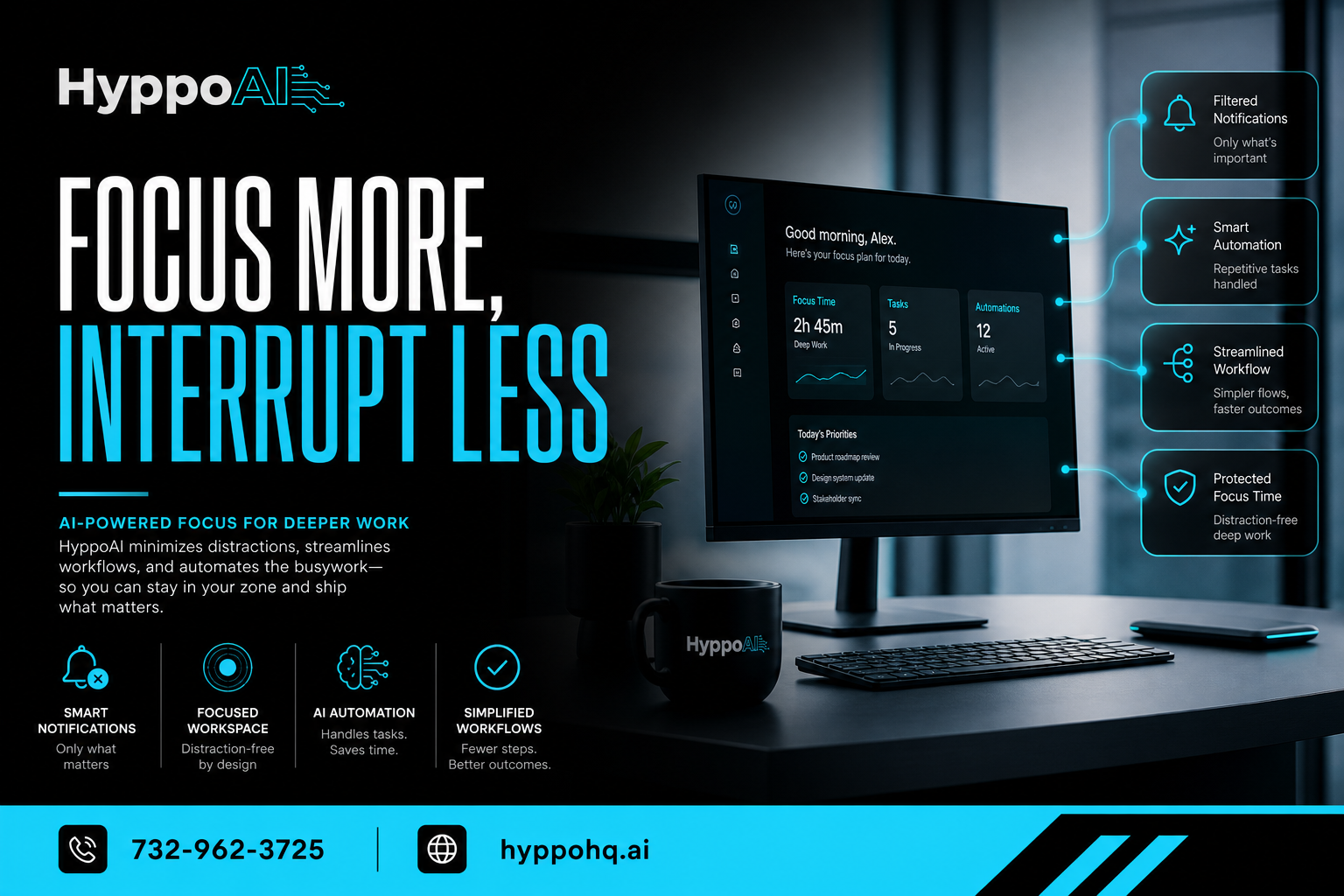
How AI reduces interruptions during the workday
Interruptions are one of the biggest hidden costs in a modern workday. A quick Slack message, a repetitive customer question, a scheduling issue, or a status update request can seem small on its own. But stacked together, they break focus, slow execution, and make even simple work take longer than it should.
For small and midsize businesses, this problem hits even harder. Teams are lean, everyone wears multiple hats, and every interruption pulls attention away from work that actually moves the business forward.
That is where AI can make a real difference. Used well, AI does not just help people work faster. It helps reduce the number of unnecessary interruptions in the first place.
Why interruptions hurt productivity more than most teams realize
Most interruptions do not look dramatic. They show up as:
- Repetitive internal questions
- Customer inquiries that need the same answers every day
- Manual scheduling back-and-forth
- Follow-up reminders that depend on someone remembering
- Requests for updates, files, notes, or next steps
- Context switching between apps, messages, and tasks
The problem is not only the time spent answering. It is the mental reset that comes after. Every interruption forces a person to pause, shift context, and rebuild momentum.
Over time, this creates:
- Lower concentration
- Slower turnaround times
- More mistakes
- Frustrated employees
- Delayed customer response times
- Less time for strategic work
AI helps by taking repetitive, interrupt-driven work off the plate of your team.
How AI reduces interruptions during the workday
AI is most effective when it handles the low-value interruptions that repeatedly break focus. Instead of making your team react to every small request, AI can absorb, route, answer, or automate many of them.
1. AI answers common questions instantly
A large share of interruptions come from simple, repeatable questions.
Examples include:
- What is the status of this request?
- How do I access this file?
- What are your business hours?
- Can I reschedule my appointment?
- What is the next step in onboarding?
AI tools can be trained on business information, standard operating procedures, FAQs, and internal documentation. That allows them to provide fast, consistent answers without forcing a teammate to stop what they are doing.
For SMBs, this means fewer disruptions across both customer-facing and internal workflows.
2. AI handles first-response communication
Not every message needs a person immediately. Many just need acknowledgment, routing, or a basic answer.
AI can manage first-touch communication by:
- Responding to inbound questions
- Collecting key details
- Routing requests to the right person
- Prioritizing urgent issues
- Setting expectations for response times
This reduces the constant pressure on team members to monitor every inbox, text thread, or support channel in real time.
3. AI automates scheduling and coordination
Scheduling is a major source of interruptions. One meeting can trigger multiple messages, calendar checks, confirmations, and reminders.
AI-powered scheduling tools reduce this friction by:
- Offering available times automatically
- Confirming appointments
- Sending reminders
- Handling reschedules
- Updating calendars and systems
Instead of dragging multiple people into a simple coordination task, AI keeps the process moving with minimal back-and-forth.
4. AI reduces follow-up gaps
A surprising number of interruptions happen because a process was not completed the first time. Someone has to chase an update, remind a lead, ask for missing information, or check whether a task was done.
AI can automate follow-up sequences and trigger actions based on timing or behavior. That means fewer manual reminders and fewer status-check interruptions.
Examples include:
- Lead follow-up after an inquiry
- Appointment reminders
- Invoice reminders
- Onboarding nudges
- Internal task prompts
When follow-up is automated, your team spends less time chasing and more time closing loops.
Where SMBs feel the biggest impact
For small and midsize businesses, AI does not need to replace entire roles to create value. Often, the biggest gains come from removing the constant micro-interruptions that eat up the day.
Customer service and front-desk tasks
If your team answers the same questions repeatedly, AI can take over much of that volume. This protects employee focus while still improving response speed.
Sales and lead management
AI can respond to inquiries, qualify leads, and trigger follow-ups automatically. That reduces the need for constant manual checking and outreach.
Operations and admin work
AI can help with reminders, workflow routing, documentation lookup, and repetitive process steps that usually generate internal pings and disruptions.
Leadership and decision support
Owners and managers are often interrupted for updates, approvals, and recurring questions. AI can centralize information, summarize activity, and make routine answers easier to access.
What AI should handle first
If you want to reduce interruptions, start by identifying tasks that are:
- Repetitive
- Rules-based
- Time-sensitive
- High-frequency
- Easy to document
Good early use cases include:
- FAQ responses
- Appointment scheduling
- Intake forms and data collection
- Lead follow-up
- Internal knowledge lookup
- Reminder and notification workflows
These are usually the fastest wins because they create immediate relief without requiring a full operational overhaul.
AI supports focus, not just speed
A lot of AI conversations focus on efficiency. That matters, but focus is just as important.
When your team is interrupted less often, they can:
- Finish deep work faster
- Communicate more clearly
- Make fewer errors
- Serve customers more consistently
- Spend more time on revenue-generating activity
In other words, AI is not only about doing more. It is about protecting attention so the right work gets done well.
Common mistake: automating chaos
AI works best when applied to clear, repeatable processes. If a workflow is disorganized, AI may simply make the confusion happen faster.
Before implementing AI, define:
- What types of interruptions happen most often
- Which ones are repetitive and preventable
- What the ideal response should be
- When a human should step in
This creates a better foundation for automation and helps ensure AI improves the workday instead of adding noise.
A practical way to get started
You do not need to automate everything at once. Start with one interruption-heavy workflow and measure the result.
For example:
- Identify the top 10 repetitive questions your team gets.
- Build a standard response system.
- Use AI to answer or route those requests.
- Track time saved and response speed.
- Expand to scheduling, follow-up, or internal support next.
Small improvements in interruption management can create a noticeable change in team performance.
The bottom line
Interruptions are not just annoying. They are expensive. They reduce focus, slow teams down, and make growth harder than it needs to be.
AI helps reduce interruptions during the workday by handling repetitive questions, automating routine communication, managing scheduling, and keeping follow-up moving without constant human input. For SMBs, that means more focus, better consistency, and a more scalable way to operate.
If your team is losing time to constant pings, repeated questions, and manual coordination, HyppoAI can help you build smarter systems around that. Learn more at https://hyppohq.ai or call +17329623725 to explore practical AI solutions for your business.