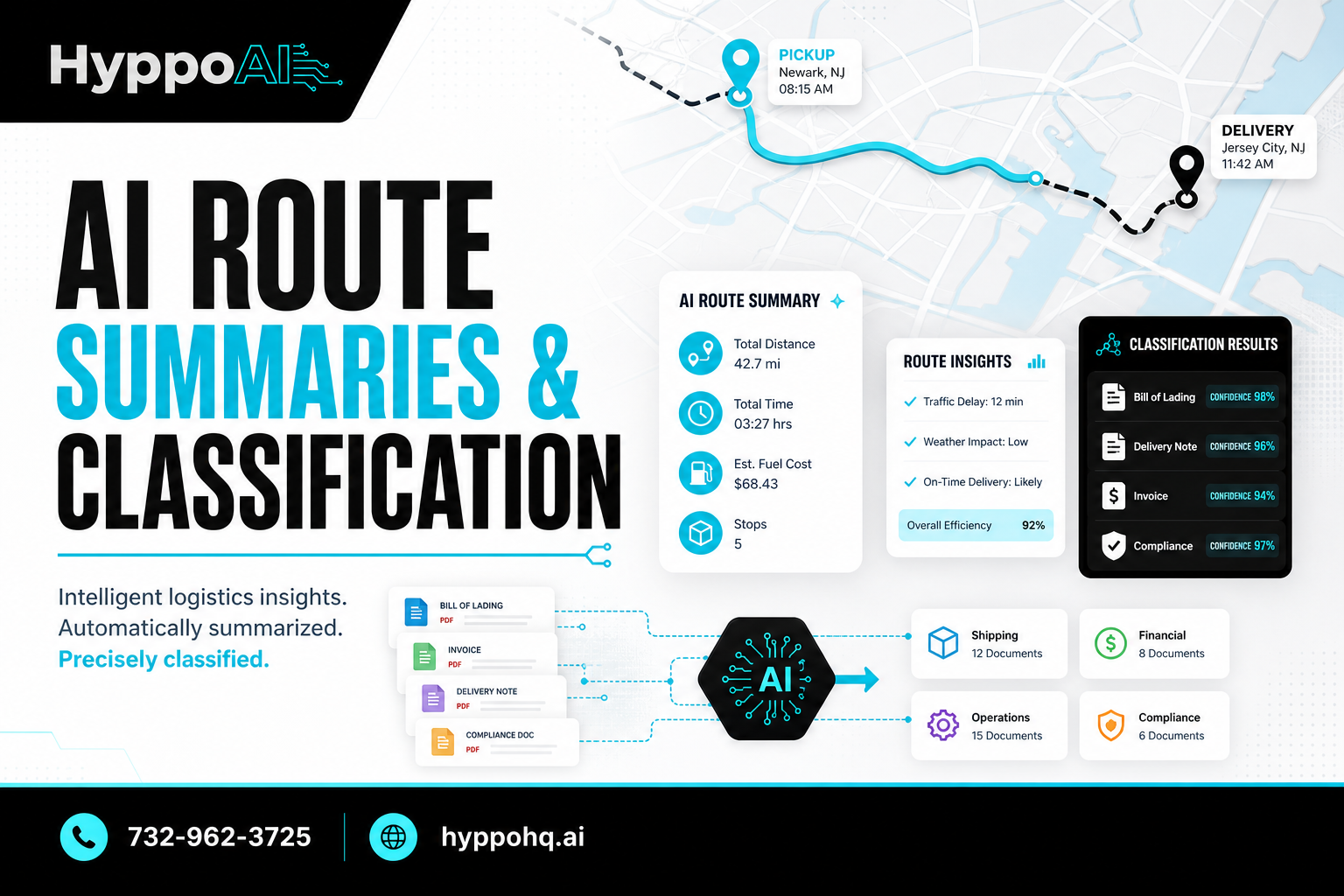
How AI summarizes routes and classifies information
AI is becoming a practical tool for small and midsize businesses that need faster decisions without adding more manual work. Two high-value use cases stand out: summarizing routes and classifying information.
On the surface, these sound like technical tasks. In practice, they solve everyday business problems. Route summaries help teams understand where people, vehicles, or jobs are going and why. Information classification helps businesses organize incoming data so the right actions happen next.
For SMBs, the value is simple: less time sorting through details, fewer missed opportunities, and more consistent operations.
What it means for AI to summarize routes
Route summarization is the process of taking detailed route data and turning it into a shorter, more useful explanation. Instead of reviewing every stop, turn, or timestamp, AI can produce a concise summary that highlights what matters.
A route summary might include:
- Start and end points
- Number of stops
- Estimated travel time
- Delays or exceptions
- Priority visits completed
- Missed or rescheduled stops
- Patterns across multiple routes
This is useful when teams need quick visibility without reading raw logs or maps.
Why route summaries matter for SMBs
Many businesses rely on movement and scheduling, even if they do not think of themselves as logistics companies. Service businesses, field teams, delivery operations, sales reps, and mobile staff all create route-related data.
AI route summaries can help with:
- Daily team coordination
- Customer updates
- Dispatch reviews
- Manager reporting
- Identifying inefficiencies
- Spotting route risks early
Instead of asking a manager to interpret scattered notes, GPS data, or scheduling updates, AI can condense the activity into a readable summary.
How AI summarizes routes
The exact method depends on the system, but the general workflow is straightforward.
1. Collect route data
AI starts with available inputs, such as:
- GPS coordinates
- Driver or technician check-ins
- Calendar or scheduling data
- Delivery status updates
- Time stamps
- Customer notes
2. Detect important events
The model looks for key signals in the route. These might include long delays, skipped stops, unusual detours, repeated visits, or jobs completed outside the expected sequence.
3. Prioritize what matters
Not every detail belongs in a summary. AI ranks the most relevant information based on context. A dispatcher may care about delays and missed stops. A customer may only need arrival windows and completion status.
4. Generate a human-readable summary
The output is then written in plain language. That could be a short paragraph, bullet list, dashboard card, or internal note.
For example:
- Technician completed 7 of 8 scheduled stops between 8:10 AM and 3:45 PM.
- One appointment was delayed by traffic and moved to the end of the route.
- Total drive time exceeded estimate by 22 minutes.
That is much easier to act on than a raw stream of route events.
What it means for AI to classify information
Classification is the process of assigning labels or categories to data. AI reviews text, images, voice transcripts, forms, emails, or records and determines what each item is about.
This matters because businesses receive information in many formats, and most of it arrives unstructured.
Examples include:
- Customer emails
- Chat messages
- Call transcripts
- Support tickets
- Intake forms
- Reviews
- Notes from staff
Without classification, teams manually read, sort, and route this information. With AI, much of that process can be automated.
Common classification examples
AI can classify information by:
- Urgency
- Topic
- Sentiment
- Department
- Lead quality
- Appointment type
- Customer intent
- Complaint category
- Billing vs support request
A message like, “I need to reschedule tomorrow’s service and also update my billing info,” can be classified into more than one category and sent to the right workflow.
How AI classifies information
Classification usually follows a pattern similar to route summarization.
1. Ingest the input
The system receives data from one or more sources, such as email, CRM notes, forms, or call transcripts.
2. Extract features and meaning
AI models analyze the content for keywords, context, phrasing, entities, and intent. Modern systems do more than keyword matching. They look at meaning, not just exact words.
3. Assign one or more labels
The model predicts the best category or categories based on training, rules, or a combination of both.
4. Trigger the next action
Once classified, the information can be routed, prioritized, tagged, or summarized for a person to review.
That is where the operational value shows up.
Why these two capabilities work well together
Route summarization and information classification are often more powerful when combined.
For example, a field service business may need to:
- Summarize the day’s technician route
- Classify customer notes by urgency
- Identify delays tied to specific job types
- Route follow-up tasks to the right team
A sales team might:
- Summarize rep travel activity
- Classify meeting notes by deal stage
- Flag high-intent prospects for immediate follow-up
An operations team could:
- Summarize delivery exceptions by region
- Classify incident reports by cause
- Spot patterns affecting efficiency or customer satisfaction
When AI handles both summarization and classification, teams spend less time organizing information and more time acting on it.
Practical benefits for SMBs
For growing businesses, the biggest advantage is not novelty. It is clarity.
Here is what these AI capabilities can improve:
Faster decision-making
Managers get quick summaries instead of digging through raw data.
Better prioritization
Classified information helps teams focus on urgent issues first.
More consistent workflows
AI applies the same logic every time, reducing manual variation.
Reduced admin work
Staff spend less time sorting emails, notes, and route updates.
Improved customer experience
Quicker responses and more accurate updates create a smoother experience.
What to watch for when implementing AI
Not every AI workflow is useful by default. Good implementation matters.
Businesses should think about:
- Data quality and consistency
- Clear categories and business rules
- Human review for edge cases
- Integration with current systems
- Output format for different teams
A route summary is only useful if it highlights the right events. A classification system is only useful if categories reflect real business actions.
That is why the best AI setups are designed around operations, not just model capability.
Where HyppoAI fits
At HyppoAI, the focus is on helping SMBs use AI in ways that create practical business value. That means building systems that reduce friction, organize information, and support faster action across teams.
Whether the challenge is summarizing route activity, classifying incoming data, or connecting both into a more efficient workflow, the goal is the same: make AI useful in day-to-day operations.
Final thoughts
AI summarizing routes and classifying information is not just about automation for its own sake. It is about turning complexity into clarity. When businesses can quickly understand movement, label incoming information, and trigger the right next step, they operate with more speed and less waste.
If your business is dealing with route data, customer messages, field activity, or high volumes of unstructured information, HyppoAI can help you explore practical AI workflows. Visit https://hyppohq.ai or call +17329623725 to learn more.