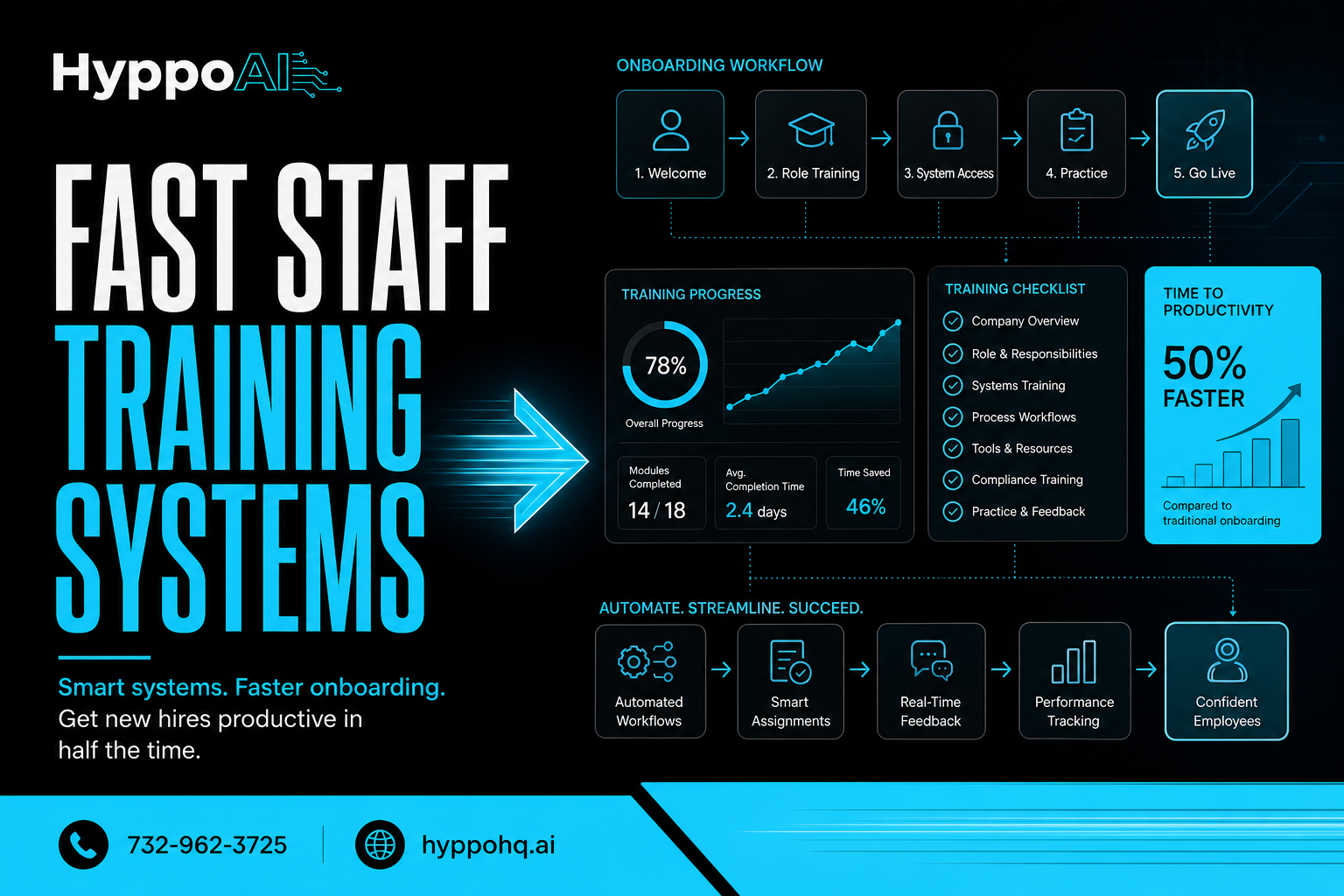
How systems reduce training time for new staff fast
Bringing on a new team member should create momentum, not slow your business down.
But for many small and midsize businesses, onboarding still depends on scattered notes, verbal handoffs, and someone saying, “Just shadow me for a few days.” That approach feels simple in the moment, but it usually creates delays, inconsistency, and avoidable mistakes.
The fix is not more meetings. It is better systems.
When your business runs on clear, repeatable systems, new staff learn faster, ask better questions, and become productive sooner. That means less time spent on retraining, less pressure on managers, and a smoother path to growth.
Why training takes too long without systems
Most long onboarding cycles are not caused by a lack of effort. They are caused by a lack of structure.
When processes live in people’s heads, every new hire has to piece together how work gets done. They may get different instructions from different team members. They may miss steps no one realized were important. And they often need constant clarification before they can work independently.
Common causes of slow training include:
- Inconsistent instructions from team to team
- No documented standard operating procedures
- Too many manual steps in daily workflows
- Training that depends on one experienced employee
- Limited visibility into what “good performance” looks like
- Repetitive admin work that distracts from learning core tasks
Without systems, training becomes reactive. Every question starts from zero.
How systems reduce training time for new staff
Good systems remove guesswork.
They give new employees a clear path to follow, so they do not have to rely on memory, assumptions, or constant supervision. Instead of learning through trial and error, they learn through documented workflows, guided tools, and repeatable processes.
Here is what that looks like in practice.
1. Systems create consistency
Consistency is one of the biggest accelerators in onboarding.
If every customer interaction, handoff, and internal task follows the same structure, new hires can learn the pattern once and apply it repeatedly. That reduces confusion and builds confidence quickly.
For example, a standardized process for handling inbound leads can show:
- What information to collect
- Which questions to ask
- Where to log the conversation
- When to follow up
- How to escalate issues
Instead of learning five different versions of the same task, a new team member learns one reliable system.
2. Systems reduce reliance on tribal knowledge
Many businesses run on tribal knowledge, the unwritten know-how held by a few experienced people.
That creates risk. If your best employee is out, busy, or eventually leaves, training slows down immediately.
Documented systems turn hidden knowledge into shared knowledge. That means:
- Faster ramp-up for new hires
- Less interruption for senior staff
- Better continuity across the business
- Easier delegation as the team grows
The goal is simple: make success teachable.
3. Systems clarify expectations early
New staff perform better when they know exactly what is expected.
Systems help define:
- The correct sequence of steps
- Service standards
- Response time goals
- Quality benchmarks
- Common exceptions and how to handle them
This clarity shortens the learning curve because employees are not guessing what “done right” means. They can compare their work against a standard and improve faster.
4. Systems make training repeatable
A repeatable onboarding experience saves time every time you hire.
Instead of rebuilding the training process from scratch, you can reuse the same assets:
- Checklists
- SOPs
- Scripts
- Templates
- Workflow automations
- Recorded walkthroughs
This creates a more predictable ramp-up period and makes it easier to measure where new hires get stuck.
Repeatable training is also easier to improve. Once the process is documented, you can refine it over time instead of relying on memory.
The role of automation in faster onboarding
Systems become even more powerful when paired with automation.
Automation does not replace training. It removes low-value friction so people can focus on learning the work that actually matters.
In an SMB, automation can reduce training time by handling repetitive tasks such as:
- Routing leads to the right person
- Sending follow-up messages
- Logging customer data
- Triggering reminders and notifications
- Assigning tasks after a form submission
- Organizing internal requests
When these steps are automated, new employees do not have to memorize every small handoff on day one. The system supports the process, which lowers cognitive load and reduces early errors.
For business owners, that means training can focus more on judgment, communication, and customer experience rather than repetitive admin.
What strong training systems look like
You do not need a massive corporate playbook to train people well. You need practical systems that are easy to use.
Strong training systems usually include:
Clear documentation
Each core process should be written in plain language with step-by-step instructions.
Role-specific checklists
A new hire should know what to learn in week one, week two, and beyond.
Standard scripts and templates
These help employees communicate consistently while they build confidence.
Centralized information
Processes, FAQs, and resources should live in one place, not across random messages and files.
Automated workflow support
Technology should guide the next step whenever possible.
Feedback loops
Managers should track common questions and update systems so training gets better over time.
Signs your business needs better systems now
If onboarding feels harder than it should, your business is probably ready for stronger operational systems.
Watch for these signs:
- New hires take too long to become independent
- Managers answer the same questions repeatedly
- Different employees complete the same task differently
- Mistakes happen during handoffs or follow-up
- Training quality depends on who is available
- Growth creates more chaos instead of more capacity
These are not just training issues. They are systems issues.
Fix the system, and training gets easier.
How SMBs can start simplifying onboarding
You do not need to document everything at once. Start with the highest-impact workflows.
A practical way to begin:
- Identify the 3 to 5 tasks every new hire must learn first
- Write the current process step by step
- Remove unnecessary steps and clarify decision points
- Create a checklist or SOP for each task
- Add templates, scripts, or examples
- Automate repetitive handoffs where possible
- Review where new hires still get stuck and improve the system
This approach creates quick wins without overwhelming your team.
For many SMBs, the biggest breakthrough comes from standardizing just a few key workflows. Once those are in place, training becomes faster, smoother, and far less dependent on constant manager involvement.
Better systems support better growth
Hiring should help your business scale. But if every new employee requires heavy hand-holding, growth gets expensive fast.
Systems solve that.
They reduce training time for new staff by turning scattered knowledge into repeatable operations. They help your team deliver more consistent results. And they create a stronger foundation for automation, delegation, and long-term efficiency.
At HyppoAI, we help SMBs build smarter systems that reduce friction and support real growth with AI and automation. If you want to simplify onboarding and make your operations easier to scale, visit https://hyppohq.ai or call +17329623725 to start the conversation.