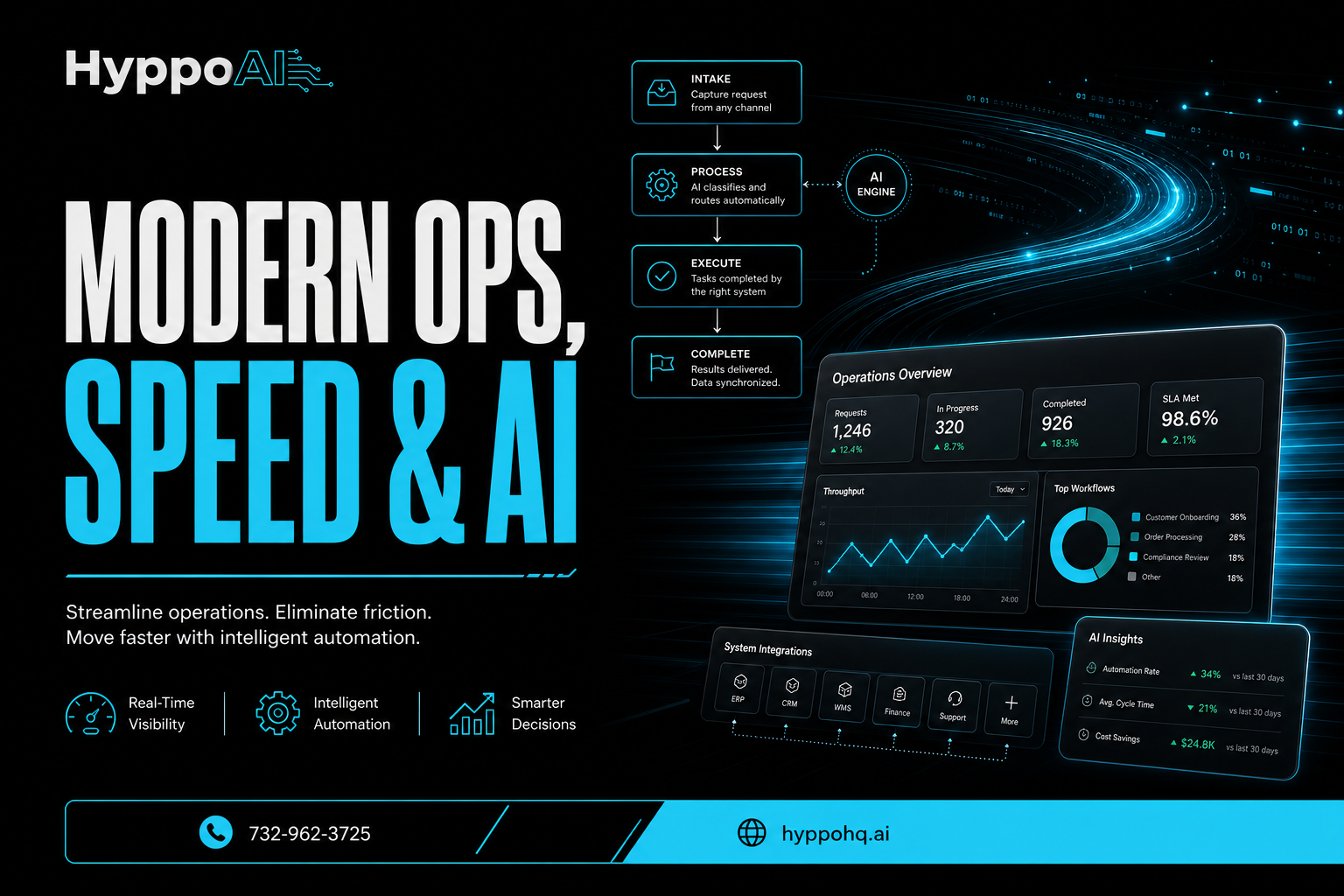
Modern business operations today: systems, speed, and AI
Modern business operations today look very different from the manual, disconnected workflows many companies relied on even a few years ago. Teams are expected to move faster, make better decisions, and deliver a stronger customer experience without adding unnecessary overhead.
For small and midsize businesses, that shift matters even more. Resources are tighter, margins matter, and every missed lead, delayed response, or repetitive task has a real cost. That is why modern operations are no longer just about staying organized. They are about building systems that help the business run with more clarity, consistency, and speed.
The shift from manual work to connected systems
Traditional operations often depended on people filling gaps between tools. One person updated the CRM, another answered phones, someone else followed up with leads, and reporting happened days or weeks later. That model creates friction.
Modern business operations are built around connected systems instead of isolated tasks. The goal is simple: reduce handoff errors, eliminate bottlenecks, and make sure information moves where it needs to go.
A modern operating environment often includes:
- A CRM that tracks leads, customers, and communication history
- Automated follow-up for inquiries and missed calls
- Shared dashboards for visibility into sales and service performance
- Standardized workflows for onboarding, scheduling, and support
- AI tools that assist with communication, routing, and repetitive admin tasks
This does not mean replacing people. It means removing low-value work so teams can focus on higher-value decisions and customer interactions.
Speed is now an operational advantage
One of the clearest signs of modern business operations is response time. Businesses that respond faster tend to convert more leads, solve issues sooner, and create a better customer experience.
Today, customers expect:
- Quick answers
- Clear next steps
- Consistent communication
- Easy scheduling or follow-up
If a business is still relying on manual callbacks, scattered inboxes, or delayed internal communication, it is operating at a disadvantage.
Modern operations prioritize speed through process design. That may include automated lead capture, instant replies, AI-supported call handling, and internal alerts that keep work moving. When speed is built into the system, the business becomes more reliable without demanding constant firefighting from the team.
Why consistency matters as much as speed
Fast is good. Fast and consistent is better.
A business can respond quickly once or twice through extra effort. But modern operations are designed to produce the same quality outcome every time. That is where systems matter most.
Consistency helps businesses:
- Protect the customer experience
- Reduce training time for staff
- Lower the risk of missed tasks
- Improve reporting and accountability
- Scale without chaos
When operations are documented and supported by the right tools, growth becomes easier to manage.
Data is no longer optional
Modern business operations rely on visibility. Owners and managers need to know what is happening in real time, not after the fact.
That includes questions like:
- How many leads came in this week?
- How fast were they contacted?
- Which channels are producing results?
- Where are jobs, projects, or deals getting stuck?
- How much staff time is being spent on repetitive work?
Without operational data, decision-making becomes reactive. With data, businesses can spot patterns, fix weak points, and allocate resources more effectively.
This is one reason dashboards, CRM reporting, and workflow analytics have become central to modern operations. They turn assumptions into measurable insights.
AI is changing how SMBs operate
AI is now part of what modern business operations look like today, especially for SMBs that need to do more with lean teams. Used correctly, AI supports operations by handling routine interactions, organizing information, and helping teams move faster.
Some practical uses of AI in operations include:
- Answering common customer questions
- Routing inquiries to the right person or department
- Following up on leads automatically
- Summarizing calls, messages, or notes
- Assisting with scheduling and reminders
- Supporting internal knowledge access for staff
For many businesses, AI is most valuable when it works quietly in the background. It helps reduce delays, improve responsiveness, and keep workflows moving without adding complexity.
AI should support operations, not complicate them
Not every business needs a stack of advanced tools. Modern operations are not about adding technology for the sake of it. They are about using the right technology to solve a specific operational problem.
A strong approach usually starts with a few questions:
- Where are we losing time?
- Where are leads or customers falling through the cracks?
- Which tasks are repeated every day?
- What work depends too heavily on one person remembering to do it?
The best operational improvements often come from solving these basic issues first.
Modern operations are customer-centered
Another major shift is that operations are no longer viewed only as internal process management. They are directly tied to customer experience.
If your systems are slow, your customers feel it. If your follow-up is inconsistent, your customers notice. If your team has to search for information, your customers wait.
Modern business operations are designed around the customer journey as much as internal efficiency. That means aligning tools and workflows to support better communication from the first inquiry through ongoing service.
Examples include:
- Immediate acknowledgment when someone reaches out
- Clear handoff between sales and service
- Accurate records of prior communication
- Proactive reminders and updates
- Faster resolution of common requests
When operations improve, customer trust often improves with them.
Lean teams need stronger systems
SMBs do not always have the luxury of hiring more people every time demand increases. That is why modern operations focus on leverage.
Leverage comes from building systems that allow a small team to perform like a larger one. This may involve:
- Automating repetitive administrative tasks
- Creating standard operating procedures for common workflows
- Centralizing customer and operational data
- Using AI to support communication and intake
- Reducing tool sprawl and duplicated effort
The result is not just efficiency. It is operational resilience. When systems are clear, businesses are less dependent on memory, heroics, or constant oversight.
What modern business operations look like in practice
In practical terms, a modern business often runs on a simple principle: fewer manual steps, better visibility, faster execution.
That can look like:
- A lead comes in and is logged automatically
- The customer receives an immediate response
- The right team member is notified
- Follow-up happens on schedule without manual reminders
- Managers can see status updates in one place
- Common customer questions are handled quickly through automation or AI support
This is not about making operations feel robotic. It is about making the business dependable.
Where to start if your operations feel outdated
If your current operations feel fragmented, the best first step is not a complete overhaul. It is an audit.
Look at where the business is experiencing friction:
- Missed calls or slow lead response
- Staff repeating the same admin tasks every day
- Information spread across too many tools
- No clear reporting on performance
- Customers waiting too long for answers
From there, identify one or two high-impact systems to improve first. For many SMBs, lead handling, follow-up, scheduling, and internal visibility are the best places to start.
Modern business operations are not defined by how many tools you use. They are defined by how well your business runs.
If you want to explore how smarter systems and AI can support your team, HyppoAI helps SMBs think more clearly about automation and operational efficiency. Visit https://hyppohq.ai, email admin@hyppohq.ai, or call +17329623725 to learn more.