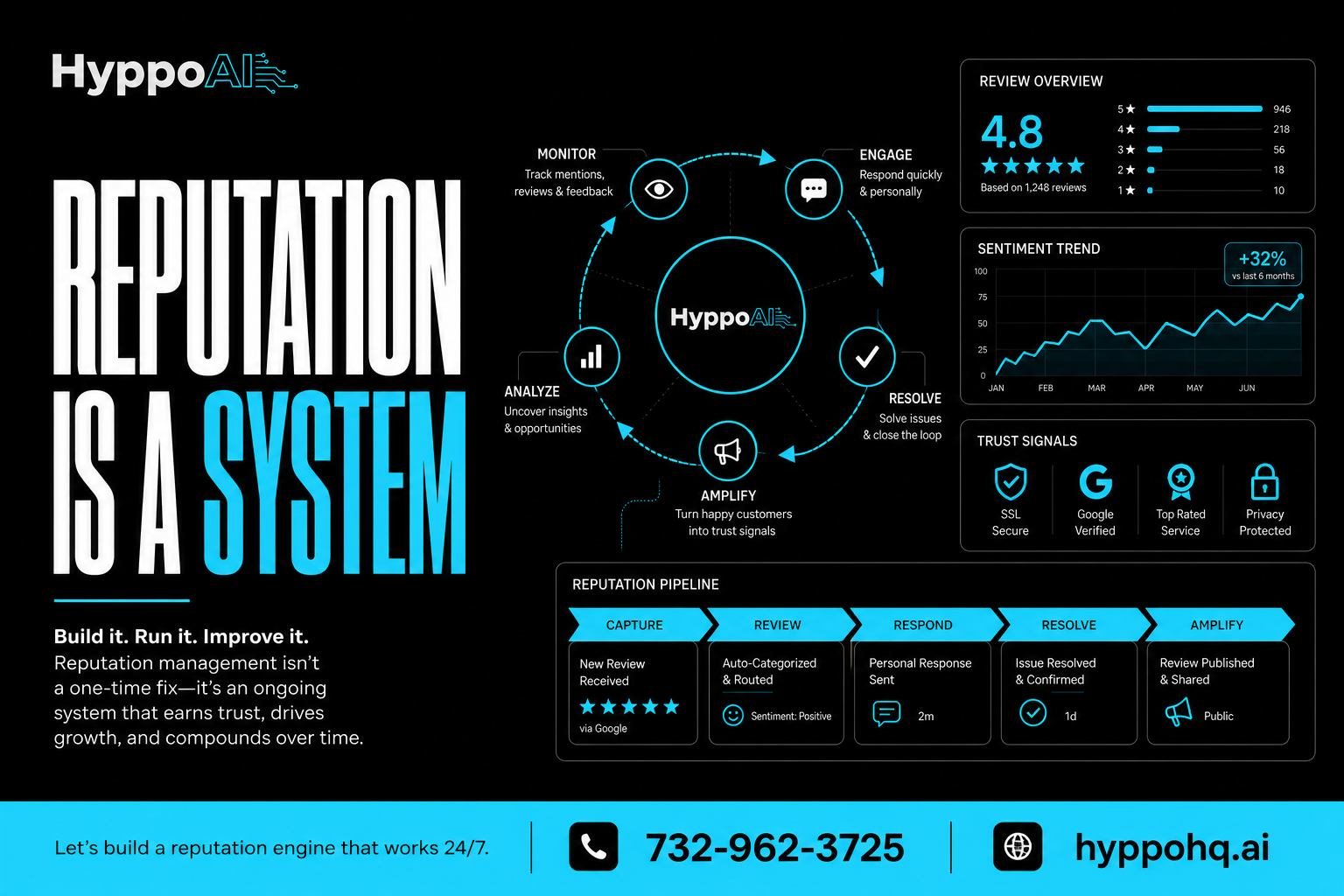
Reputation management is a system, not a one-time task
Most businesses treat reputation management like a task on a checklist.
Ask for a few reviews. Reply when there is time. Handle a complaint if it gets loud enough. Then move on.
That approach feels productive, but it is not reliable. Reputation does not improve because of occasional effort. It improves because of a consistent system.
If you are an SMB owner, this matters more than ever. Customers are making decisions fast. They scan reviews, compare response times, read how you handle problems, and decide whether your business feels trustworthy.
That means reputation management is not a marketing side job. It is an operating system for trust.
What reputation management really means
Reputation management is often reduced to one narrow goal: getting more five-star reviews.
Reviews matter, but they are only one part of the picture.
A real reputation system includes:
- How and when you ask for feedback
- How quickly you respond to reviews
- How you handle negative experiences
- How consistently your team follows up
- How your business shows reliability across channels
- How customer insights are turned into process improvements
In other words, reputation is the output of your operations.
If your service is inconsistent, your reputation will reflect it. If your communication is slow, your reputation will reflect that too. If your follow-up is strong and your customer journey is clear, that will show up publicly.
Why treating reputation like a task fails
A task is something you do once.
A system is something that keeps working.
That difference is everything.
When reputation management is treated like a task, it usually becomes reactive. You only pay attention when:
- A bad review appears
- Leads stop converting
- A competitor starts outranking you
- Someone on the team remembers to ask for reviews
This creates gaps. And gaps create inconsistency.
Customers do not experience your business in isolated moments. They experience the full sequence: first contact, booking, communication, service delivery, follow-up, and post-service support.
If there is no system behind those touchpoints, your reputation becomes unstable.
Common signs you do not have a reputation system
You may be managing reputation as a task if:
- Review requests happen randomly
- Only some customers get follow-up messages
- Negative reviews sit unanswered for days
- No one owns the process internally
- Feedback is collected but never analyzed
- Your team has no response standards
These are not small issues. They directly affect trust, conversions, and retention.
The business case for a reputation system
For SMBs, reputation has a measurable impact.
It influences:
- Local search visibility
- Lead conversion rates
- Referral volume
- Customer retention
- Perceived professionalism
- Pricing power
A strong reputation system helps your business scale trust without relying on memory or manual effort.
That is important because growth creates complexity. As inquiry volume rises, it becomes harder to maintain personal follow-up, consistent messaging, and timely responses without process support.
A system solves that.
It gives your business a repeatable way to create positive customer signals at scale.
The core parts of a reputation management system
A useful reputation system does not need to be complicated. It needs to be clear, repeatable, and measurable.
1. Trigger-based review requests
Do not rely on someone remembering to ask.
Build review requests into your workflow. After a completed service, resolved support case, or successful delivery, the customer should automatically receive a request at the right time.
This increases consistency and captures feedback while the experience is still fresh.
2. Response standards
Every review deserves a response strategy.
That does not mean robotic replies. It means your business should know:
- Who responds
- How fast they respond
- What tone to use
- How to escalate complaints
- When to take issues offline
Fast, thoughtful responses show customers that your business is active and accountable.
3. Negative feedback routing
Bad reviews should not be your first signal that something went wrong.
A strong system captures dissatisfaction earlier through surveys, follow-up messages, or support checkpoints. That gives your team a chance to resolve issues before they become public trust problems.
4. Feedback analysis
Reviews are not just social proof. They are operational data.
Look for patterns in what customers praise and what they criticize. If the same issue keeps showing up, that is not a reputation problem alone. It is a process problem.
5. Ownership and accountability
If reputation belongs to everyone, it often belongs to no one.
Assign clear ownership. One person or team should be responsible for monitoring reviews, tracking response times, and reporting trends.
6. Automation where it makes sense
Manual reputation management breaks down as volume grows.
Automation can help with:
- Sending review requests
- Routing feedback
- Flagging urgent issues
- Monitoring mentions
- Tracking performance over time
The goal is not to remove the human element. The goal is to make consistency possible.
Reputation is built before the review is written
This is where many businesses miss the point.
You do not fix reputation at the review stage. You shape it upstream.
A customer leaves a review based on the experience your system created.
That means reputation management starts with operational clarity:
- Was the first response fast?
- Was the booking process simple?
- Were expectations clear?
- Did the team communicate well?
- Was follow-up handled professionally?
If those pieces are weak, asking for more reviews will not solve the real issue.
More volume only exposes the inconsistency faster.
How AI can support reputation systems for SMBs
For small and mid-sized businesses, AI can reduce the friction that causes reputation management to become inconsistent.
Used well, AI can support:
- Automated review request timing
- Smart follow-up workflows
- Sentiment detection in customer feedback
- Drafting review responses for approval
- Identifying recurring themes across reviews
- Alerting teams to urgent reputation risks
This matters because SMBs often do not have large teams. They need systems that work without adding constant manual overhead.
AI does not replace judgment. It supports speed, consistency, and visibility.
That is what a real system needs.
How to start building your system
If your current process is scattered, start simple.
Here is a practical sequence:
Audit the current customer journey
Map where customer interactions happen from first contact to post-service follow-up.
Identify trust gaps
Look for delays, unclear communication, missed follow-up, and points where feedback gets lost.
Standardize the basics
Create simple rules for review requests, response times, and escalation paths.
Add automation carefully
Automate repetitive steps first, especially review requests and follow-up triggers.
Measure what matters
Track:
- Review volume
- Review quality
- Response time
- Resolution time
- Recurring complaint themes
- Conversion impact
Improve the operation, not just the optics
If feedback reveals a service issue, fix the process. Do not just polish the response.
Final thought
Reputation management is not something you finish.
It is something you design.
The businesses that win trust consistently are not the ones that react the fastest once there is a problem. They are the ones that build systems that reduce problems, capture feedback, and respond with consistency every day.
If you want a smarter way to build trust at scale, HyppoAI helps SMBs use AI and automation to create stronger systems across communication, follow-up, and customer experience. Visit https://hyppohq.ai or call +17329623725 to learn more.