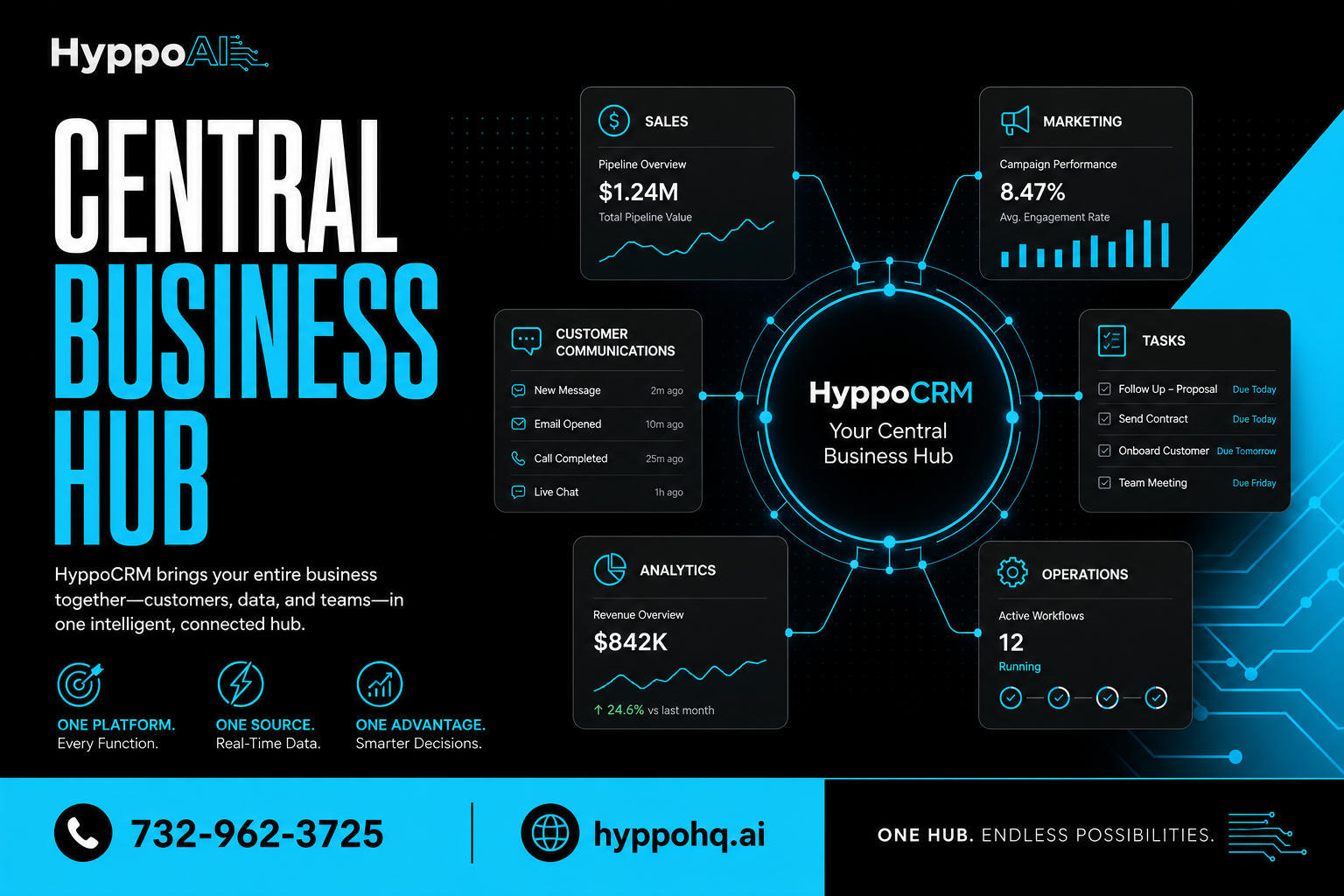
What HyppoCRM does as a central business hub
For small and growing businesses, the biggest problem usually is not a lack of effort. It is fragmentation.
Leads come in from one place. Conversations happen somewhere else. Tasks live in another tool. Notes are buried in inboxes. Follow-up depends on memory. Reporting is delayed, incomplete, or missing entirely.
That is where a central business hub matters.
HyppoCRM is built to help businesses bring the moving parts of growth and operations into one organized system. Instead of jumping between disconnected apps, teams can manage customer activity, internal workflows, and follow-up from a single core platform.
What it means to be a central business hub
A central business hub is the system where the most important parts of your business connect.
That includes areas like:
- lead capture
- contact management
- communication history
- pipeline visibility
- task tracking
- automation
- team accountability
- reporting
When these functions are scattered, businesses lose time and consistency. When they are centralized, decision-making gets faster and execution gets cleaner.
HyppoCRM serves that central role by giving businesses one place to manage what is happening, what needs attention, and what should happen next.
Why SMBs need one source of truth
Small and mid-sized businesses often grow around tools they added as needed. That is normal. But over time, the stack becomes harder to manage.
A business may be using:
- spreadsheets for lead tracking
- email for follow-up
- text messages for quick updates
- separate calendars for appointments
- manual reminders for next steps
- disconnected tools for marketing and operations
The result is simple: things slip.
Leads go cold. Customers wait too long. Team members duplicate work. Owners spend too much time checking status instead of moving the business forward.
A central business hub creates a single source of truth. Everyone can see the same information, work from the same system, and follow the same process.
Core functions HyppoCRM can support
While every business uses a CRM differently, the role of HyppoCRM as a hub is straightforward: organize activity, reduce friction, and improve follow-through.
Lead and contact organization
Businesses need a reliable way to track who is in the system, where they came from, and what stage they are in.
HyppoCRM helps centralize contact records so teams can manage:
- new inquiries
- existing customers
- follow-up status
- notes and history
- assigned ownership
This makes it easier to avoid missed opportunities and keep communication consistent.
Pipeline visibility
If you cannot see where deals or opportunities stand, forecasting becomes guesswork.
A central hub gives teams a clearer view of:
- open opportunities
- stalled conversations
- next actions
- conversion progress
- bottlenecks in the process
That visibility helps owners and managers make better decisions without digging through multiple systems.
Communication tracking
One of the biggest operational gaps in growing businesses is incomplete conversation history.
When messages, calls, and notes are spread across different channels, context gets lost. A central hub helps keep customer interactions easier to track so teams can respond with more speed and consistency.
That matters for both sales and service.
Task and workflow management
A business does not scale on good intentions. It scales on repeatable execution.
HyppoCRM can function as the place where tasks, reminders, and workflows are managed in a more structured way. Instead of relying on memory, teams can use systems that support:
- follow-up timing
- handoffs between team members
- recurring process steps
- internal accountability
- fewer dropped tasks
Automation support
Centralization also creates a stronger foundation for automation.
When business activity runs through one core platform, it becomes easier to trigger actions based on what customers do or what stage they are in.
That can help reduce manual work and improve response time.
How HyppoCRM helps reduce operational chaos
Operational chaos usually shows up in predictable ways.
Missed follow-up
A lead comes in. Someone sees it. No one owns the next step. Hours turn into days.
A central hub helps create a more reliable process for assigning, tracking, and completing follow-up.
Inconsistent customer experience
If one team member has the full history and another has none, the customer experience becomes uneven.
Centralized records help teams respond with better context.
Limited reporting
If reporting depends on manually combining data from different tools, it is usually outdated by the time it is reviewed.
A central hub improves visibility into activity and performance by keeping more of the process in one place.
Owner overload
Many business owners become the default connector between systems, people, and decisions.
That is not scalable.
HyppoCRM helps reduce that dependence by making information easier to access and workflows easier to manage.
The strategic value of centralization
A CRM should not just store contacts. It should support how the business runs.
That is the strategic value of a central business hub.
When core activity is centralized, businesses can:
- respond faster
- improve team alignment
- standardize follow-up
- create more predictable workflows
- reduce manual admin work
- make decisions with better visibility
For SMBs, this is especially important. Smaller teams do not have room for waste. Every missed lead, delayed response, and broken handoff has a real cost.
A stronger system creates leverage.
HyppoCRM as part of a smarter AI-driven operation
For businesses exploring AI and automation, centralization is often the first practical step.
AI works best when the underlying business process is organized. If data is fragmented and workflows are inconsistent, automation becomes harder to deploy effectively.
That is why a platform like HyppoCRM matters beyond basic contact management. It can serve as the operational layer that supports more advanced automation, better follow-up systems, and cleaner execution.
In simple terms, you need a solid hub before you can build smarter systems around it.
Who benefits most from a central business hub
HyppoCRM is especially useful for businesses that are dealing with growth, complexity, or inconsistent follow-through.
That often includes teams that:
- manage a steady flow of leads
- rely on appointments or consultations
- need structured follow-up
- want clearer visibility into pipelines
- are preparing to automate parts of the business
- are tired of switching between too many tools
If your business feels busy but not fully organized, a central hub can help create more control.
Final thought
HyppoCRM acts as a central business hub by bringing key business activity into one system so teams can track leads, manage communication, improve follow-up, and create stronger operational consistency.
For SMBs, that is not just a convenience. It is a better way to run the business.
If you want to learn how HyppoAI approaches smarter systems for growing businesses, visit https://hyppohq.ai or call +17329623725 to start the conversation.