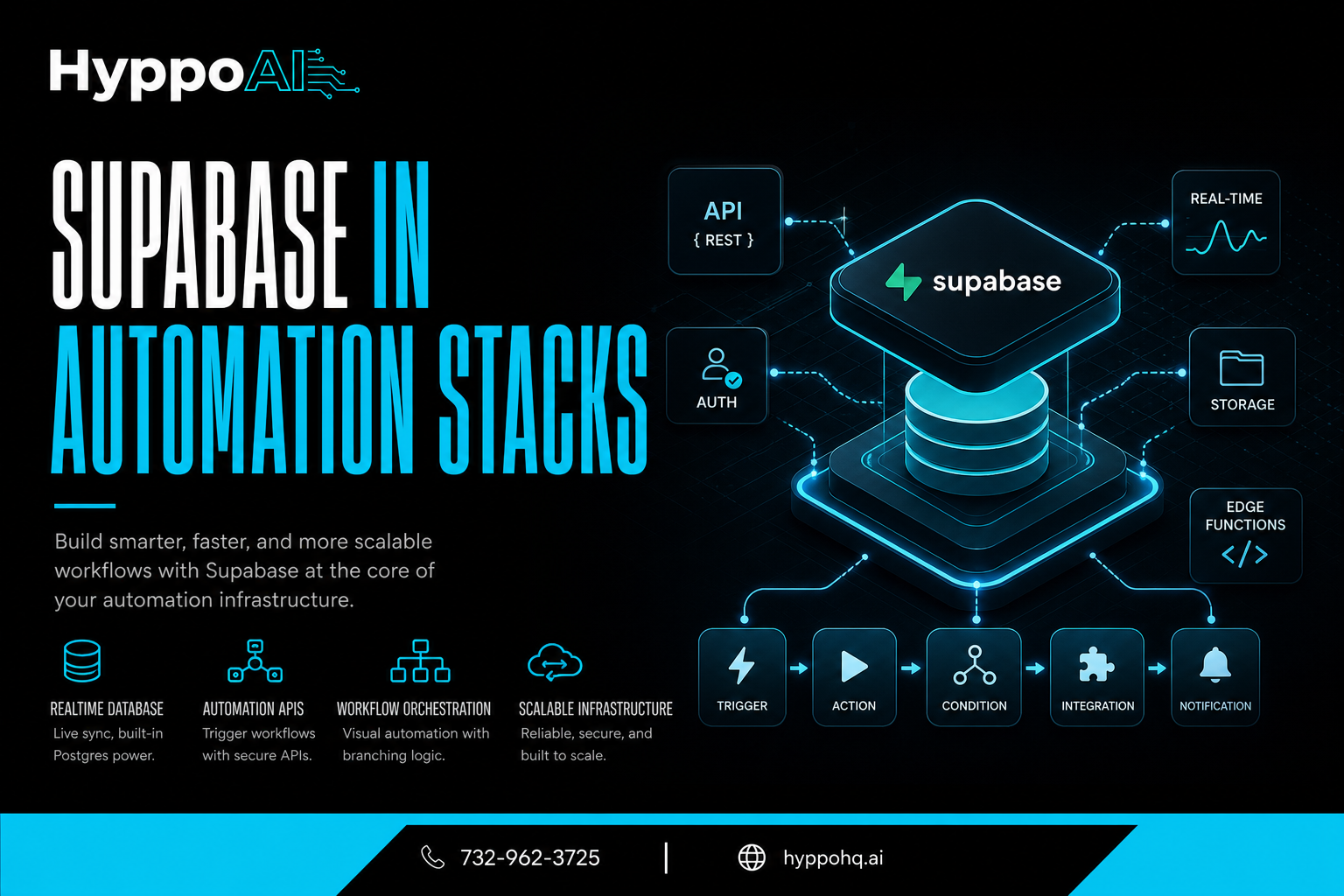
What Supabase is used for in modern automation stacks
Modern automation stacks need more than a few connected apps.
They need a reliable place to store data, trigger workflows, manage users, and support real-time actions across tools. That is where Supabase often comes in.
If you have heard the name but are not sure how it fits, the short answer is simple: Supabase is used as a backend platform for building apps, automations, dashboards, and AI-enabled systems without starting every core component from scratch.
For SMBs and fast-moving teams, that matters. You can move faster when your stack has a clean data layer, authentication, APIs, and event-driven capabilities in one place.
What Supabase is, in plain terms
Supabase is commonly used as a developer-friendly backend platform built around a PostgreSQL database.
In practical terms, it gives teams a way to:
- store structured business data
- manage user accounts and permissions
- expose data through APIs
- react to database changes in real time
- upload and manage files
- run backend logic for workflows and applications
That combination makes it useful in modern automation stacks where data has to move between forms, CRMs, internal tools, AI systems, and customer-facing apps.
Instead of stitching together separate services for database hosting, auth, storage, and APIs, teams often use Supabase as a central backend layer.
Why Supabase shows up in automation stacks
Automation is really about coordination.
A lead comes in. Data gets validated. A workflow routes it. A rep gets notified. An AI agent updates a record. A dashboard reflects the change. A follow-up sequence starts.
For that to work well, you need a system that can act as a source of truth.
1. Centralized data storage
Supabase is often used to store operational data that powers automations.
Examples include:
- lead records
- customer profiles
- appointment data
- support tickets
- job status updates
- workflow logs
- AI outputs and summaries
When multiple tools are involved, a central database helps reduce confusion. Instead of every app holding a slightly different version of the same information, Supabase can hold the core record and support the rest of the stack.
2. APIs for app and workflow connectivity
Modern automation stacks rely on systems being able to read and write data quickly.
Supabase is used to expose database operations through APIs, making it easier for internal apps, front ends, and automation tools to interact with the same backend.
That matters when you are building:
- client portals
- internal admin dashboards
- lead routing systems
- AI-powered assistants
- custom workflow interfaces
Rather than building every endpoint manually, teams can get a usable backend structure faster.
3. Authentication and permissions
A lot of automations break down when access control is messy.
Supabase is used to handle authentication for apps and tools that need user accounts, secure logins, and role-based access.
That is useful when different people need different views of the same system, such as:
- admins managing workflows
- sales teams viewing leads
- clients checking project status
- staff updating service records
In a modern stack, security is not optional. If your automation platform touches customer or operational data, access rules need to be clear.
4. Real-time updates
Some workflows cannot wait for a nightly sync.
Supabase is used in systems that need real-time behavior, such as when records change and users or connected apps need to see updates immediately.
Examples include:
- live dispatch boards
- instant status changes in dashboards
- notification triggers after a record update
- collaborative internal tools
This makes Supabase useful not just for storage, but for systems that need to feel responsive in day-to-day operations.
Where Supabase fits in a modern automation stack
Supabase is rarely the entire stack.
It is usually one important layer inside a broader system.
A common modern setup might include:
- a frontend app for staff or customers
- Supabase for database, auth, storage, and backend services
- an automation platform for orchestration
- AI tools for classification, summarization, or response generation
- a CRM or communication system for sales and support actions
In this setup, Supabase acts like the operational backend.
It stores the data, supports app logic, and gives the rest of the stack a stable place to connect.
Typical use cases
Here are a few common ways teams use Supabase in automation-heavy environments.
Internal operations dashboards
Businesses often build lightweight dashboards to manage leads, jobs, tasks, or service workflows.
Supabase can power the backend for these dashboards, giving teams a structured database and user access layer without heavy infrastructure overhead.
Lead management systems
When leads come from forms, ads, chat, or outbound systems, Supabase can be used to normalize and store that data before it gets routed to the right workflow.
That helps with:
- deduplication
- status tracking
- ownership assignment
- follow-up automation
- reporting
AI workflow memory and logging
In AI-enabled systems, you often need to store prompts, outputs, user actions, and workflow state.
Supabase is used as a structured memory and logging layer so AI automations have context and teams can review what happened.
Customer portals and lightweight SaaS tools
For businesses building simple customer-facing tools, Supabase can support user accounts, database records, and file storage while keeping the stack relatively lean.
That makes it a practical option for teams that want custom software without enterprise-level complexity.
Why teams choose it over heavier alternatives
Supabase is often attractive because it helps reduce backend friction.
Instead of assembling many separate services, teams can start with a platform that covers several core needs.
Common reasons it gets chosen include:
- faster setup for custom tools
- PostgreSQL as a familiar, flexible database foundation
- built-in auth and storage
- support for real-time features
- a cleaner path to building custom automation interfaces
For SMB-focused automation, speed and maintainability matter.
A stack does not need to be flashy. It needs to be dependable, understandable, and capable of growing with the business.
What Supabase is not
It is also helpful to be clear about what Supabase is not.
It is not a complete replacement for every automation tool.
It is not your CRM by default.
It is not your entire AI layer.
It is not strategy.
Supabase is infrastructure. It is a backend foundation that supports systems and workflows. The real value comes from how well it is designed into the broader automation stack.
That is the key point many businesses miss. Tools do not create operational leverage on their own. Good system design does.
When Supabase makes sense
Supabase is a strong fit when you need:
- a central backend for custom automation systems
- structured data shared across multiple tools
- secure user access for internal or client-facing apps
- real-time updates in operational workflows
- a flexible database layer for AI and automation use cases
It may be especially useful for teams building custom solutions that sit between off-the-shelf software and fully bespoke enterprise systems.
Final takeaway
What is Supabase used for in modern automation stacks? Most often, it is used as the backend layer that keeps data, users, app logic, and real-time workflows connected.
That makes it valuable for businesses building smarter systems around operations, lead handling, customer experience, and AI-enabled processes.
If you are designing an automation stack, the question is not whether a tool is popular. The question is whether it gives your business a stable, scalable foundation.
If you want help designing practical AI and automation systems for your business, visit https://hyppohq.ai or call +17329623725 to talk with HyppoAI.