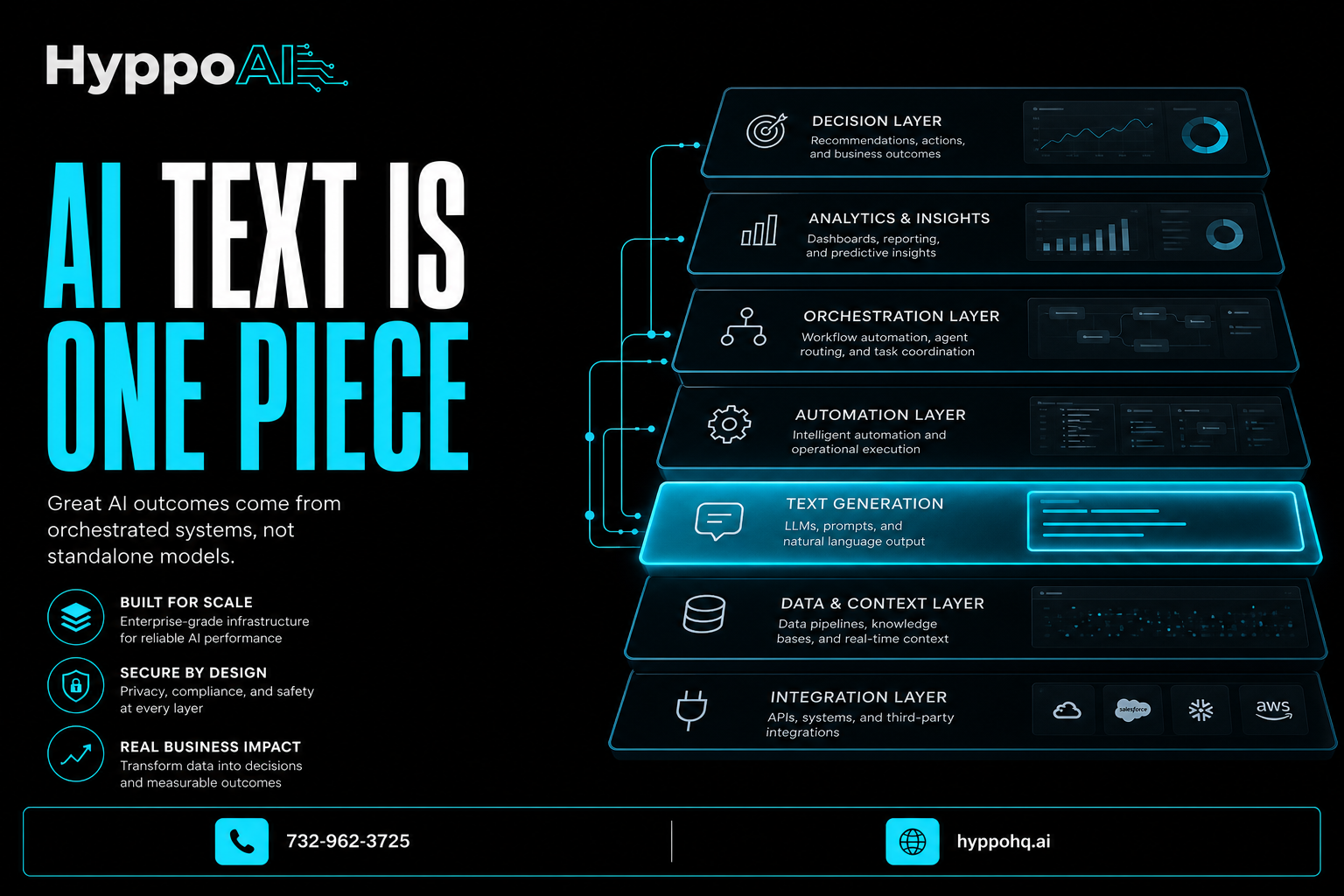
Why AI text generation is one small piece of the stack
AI text generation gets a lot of attention for good reason. It can draft emails, write captions, summarize notes, and help teams move faster.
But for small and midsize businesses, text generation alone is not the full solution. It is one capability inside a much larger system. If you treat it like the whole stack, you usually end up with disconnected outputs, inconsistent quality, and very little operational impact.
The real value of AI comes from how text generation connects to your data, workflows, team processes, and customer experience. That is where businesses move from experimenting with prompts to building systems that actually save time, capture leads, and support growth.
What people mean by AI text generation
AI text generation is the ability of a model to produce written content from a prompt. That can include:
- Email drafts
- Blog outlines
- Social captions
- Sales responses
- FAQ answers
- Internal documentation
- Customer support replies
It is useful because it reduces blank-page time and speeds up repetitive writing tasks. For many businesses, it is the first AI feature they try.
That makes sense. It is visible, easy to test, and often impressive in a demo.
The problem is that business operations are not made of text alone.
Why text generation is only one layer
A generated answer is not the same thing as a business outcome.
If an AI writes a good response but it is based on outdated information, the result can create confusion. If it drafts a follow-up message but nobody sends it, there is no value. If it creates content but there is no review process, no distribution system, and no measurement, it becomes noise instead of leverage.
Text generation is the interface people notice. The rest of the stack is what makes it reliable and useful.
The stack around the model matters
For AI to work inside an SMB, it usually needs support from several layers:
- Clean business data
- Defined workflows
- Integrations with existing tools
- Rules and approvals
- Human review where needed
- Reporting and feedback loops
Without those pieces, text generation stays a standalone feature instead of becoming part of the business.
The parts of the AI stack SMBs should care about
If you want practical AI, focus less on the novelty of generated text and more on the system around it.
1. Data and context
AI is only as useful as the context it can access.
If your business information lives across inboxes, spreadsheets, CRMs, call logs, and team chat, then the model needs a way to work with the right source of truth. Otherwise, it will produce content that sounds polished but misses the facts.
For SMBs, strong context often includes:
- Service details
- Pricing rules
- Lead status
- Customer history
- FAQs
- Scheduling information
- Internal policies
When the context is accurate, generated text becomes much more dependable.
2. Workflow automation
Writing text is not the end of the process. It is usually the middle.
A lead comes in. A message is generated. It gets routed. A follow-up is scheduled. A team member is notified. The CRM is updated. The customer gets a confirmation.
That is a workflow.
If AI only handles the writing step, your team still has to manually move information from one stage to the next. That limits the return.
3. Integrations with business systems
Most SMBs already use tools for communication, scheduling, payments, support, and sales. AI becomes more valuable when it fits into those systems instead of sitting outside them.
Useful integrations may include:
- CRM platforms
- Shared inboxes
- Scheduling tools
- Website chat
- Phone systems
- Help desk software
- Internal knowledge bases
The goal is not to add more disconnected tools. It is to make the existing stack work smarter.
4. Quality control and guardrails
Generated text can be fast, but speed without controls creates risk.
Businesses need guardrails for:
- Brand voice
- Accuracy
- Compliance-sensitive language
- Escalation rules
- Approval steps
- Fallback behavior when the AI is uncertain
This is especially important in customer-facing workflows. A confident answer is not always a correct one.
5. Measurement and iteration
If you cannot measure the outcome, you cannot improve the system.
The important question is not, “Did the AI write something?” It is, “Did it help the business perform better?”
That could mean tracking:
- Faster response times
- More booked appointments
- Higher lead conversion
- Fewer missed follow-ups
- Reduced admin time
- Better customer satisfaction
AI should be tied to business metrics, not just output volume.
What this looks like in the real world
A lot of businesses start with content because it feels accessible. They use AI to generate blog posts, emails, or social captions.
That can help. But the bigger opportunity often sits in operational use cases.
For example, imagine a service business using AI across a simple lead workflow:
- A prospect submits a form or calls.
- The system captures the inquiry.
- AI drafts or delivers the right response based on business context.
- The lead is categorized and routed.
- A follow-up sequence starts automatically.
- The team sees the full history in one place.
- Results are tracked and improved over time.
In that scenario, text generation matters. But it is only one step in a stack that includes intake, routing, automation, and reporting.
That is where AI starts producing operational value instead of isolated content.
Common mistake: buying the demo, not the system
Many AI tools look great in a demo because text generation is easy to showcase. You type a prompt, get a polished answer, and imagine the time savings.
But once the tool hits real business conditions, the gaps show up fast:
- It does not know your process
- It cannot access the right data
- It does not connect to your tools
- It needs too much manual oversight
- It creates extra review work
- It does not map to clear ROI
That is why SMBs should evaluate AI based on system fit, not just output quality.
How SMBs should think about AI adoption
A practical approach is to ask a different set of questions.
Instead of asking, “Can this generate text?” ask:
- What business process does this improve?
- What data does it need?
- What systems does it connect to?
- Where does human review belong?
- How will we measure success?
- What happens after the text is generated?
Those questions lead to better decisions and more durable results.
The bottom line
AI text generation is valuable, but it is not the whole story. It is one small piece of the stack.
For SMBs, the real win comes from building systems where AI can access the right context, support real workflows, connect with existing tools, and drive measurable outcomes. That is how you move from interesting outputs to actual business performance.
If you are evaluating AI for your business, think beyond the prompt box. The strongest solutions are not just good at writing. They are designed to work inside the way your business actually runs.
If you want to explore practical AI systems for SMB growth and operations, visit https://hyppohq.ai or call +17329623725 to learn more about HyppoAI.