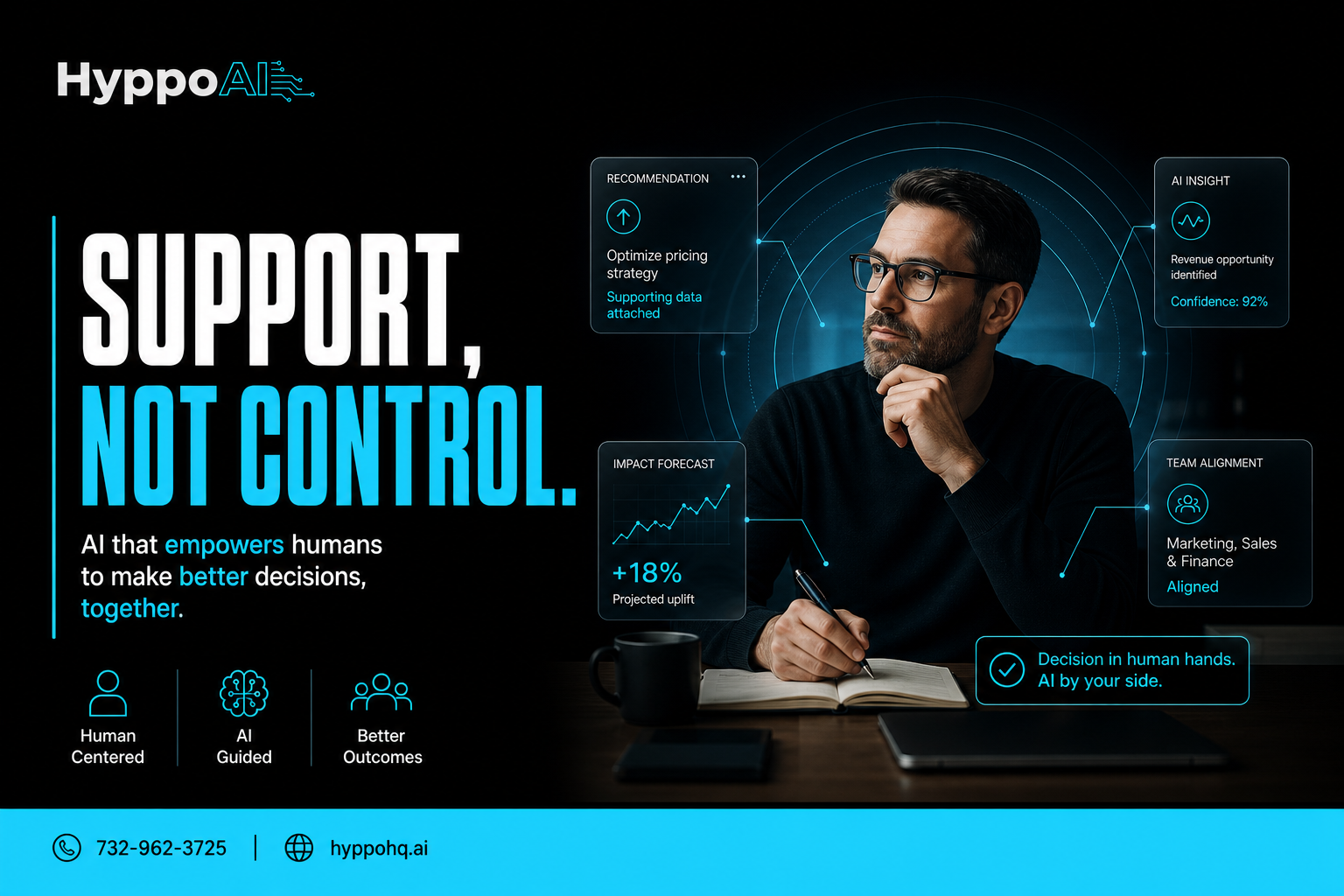
Why AI works best as support, not control
AI is changing how small and midsize businesses operate. It can summarize data, speed up workflows, draft content, answer common questions, and help teams move faster.
But there is a line smart businesses should pay attention to: AI works best as support, not control.
That distinction matters. Support means AI helps people make better decisions. Control means AI makes decisions on its own with little oversight. For most SMBs, the first approach creates leverage. The second can create avoidable risk.
The real strength of AI is augmentation
AI is excellent at pattern recognition, language generation, and handling repetitive tasks at scale. It can process more information than a person can in the same amount of time. That makes it incredibly useful.
What it does not have is true business accountability.
AI does not own the outcome. Your team does. Your brand does. Your customers feel the impact when something goes wrong.
That is why the best use of AI is augmentation, not replacement. It should strengthen human performance, not eliminate human judgment.
What support looks like in practice
When AI is used as support, it can:
- surface trends from customer conversations
- draft emails, proposals, or social posts
- summarize meetings and action items
- prioritize leads based on signals
- answer routine questions instantly
- help teams respond faster and more consistently
In this model, humans still review, decide, and take responsibility.
That balance is where AI creates the most value.
Control sounds efficient, but often creates hidden problems
A lot of businesses are tempted by full automation. It sounds simple: let AI run the process, remove the bottleneck, and scale faster.
The problem is that business decisions are rarely just technical. They involve context, tradeoffs, ethics, tone, timing, and customer expectations.
AI can miss those nuances.
When AI is given too much control, businesses can run into issues like:
- incorrect responses sent to customers
- poor decisions based on incomplete data
- brand voice inconsistency
- compliance or policy mistakes
- overconfident outputs that sound right but are wrong
- reduced trust from customers and staff
These are not edge cases. They are common failure points when companies treat AI like a decision-maker instead of a decision-support system.
Human judgment is still the competitive advantage
For SMBs, speed matters. Efficiency matters. But trust matters more.
Customers want fast answers, but they also want accuracy. Teams want automation, but they also want clarity and control. Owners want leverage, but they cannot afford systems that make expensive mistakes.
That is where human judgment stays essential.
People understand the business context behind the task. They know when a customer needs empathy instead of efficiency. They can spot when an answer is technically correct but strategically wrong.
AI can support that judgment. It should not replace it.
The best systems keep humans in the loop
A strong AI workflow usually includes:
- clear rules for what AI can and cannot do
- human review for sensitive or high-impact decisions
- escalation paths when confidence is low
- regular monitoring for quality and accuracy
- feedback loops that improve outputs over time
This is how businesses get the benefit of automation without losing control of outcomes.
AI is best at the first draft, not the final call
One of the most useful ways to think about AI is this: it is a powerful first-pass tool.
It can give you a fast draft, a shortlist, a summary, a recommendation, or a likely answer. That saves time. It reduces friction. It helps your team focus on higher-value work.
But the final call should stay with a person when the stakes are meaningful.
That includes areas like:
- hiring decisions
- customer conflict resolution
- financial approvals
- legal or compliance-sensitive communication
- strategic planning
- reputation management
In these moments, AI can inform the process. It should not own the outcome.
Why this matters even more for SMBs
Large enterprises may have layers of review, compliance teams, and bigger margins for error. SMBs usually do not.
A single bad customer interaction, missed lead, or wrong operational decision can have an outsized impact.
That is why SMBs need practical AI systems, not hype-driven automation.
The goal is not to remove people from every process. The goal is to remove waste, delays, and repetitive work so people can do better work where it counts.
Used this way, AI becomes a multiplier.
A smarter way to adopt AI
If you are an SMB owner or operator, start with these principles:
1. Automate repetition, not responsibility
Use AI for routine tasks first. Keep ownership with your team.
2. Add oversight before adding autonomy
Build review steps into the workflow before letting AI act independently.
3. Measure outcomes, not just speed
Faster is only better if quality stays high.
4. Protect trust at every step
Your customers care about consistency, accuracy, and reliability more than novelty.
5. Use AI to improve decisions, not avoid them
The right system helps leaders think more clearly. It does not remove leadership from the equation.
Support-first AI creates sustainable growth
The businesses getting the most from AI are not the ones chasing full replacement. They are the ones building support-first systems.
These systems help teams:
- respond faster
- stay organized
- reduce manual workload
- improve follow-up
- make better use of data
- scale without losing quality
That is the real promise of AI for SMBs.
Not uncontrolled automation. Better operations with smarter support.
The bottom line
AI is a powerful tool, but tools need direction.
When businesses hand AI total control, they often trade short-term efficiency for long-term risk. When they use AI as support, they gain speed, insight, and consistency while keeping human judgment where it belongs.
That is the smarter model.
AI should assist the business, not run it.
If you want to build practical AI systems that support your team and help your business scale with more control, visit HyppoAI at https://hyppohq.ai or call +17329623725 to learn more.