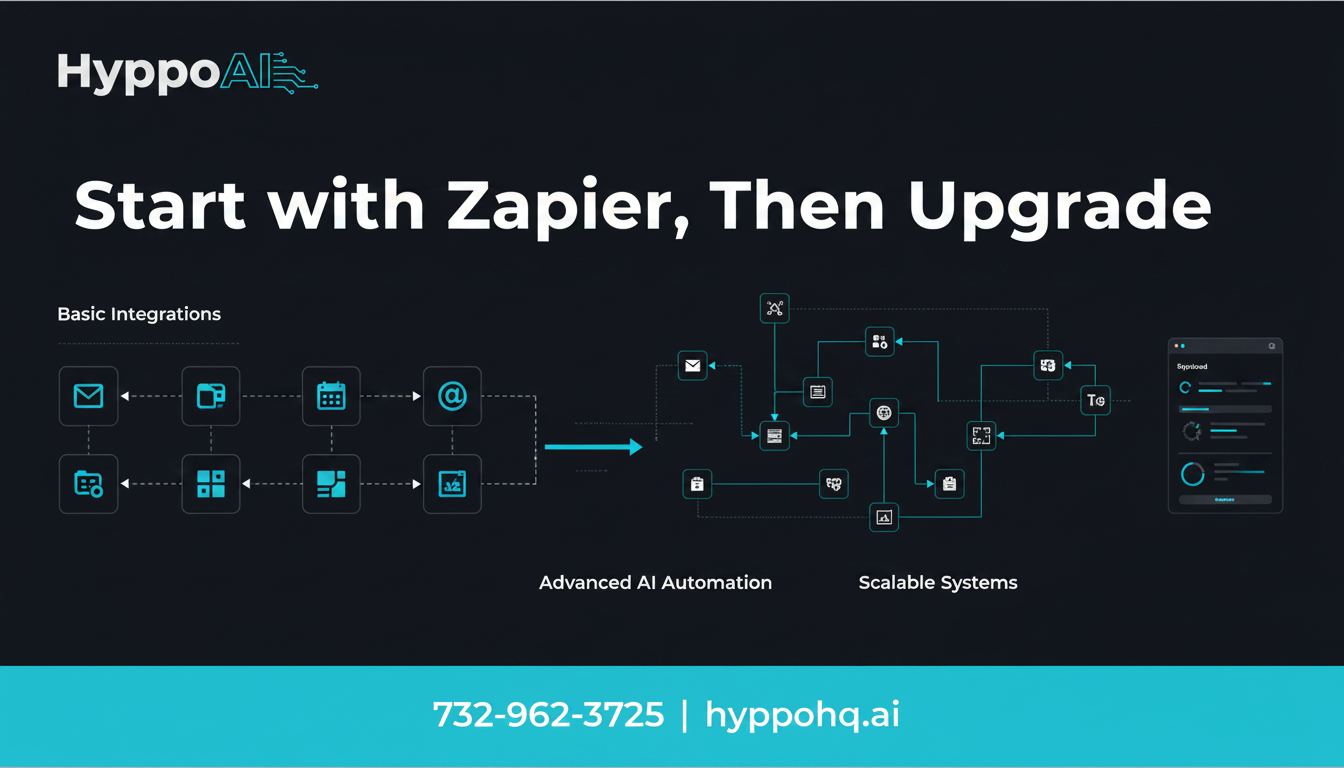
Why many businesses start with Zapier before upgrading
Zapier is often the first automation tool businesses try, and for good reason. It is approachable, fast to set up, and gives teams a practical way to connect apps without hiring a developer.
For small and growing businesses, that matters. When you are juggling leads, follow-ups, scheduling, invoicing, and internal notifications, even a few simple automations can save real time.
But there is also a pattern many businesses discover after the first wave of wins: Zapier helps you start, then your needs evolve. What began as a few helpful automations can turn into a web of fragile workflows, rising task costs, and limitations around logic, speed, and scale.
That is why many businesses start with Zapier before upgrading. It is not because Zapier is a bad tool. It is because it is often the right entry point, but not always the right long-term architecture.
Why Zapier is such a common starting point
Zapier lowers the barrier to automation. For SMBs, that is a big deal.
Instead of waiting months for a custom system, teams can create useful workflows in hours. A new lead can trigger an email. A form submission can create a CRM contact. A booked appointment can alert the team in Slack.
That early momentum is valuable because it helps businesses:
- prove automation works
- reduce manual admin tasks
- move faster without heavy technical overhead
- test processes before investing in custom systems
- connect common tools already in use
In other words, Zapier is simple enough to get started and powerful enough to create immediate ROI.
The appeal for SMBs
For many small businesses, the first automation goal is not transformation. It is relief.
They want to:
- stop copying data between apps
- reduce missed follow-ups
- create consistency in repetitive tasks
- save staff time
- respond faster to leads and customers
Zapier is built for exactly that stage. It gives businesses an easy on-ramp into automation without forcing them to redesign everything at once.
What businesses usually automate first
Most companies do not begin with advanced AI workflows or deeply customized systems. They start with obvious bottlenecks.
Common early use cases include:
- sending lead form submissions into a CRM
- creating tasks when a customer books an appointment
- sending internal notifications for new sales opportunities
- syncing contact data between platforms
- triggering welcome emails or follow-up sequences
- routing inquiries to the right person
These are high-value, low-complexity automations. They remove friction quickly and help teams feel the impact of automation almost immediately.
Where Zapier starts to show limits
As a business grows, workflows usually become more important and more complicated.
That is when teams begin to notice that what worked at the start may not be enough anymore.
1. Workflow complexity increases
Simple if-this-then-that automations are easy. But real operations rarely stay simple.
Over time, businesses need things like:
- conditional logic across multiple systems
- exception handling
- deduplication rules
- branching workflows
- approval steps
- multi-step lead qualification
- custom data transformations
At that point, managing everything inside Zapier can become messy. Workflows grow harder to troubleshoot, and small changes can create downstream issues.
2. Costs rise with volume
Zapier is convenient, but convenience can get expensive.
As task volume increases, monthly costs can climb fast. A business that starts with a few automations may not mind. A business processing large numbers of leads, messages, updates, and triggers every day often starts asking a different question:
Is this still the most efficient way to run our systems?
3. Reliability becomes mission-critical
Early on, a delayed task may be annoying. Later, it can mean missed revenue.
When automations support lead response, customer communication, appointment handling, or internal operations, reliability matters more. Businesses begin to care about:
- error monitoring
- recovery paths
- logging and visibility
- speed of execution
- system resilience
That is often the moment when a lightweight automation stack starts feeling too lightweight.
4. Businesses want more ownership
Zapier is great for connecting tools, but many companies eventually want deeper control over how their systems work.
They may need:
- custom integrations
- AI-driven decision logic
- database-backed workflows
- secure internal tools
- automation tied directly to business rules
- unified systems instead of scattered app connections
When that need for ownership grows, upgrading becomes less about features and more about strategy.
Why upgrading is a smart move, not a failure
Some businesses think moving beyond Zapier means they chose wrong. Usually, the opposite is true.
Starting with Zapier is often the logical move because it helps validate processes before bigger investment. It lets teams learn what should be automated, what breaks, and where the biggest gains are.
That learning is valuable.
By the time a business is ready to upgrade, it usually has a much clearer picture of:
- its real workflow bottlenecks
- which automations create the most value
- where manual work still slows growth
- what systems need to talk to each other
- what level of customization is now required
In that sense, Zapier is often a stepping stone. It helps businesses move from guessing to understanding.
Signs it may be time to upgrade
Not every business needs to move beyond Zapier right away. But there are clear signals that the next stage has arrived.
You may be ready to upgrade if:
- your workflows are difficult to maintain
- errors are becoming costly
- your monthly automation bill keeps rising
- your team relies on workarounds to fill gaps
- you need faster lead handling or more advanced routing
- you want AI to do more than trigger simple tasks
- your operations depend on automation working flawlessly
If several of those sound familiar, the issue is probably not whether automation works. It is whether your current setup still fits the business.
What upgrading can look like
Upgrading does not always mean replacing everything overnight. In many cases, the best path is gradual.
A business might:
- keep Zapier for simple connections
- move critical workflows into more robust systems
- add custom integrations for core operations
- introduce AI agents or AI-assisted workflows
- centralize data and process logic
- improve visibility, monitoring, and control
The goal is not complexity for its own sake. The goal is building a system that matches the current stage of the business.
The bigger lesson for growing businesses
The real takeaway is simple: tools should match the stage you are in.
Zapier makes sense when speed, accessibility, and quick wins matter most. More advanced systems make sense when scale, reliability, and customization become the priority.
That progression is normal.
Businesses do not outgrow Zapier because they failed. They outgrow it because they are growing. Their operations become more valuable, their customer journeys become more important, and their automation needs become more strategic.
For SMBs, that is actually a good problem to have.
Final thoughts
Many businesses start with Zapier before upgrading because it is one of the easiest ways to begin automating. It helps teams save time, reduce manual work, and learn what matters. But once workflows become more central to growth, many businesses need a stronger foundation.
If your team is hitting limits with basic automation and wants a smarter path forward, HyppoAI can help you evaluate what to keep, what to improve, and what to build next. Visit https://hyppohq.ai or call +17329623725 to explore practical AI and automation solutions for your business.