Why ChatGPT Context Matters More Than Better Questions
Why Giving ChatGPT Context Matters More Than Asking Better Questions
As AI tools like ChatGPT become part of everyday work, many teams focus on crafting clever prompts or finding secret question templates. In practice, the biggest performance gains rarely come from fancy wording. They come from giving the AI the right context.
For service businesses, this distinction matters. ChatGPT does not know your specific customers, your policies, or your constraints unless you teach it during the conversation. The quality of that context often has more impact than the quality of the question itself.
What Context Really Means for ChatGPT
In plain terms, context is everything that helps ChatGPT understand the situation around your request. It can include:
- Business details: what you sell, who you serve, and how you operate.
- Constraints: legal, safety, brand, or operational rules that must be respected.
- Examples: past emails, service responses, or documents that show your style and standards.
- Objectives: what you are trying to achieve and what success would look like.
- Audience: who will read or use the output and what they already know.
Why Better Questions Alone Are Not Enough
AI is Pattern Matching, Not Mind Reading
Large language models like ChatGPT generate text by predicting what is likely to come next, based on patterns they learned during training. They do not have direct access to your systems, your history, or your plans unless you provide that data in the conversation.
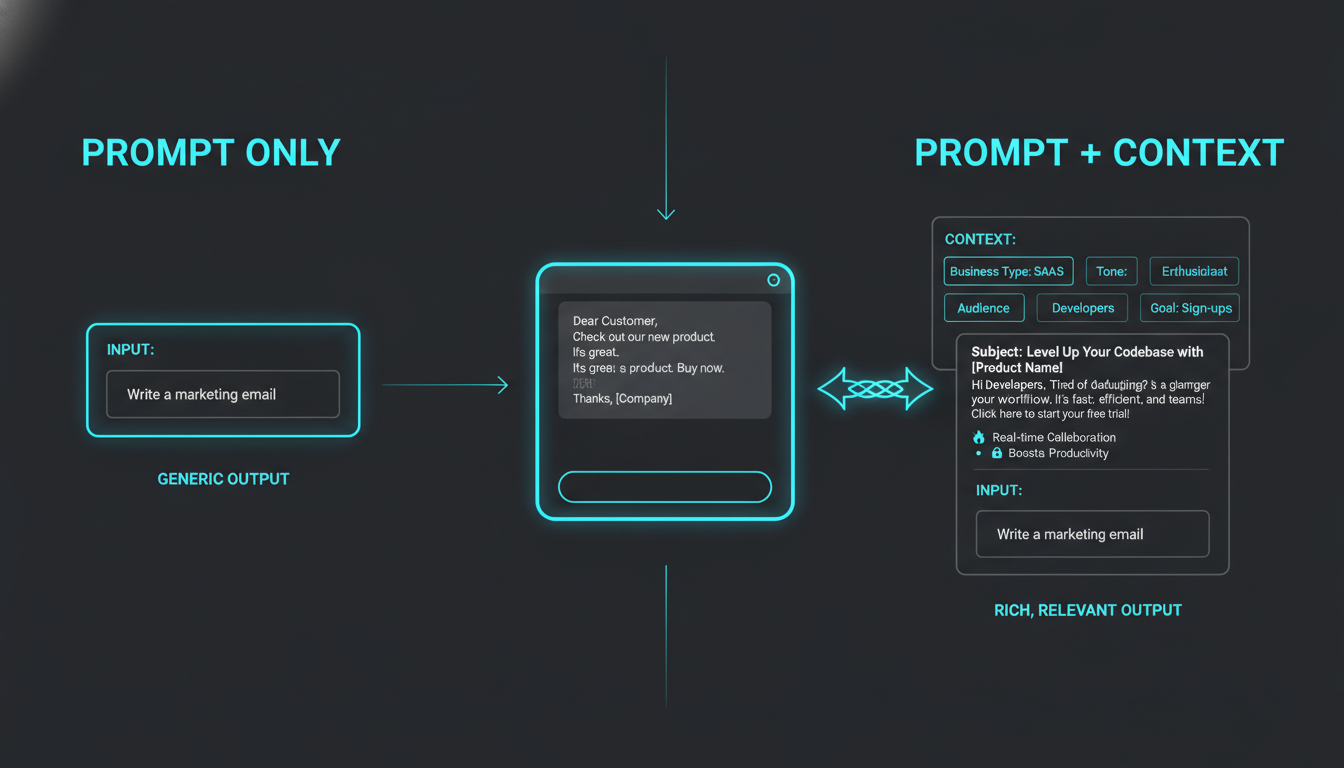
This means: if you ask a very clever question with almost no context, the model will still answer using generic patterns. If you ask a simple question with rich context, the model can adapt its answer to your specific scenario. The difference in usefulness is usually much larger than the difference between average and expert prompt wording.
Generic Answers vs. Business-Aware Answers
Consider a service business asking ChatGPT how to respond to a customer complaint about a delayed appointment. Without context, the model may produce a polite, reasonable response — but it will be generic. With context about your actual policies, brand voice, and what kinds of compensation you typically offer, even a simple question like "Draft a reply" can result in an answer that is aligned with how your team would naturally respond.
Types of Context That Change AI Output
1. Role and Perspective
Defining who the AI is acting as sets expectations for style and depth: "Act as a customer support agent for a home services company," "Act as an operations manager reviewing a process," or "Act as a neutral analyst explaining tradeoffs."
2. Business Model and Services
A law firm, HVAC company, dental practice, and marketing agency all operate under different rules and expectations. Give ChatGPT your core services and typical price range, whether you work with consumers or businesses, service areas and major limitations, and any industry-specific regulations.
3. Policies, Boundaries, and Non-Negotiables
Helpful boundaries to share include refund, cancellation, and rescheduling rules; compliance rules; brand tone guidelines; and actions that are strictly off-limits for your team.
4. Examples of Good and Bad Output
Concrete examples are one of the most powerful forms of context. Showing ChatGPT what good looks like and what to avoid often improves results more than rephrasing the question. Paste three examples of emails that worked well, a short script that matches your style, or snippets of documentation that reflect your standards.
Context as a System, Not a One-Off Prompt
Reusable Context for Repeated Tasks
Most service businesses have recurring communication patterns: quotes, follow-ups, reminders, service explanations. The context for these tasks is largely stable. Reusable context elements include your standard brand voice description, common disclaimers or legal notes, standard operating procedures for key workflows, and standard formats you like to use.
Context and Automation
When AI is embedded into workflows or automation, context often comes from your systems rather than from manual prompting: your CRM (customer history, preferences, recent interactions), your booking system (upcoming appointments and service details), your knowledge base or SOPs, and your marketing tools (campaign messages and offers in market). In these setups, the question itself may stay simple while the system supplies rich context behind the scenes.
Context vs. Prompt Engineering: How They Fit Together
You can think of it this way:
- Context defines the environment, rules, and goals.
- The prompt defines the specific task you want done right now.
Improving your prompts can sharpen the instructions you give. Improving your context can change the entire frame in which the AI operates. For most real-world use cases, that frame matters more. Over time, many organizations find it more effective to invest in clear, reusable context definitions than in endlessly searching for new magic prompt templates.
If you want to explore how context, automation, and AI can support your specific service workflows, you can learn more and reach out to the team at Hyppo Advertising Inc. by visiting hyppohq.ai/contact.