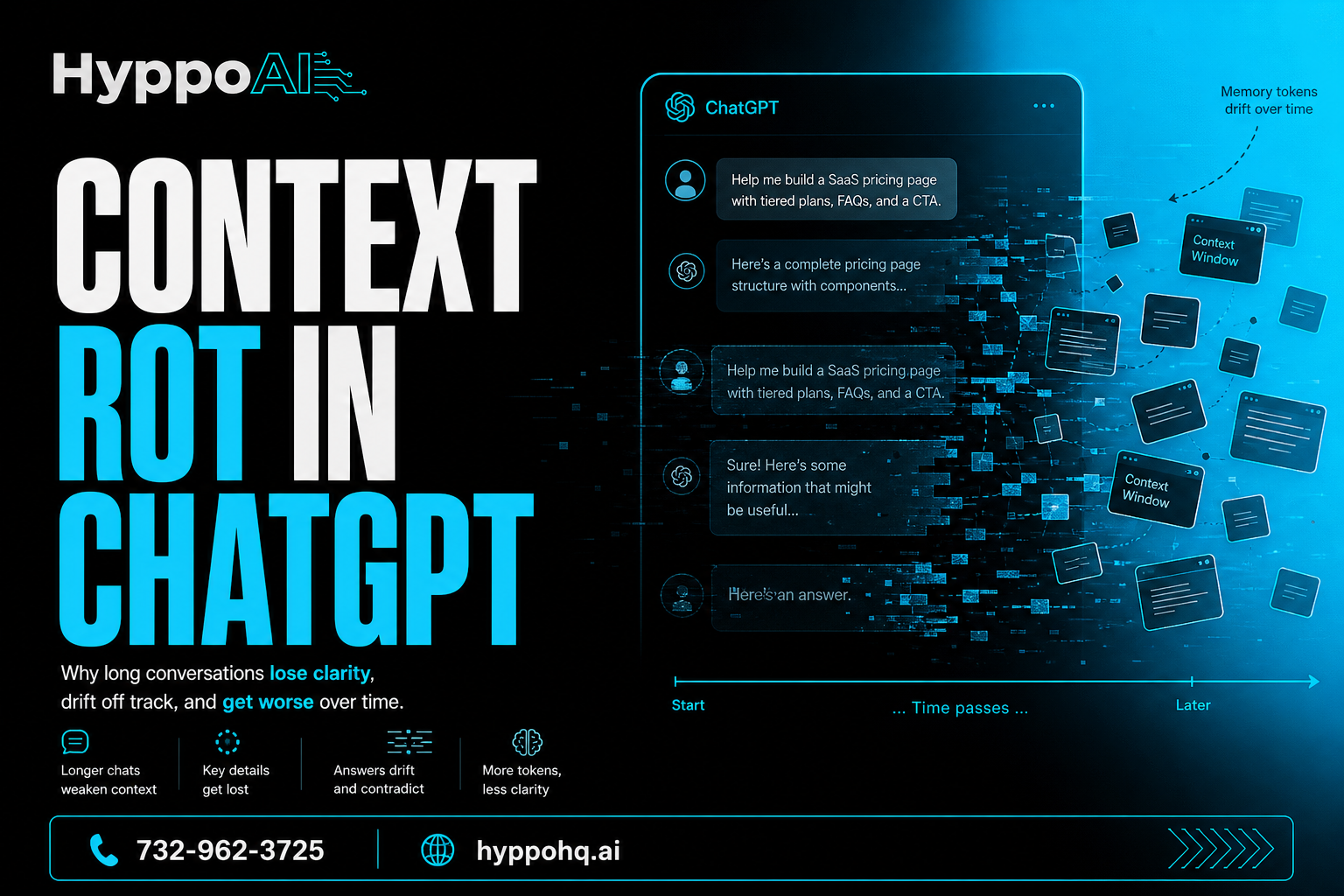
Why ChatGPT gets worse after long conversations
Most people assume ChatGPT should improve as a conversation gets longer. In theory, more context should mean better answers.
In practice, the opposite often happens.
After enough back-and-forth, responses can become less precise, less consistent, and more likely to miss important instructions. This is often described as context rot: the gradual degradation of response quality as a conversation accumulates too much history.
For SMB teams using AI in operations, sales, support, or content workflows, this matters. If you rely on long-running chats, you may be building processes on top of a system that gets noisier over time.
What is context rot?
Context rot is what happens when a model has to work with a growing pile of prior messages, instructions, clarifications, examples, and corrections.
Instead of becoming sharper, the model can start to:
- lose track of the original goal
- over-weight recent but less important details
- ignore earlier constraints
- blend conflicting instructions together
- repeat itself or drift off-topic
This does not mean the model is broken. It means long conversations create a harder reasoning environment.
The more tokens, decisions, revisions, and side paths you add, the more likely the system is to misread what matters most.
Why ChatGPT gets worse after conversations
There are a few practical reasons this happens.
Too much context is not the same as good context
More information is only useful if it is relevant, consistent, and structured.
A long chat usually contains:
- outdated instructions n- abandoned ideas
- contradictory feedback
- examples from earlier turns that no longer apply
- casual side comments that muddy the objective
When all of that stays in the thread, the model has to infer what still matters. That inference is not always correct.
Important instructions get diluted
Early in a chat, your prompt is clean.
Later, your original request is buried under dozens of messages. Even if the model technically has access to the history, signal gets mixed with noise. The result is often weaker instruction-following.
This is one reason users say, "It was great at first, then it started missing obvious things."
Recency can overpower priority
In ongoing conversations, newer messages often shape the next answer more strongly than older ones. That can be useful, but it can also create drift.
For example, you may have defined a format, audience, or business rule early in the thread. Then a later clarification changes one small detail. The model may accidentally treat that small detail as more important than the core instruction set.
Errors compound over time
If the model makes a small mistake in turn 8, and nobody corrects it clearly, that mistake can become part of the working context.
By turn 20, the system may be building on a flawed assumption. By turn 40, the output can be confidently wrong while still sounding polished.
That is dangerous for business use cases because the response quality can look high even when the logic is slipping.
Common signs of context rot
If you use ChatGPT regularly, you have probably seen some version of this.
The model forgets constraints
You asked for a specific tone, length, format, or audience. Several turns later, those rules vanish.
It starts contradicting itself
The model says one thing early in the conversation, then later says the opposite without acknowledging the change.
Responses become verbose but less useful
Long chats often produce answers that sound comprehensive while actually becoming less actionable.
It anchors to the wrong detail
A minor example or side comment suddenly becomes the main frame for the answer.
It resists clean resets
Even when you try to steer the conversation back, the old thread keeps pulling the output toward prior assumptions.
Why this matters for SMBs
For small and mid-sized businesses, AI is supposed to create leverage.
But leverage disappears when teams spend extra time correcting drift, re-explaining goals, or validating outputs that should have been straightforward.
Context rot can hurt:
- content production workflows
- customer support drafting
- internal knowledge tasks
- sales enablement prompts
- reporting and summarization
- SOP generation
If your team thinks the model is becoming unreliable, the issue may not be the model alone. It may be the way long conversations are being used.
How to reduce context rot
You do not always need a different model. Often, you need a better operating method.
Start fresh more often
One of the simplest fixes is opening a new chat when the task changes.
Do not force one thread to handle brainstorming, editing, strategy, formatting, and final production all at once. Break tasks into cleaner sessions.
Re-state the goal clearly
Before asking for the next output, summarize the active objective in a few lines.
Include:
- the exact task
- the audience
- the desired format
- any non-negotiable constraints
This helps re-establish the signal.
Use structured summaries
Instead of relying on the full conversation history, create a short working summary that captures only what still matters.
For example:
- objective
- current assumptions
- approved decisions
- required output format
- exclusions
That is much better than dragging every prior message forward.
Remove dead context
If an idea is no longer relevant, do not keep building on it.
Old alternatives, rejected drafts, and outdated instructions should not stay in the active workflow if you want consistent results.
Separate exploration from execution
Brainstorming is messy. Final production should not be.
Use one chat for exploration and another for the polished deliverable. This reduces contamination from half-formed ideas.
Validate critical outputs
For high-stakes use cases, do not assume a long-thread answer is correct because it sounds smooth.
Have checkpoints for:
- factual accuracy
- policy compliance
- formatting consistency
- instruction adherence
- business logic
Better prompting is really better context management
A lot of people talk about prompt engineering as if the magic is in one perfect prompt.
In reality, long-term performance often comes down to context management.
That means deciding:
- what information belongs in the current task
- what should be summarized
- what should be discarded
- when a conversation should be restarted
The best AI workflows are not just smart. They are clean.
The practical takeaway
ChatGPT does not always get better with more conversation. Often, it gets worse.
That is not surprising once you understand context rot. Long threads create clutter, conflicting signals, and compounding assumptions. Over time, the output can drift away from the original goal while still sounding convincing.
For SMBs, the fix is practical: use shorter task windows, cleaner summaries, better resets, and tighter process design.
If your team wants AI systems that stay useful in real business workflows, HyppoAI helps SMBs build smarter, more reliable AI operations. Visit https://hyppohq.ai or call +17329623725 to learn more.