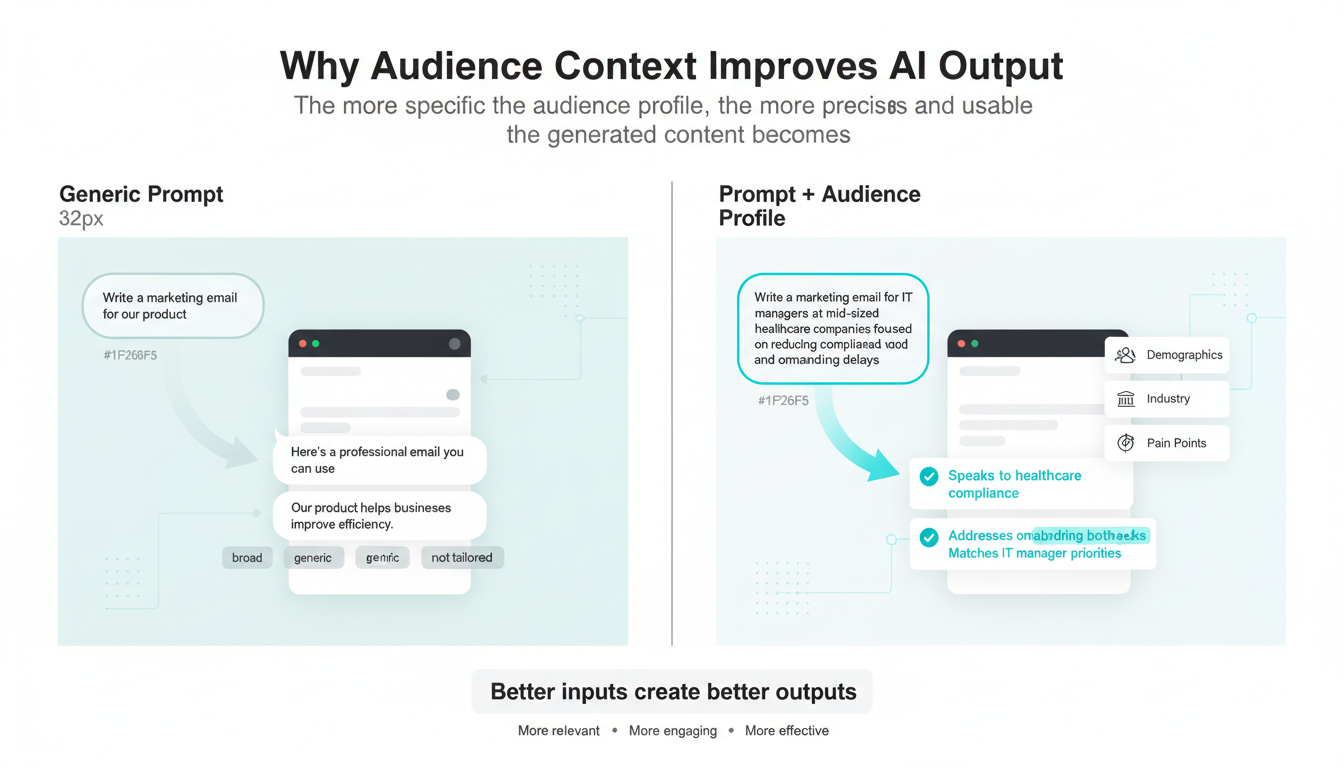
Why ChatGPT Needs to Know the Target Audience
Why ChatGPT Needs to Know Who the Output Is For
When business owners first experiment with tools like ChatGPT, one pattern shows up quickly: the same prompt can produce very different quality results depending on how clearly you describe who the output is for. Audience context is not a minor detail; it is one of the main inputs that determines whether AI-generated content is merely passable, or genuinely useful in a real business setting.
What Audience Means for an AI System
Humans naturally adapt how they speak depending on who they are talking to. Large language models like ChatGPT can do something similar, but only when you give them enough information about who the content is for.
In the context of AI-generated content, audience usually includes:
- Role and background — for example, homeowner, CFO, HR director, operations manager, or field technician.
- Knowledge level — such as beginner, intermediate, or expert in a particular topic.
- Context and situation — why they are reading or listening, and what problem they are currently facing.
- Channel format — email, website page, training guide, internal documentation, or social content.
- Decision stage — early research, comparing options, or ready to sign an agreement.
How Audience Context Changes AI Output
1. Language and Terminology
Different audiences use different words for the same concept. A homeowner might talk about a broken AC, while a facilities manager may care about HVAC downtime and preventive maintenance. When ChatGPT knows the audience, word choice becomes more natural, jargon is either introduced or intentionally avoided, and abbreviations are handled appropriately.
2. Level of Detail and Depth
An executive scanning a report and a technician performing a process need very different levels of detail. Audience context tells the AI how deep to go — whether to summarize how a technology works or describe every technical component.
3. Structure and Flow
Audience context guides how information should be ordered. When ChatGPT understands who it is writing for, it can adjust introductions to match attention span, section order so the most relevant questions are addressed early, and use of summaries for skimmers versus detailed narrative for careful readers.
4. Risk, Compliance, and Sensitivity
Certain topics require extra care depending on who is consuming the information. Audience context helps AI systems avoid implying personalized legal or medical guidance, use more cautious language where regulations may apply, and surface disclaimers more prominently for certain readers.
Why Generic Outputs Are a Business Problem
When content does not speak to a specific audience, readers have to do more work to translate it into their own situation. This often shows up as website pages that attract traffic but lead to few inquiries, emails that look polished but generate low response rates, and proposals that feel generic and harder to approve.
Inside the business, generic AI outputs can create additional work: standard operating procedures that are too high-level for frontline teams, technical summaries that are too detailed for leadership, or training materials that mix beginner and advanced concepts.
Audience as a Core Part of Your AI Prompting Strategy
Clarifying audience within your AI workflows means being explicit about the role and typical responsibilities of the reader, their familiarity with your service or industry, the context in which they will see or hear the content, and the main decision or action they are working toward.
Designing Content for Multiple Audiences
You might use the same core information about a new service but generate different versions for customers (focusing on outcomes and reliability), field teams (focusing on procedures and handoff points), and managers (focusing on capacity and quality control).
Bringing It All Together
For business owners and operators, "who it is for" is not optional metadata; it is a core part of the instructions you give to any AI system. When you invest a bit more effort clarifying the audience, you can reduce the number of revisions needed, produce materials that are easier for specific readers to act on, and spot where different stakeholders need different versions of the same information.
If you are exploring how AI, automation, and structured content workflows could fit into your service business, you can learn more or start a conversation with the team at Hyppo Advertising Inc. by visiting hyppohq.ai/contact.