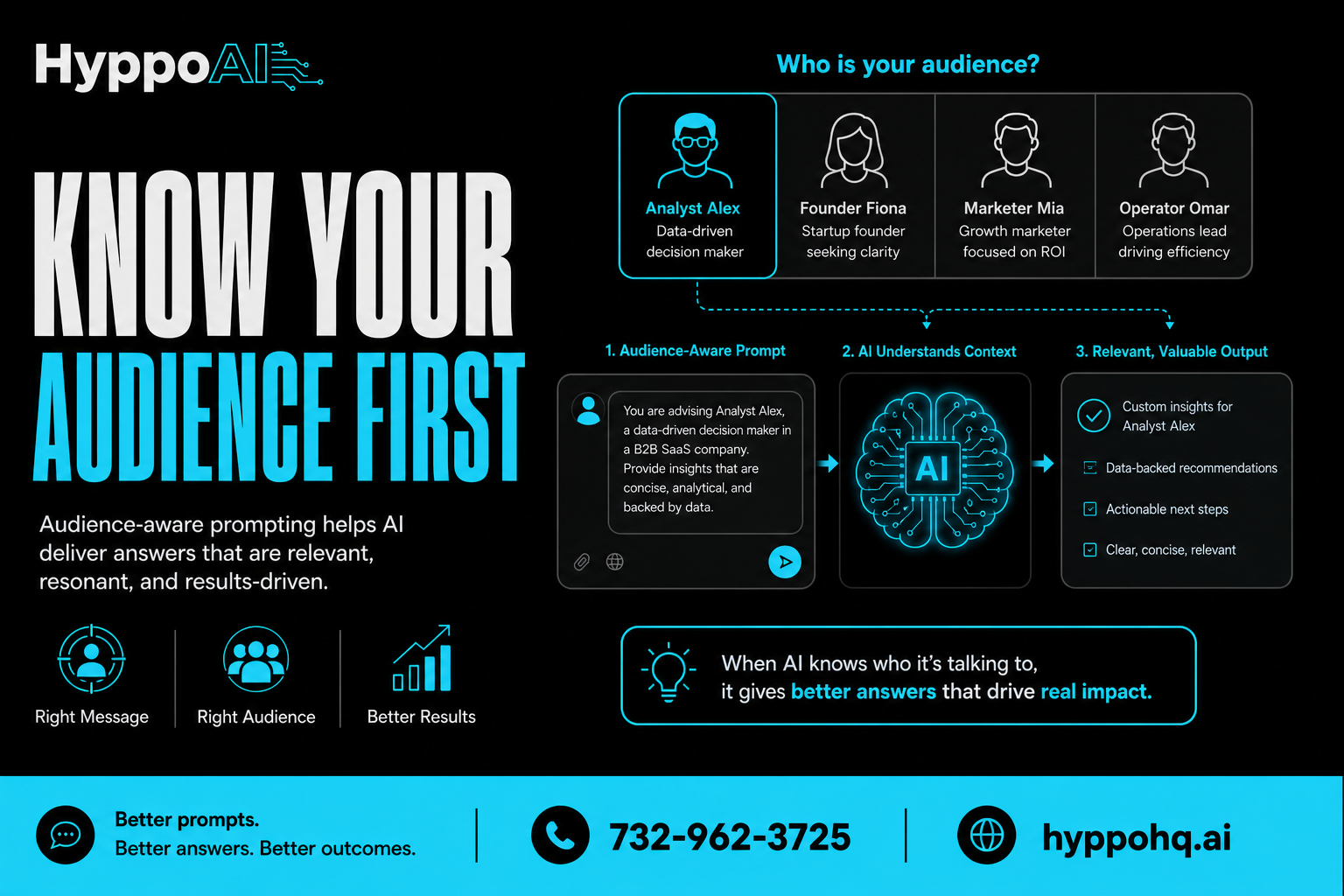
Why ChatGPT needs to know who the output is for
When people say ChatGPT gave them a weak answer, the problem is often not the model. The problem is the prompt.
More specifically, the prompt usually leaves out one critical detail: who the output is for.
That missing context changes everything. A message written for a customer should not sound like a message written for a manager. A sales email should not read like a technical memo. A social caption should not sound like a legal disclaimer.
If you want useful output, ChatGPT needs a target audience.
For SMBs, this matters even more. Small teams do not have time to rewrite every draft from scratch. They need AI output that is closer to usable on the first pass. The fastest way to improve that output is to tell ChatGPT exactly who will read it.
Why audience context changes the quality of AI output
ChatGPT predicts the next best word based on the context you give it. If you give broad instructions, you get broad output. If you give audience-specific instructions, the model can make better decisions about:
- tone
- vocabulary
- structure
- examples
- level of detail
- objections to address
- call to action
Think about the difference between these two prompts:
- Write a follow-up email about our estimate.
- Write a follow-up email about our estimate for a busy home service customer who asked about price, wants a clear next step, and does not want technical jargon.
The second prompt gives ChatGPT a real reader. That means the response can be more relevant, more persuasive, and more likely to get a reply.
What happens when you do not define the audience
When the output is not tied to a specific reader, ChatGPT tends to default to generic business language. That usually creates content that sounds polished but weak.
You have probably seen it before:
- too formal for social media
- too vague for sales
- too wordy for text messages
- too basic for technical teams
- too promotional for existing customers
Generic output is not just a style issue. It creates operational drag.
Your team spends more time editing. Your message loses clarity. Your brand voice gets diluted. And in some cases, the content misses the real goal entirely.
For example, if you ask ChatGPT to write a customer FAQ without saying the reader is a first-time buyer, it may skip beginner concerns. If you ask it to draft an internal SOP without saying the reader is a new employee, it may assume too much prior knowledge.
The result is simple: unclear input creates misaligned output.
The audience tells ChatGPT how to write
The phrase “who this is for” does more than identify a reader. It helps define the writing strategy.
Audience affects tone
A business owner may want direct, concise language. A nervous prospect may need reassurance. An internal operations team may need precision over persuasion.
Audience affects detail level
Experts usually want specifics. Beginners usually want clarity. Decision-makers often want summaries first and details second.
Audience affects format
A LinkedIn post, sales text, onboarding email, proposal summary, and support response all require different structures. The audience helps determine which format makes sense.
Audience affects persuasion
Different readers care about different things.
- prospects care about outcomes
- current customers care about support and trust
- managers care about efficiency and risk
- technicians care about accuracy and process
If ChatGPT knows the audience, it can prioritize the right benefits and address the right objections.
A simple prompt framework that works
If you want stronger output, add this line to your prompt:
This is for [specific audience], and they care most about [goal, concern, or outcome].
That one sentence can dramatically improve the result.
Here are a few examples.
Weak prompt
Write a caption about our AI receptionist.
Better prompt
Write a caption about our AI receptionist for service business owners who miss calls after hours and care about capturing more leads without hiring more front desk staff.
Weak prompt
Write an email about our new feature.
Better prompt
Write an email about our new feature for existing SMB clients who want to save admin time and need a simple explanation with one clear action step.
Weak prompt
Create a FAQ page.
Better prompt
Create a FAQ page for first-time prospects comparing AI phone support options. Keep the language simple, practical, and focused on reliability, setup, and missed-call reduction.
The difference is not subtle. Better audience context produces better business content.
What details should you include about the audience?
You do not need a full persona document every time. In most cases, a few useful details are enough.
Include:
- who the reader is
- what they already know
- what they care about most
- what action you want them to take
- what tone fits them best
You can also add constraints like:
- keep it under 150 words
- avoid jargon
- sound confident, not pushy
- explain like the reader is new to the topic
This helps ChatGPT narrow its choices and produce something more usable.
Why this matters for SMB teams using AI daily
For SMBs, AI is not just a novelty tool. It is a production tool.
Teams use it to draft:
- emails
- captions
- proposals
- FAQs
- scripts
- internal processes
- follow-up messages
- customer support replies
When those assets are built without a clear audience, teams end up doing cleanup work instead of saving time.
That defeats the point.
The real value of AI comes from reducing friction. To do that, your prompts need to include the context a human writer would naturally ask for first: who am I writing this for?
A practical habit to adopt today
Before you send any prompt to ChatGPT, pause and answer these three questions:
1. Who will read this?
Be specific. Not “customers.” Try “busy plumbing customers waiting on an estimate” or “local business owners exploring automation.”
2. What do they care about right now?
Speed? Clarity? Price? Trust? Simplicity? Results?
3. What should they do next?
Reply, book, buy, approve, schedule, or share.
If your prompt includes those three points, the output will usually improve immediately.
Final takeaway
ChatGPT is only as useful as the context you give it. If you want output that sounds sharper, converts better, and needs less editing, tell it who the content is for.
That one change helps the model choose the right tone, level of detail, structure, and message. For SMBs trying to move faster without sacrificing quality, it is one of the simplest prompt upgrades you can make.
If your business is exploring practical AI systems for content, communication, and operations, visit https://hyppohq.ai or call +17329623725 to learn how HyppoAI helps SMBs put AI to work more effectively.