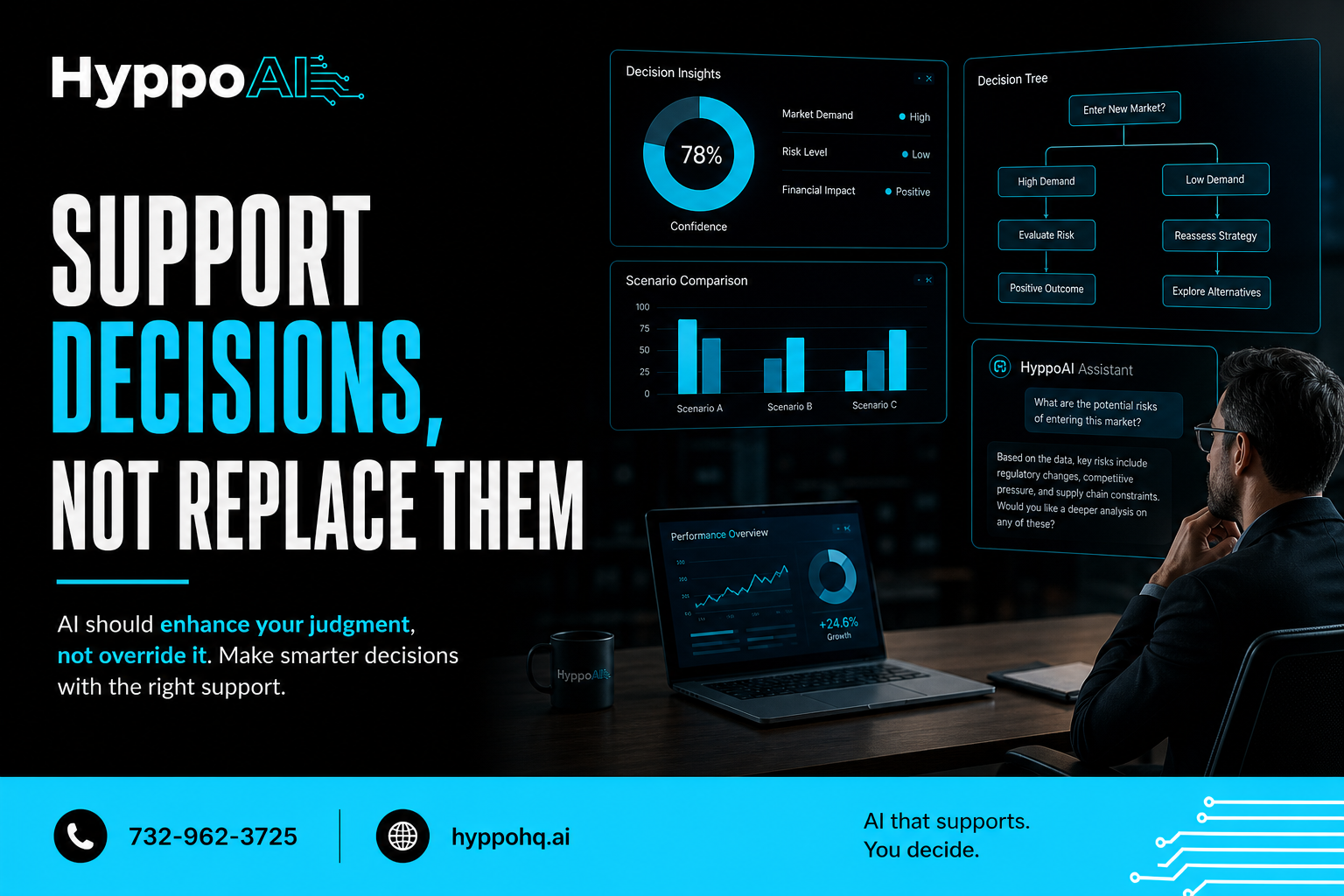
Why ChatGPT should support decisions, not make them
ChatGPT can speed up research, summarize options, and help teams think more clearly. But it should not be the final decision-maker for your business.
That distinction matters more than many small and midsize businesses realize. AI is excellent at pattern recognition, drafting, and organizing information. It is not excellent at accountability, context ownership, or living with the consequences of a bad call.
If you run an SMB, the best use of ChatGPT is not to hand over judgment. It is to improve the quality and speed of human judgment.
The real role of ChatGPT in business
ChatGPT is a support tool. It helps people process information faster and explore ideas more efficiently.
Used well, it can:
- summarize large amounts of information
- compare options side by side
- draft emails, proposals, and SOPs
- identify blind spots in a plan
- help teams brainstorm next steps
- turn messy notes into clear action items
That is valuable. In many businesses, that kind of support saves hours every week.
The problem starts when people confuse support with authority.
A tool can provide input. A leader still has to make the call.
Why AI should not make final decisions
There are practical reasons to keep humans in charge.
AI lacks full business context
Your business decisions are shaped by more than data points. They involve customer relationships, team dynamics, timing, reputation, cash flow pressure, and long-term strategy.
ChatGPT only sees the information it is given. If the prompt is incomplete, the output will be incomplete too. Even a strong answer may be based on missing context.
That means the response can sound confident while still being wrong for your situation.
AI can be persuasive without being correct
One of the biggest risks with ChatGPT is that it communicates with clarity. That can make weak reasoning sound stronger than it is.
For busy owners and managers, that creates a trap. A polished answer can feel like a reliable answer.
It is not.
You still need to test assumptions, verify facts, and ask whether the recommendation makes sense in the real world.
AI does not carry accountability
If a pricing change hurts margins, if a hiring choice creates problems, or if a customer-facing message damages trust, the AI does not absorb that cost. Your business does.
Decision-making includes responsibility. That is why final authority belongs with a person, not a model.
AI may reflect bias or flawed inputs
ChatGPT works from patterns and prompts. If the source information is biased, outdated, vague, or incomplete, the output can inherit those problems.
This is especially important for decisions involving:
- hiring and staffing
- legal or compliance issues
- financial planning
- customer disputes
- brand messaging during sensitive situations
In these areas, support is useful. Automation of judgment is risky.
What ChatGPT is great at
The better question is not whether to use ChatGPT. It is how to use it properly.
Here are areas where it performs well as a decision support tool.
Organizing messy information
Many business decisions stall because the inputs are scattered. Notes live in inboxes, docs, texts, and team chats.
ChatGPT can help consolidate that information into:
- summaries
- pros and cons lists
- risk overviews
- draft recommendations
- decision frameworks
That makes it easier for leaders to review the facts and move faster.
Stress-testing ideas
A strong use case is asking ChatGPT to challenge your thinking.
For example, you can prompt it to:
- argue against your preferred option
- identify hidden risks
- suggest alternative paths
- point out missing variables
- create best-case and worst-case scenarios
This is where AI becomes highly practical. It helps sharpen your reasoning instead of replacing it.
Improving communication around decisions
Once a decision is made, ChatGPT can help communicate it clearly.
That might include drafting:
- internal updates to staff
- customer emails
- implementation checklists
- meeting agendas
- training notes
This is a major advantage for SMBs. Better communication often leads to better execution.
A simple framework for using ChatGPT responsibly
If you want better outcomes, use a human-in-the-loop approach.
1. Define the decision clearly
Start by naming the actual decision. Not the general topic. The decision.
For example:
- Should we raise prices this quarter?
- Which lead source should get more budget?
- Should we automate this part of customer service?
Clear questions produce more useful support.
2. Give ChatGPT structured inputs
Provide relevant facts, constraints, and goals. The quality of the output depends on the quality of the prompt.
Include things like:
- budget limits
- timeline
- team capacity
- customer impact
- risks you already see
The more grounded the context, the more useful the response.
3. Ask for options, not verdicts
Instead of asking, “What should I do?” ask for:
- three viable options
- tradeoffs for each option
- likely risks
- missing information needed before deciding
This keeps the AI in a support role where it performs best.
4. Review with human judgment
A business owner, manager, or subject matter expert should review the output before action is taken.
That person should ask:
- Does this fit our actual goals?
- What context is missing?
- What are the second-order effects?
- What happens if this goes wrong?
That review step is where real decision quality is protected.
5. Track outcomes
Good decision-making improves when you measure results.
If ChatGPT helped shape a decision, compare the recommendation to the actual outcome. Over time, this helps your team learn where AI is most helpful and where human experience matters more.
Why this matters for SMBs
Large companies can absorb more mistakes. SMBs usually cannot.
A wrong decision on hiring, ad spend, operations, or customer communication can hit revenue fast. That is why small and midsize businesses need practical AI systems, not blind trust in automation.
The goal is not to remove humans from important choices. The goal is to remove friction from the thinking process.
That is a much smarter use of AI.
The best mindset: AI as amplifier, not authority
Think of ChatGPT as a force multiplier.
It can help you:
- think faster
- prepare better
- communicate more clearly
- evaluate options more efficiently
But it should not become the authority behind critical business decisions.
Strong companies use AI to enhance leadership, not replace it.
That mindset leads to better systems, cleaner workflows, and more responsible growth.
Final takeaway
ChatGPT should support decisions, not make them, because business judgment is more than information processing. It requires context, accountability, ethics, and experience.
Use AI to gather insights, test ideas, and speed up execution. Keep humans responsible for the final call.
That is how SMBs get the benefits of AI without losing control of the business.
If you want practical AI systems that help your team work smarter while keeping decision-making where it belongs, visit HyppoAI at https://hyppohq.ai or call +17329623725.