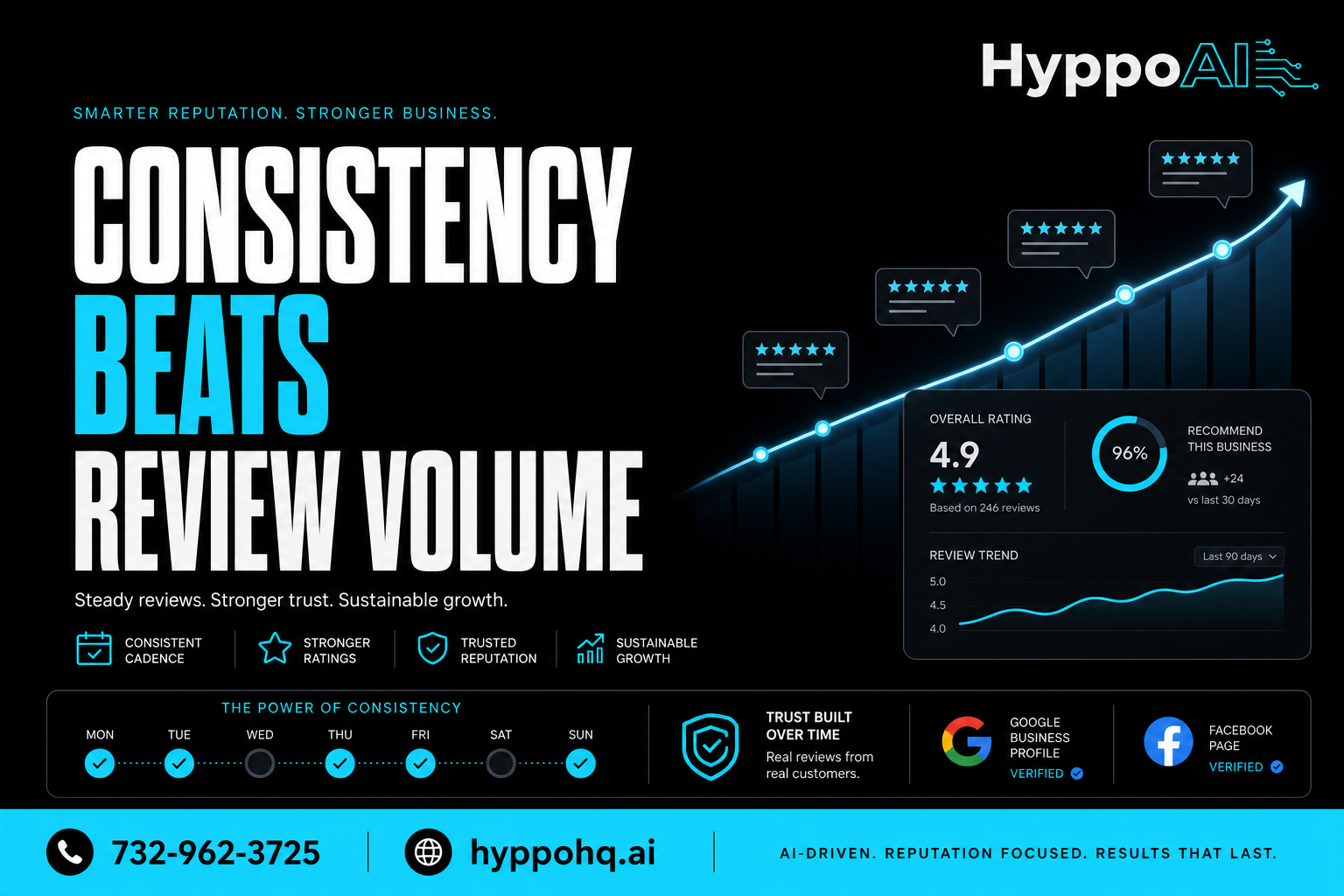
Why consistency matters more than volume in reviews
When business owners think about online reviews, the first instinct is usually simple: get more.
More reviews must mean more trust, better rankings, and more conversions, right?
Not exactly.
Volume matters, but consistency matters more.
For small and mid-sized businesses, a steady flow of recent, authentic reviews often does more for trust and performance than a one-time spike in review count. If your business gets 50 reviews in one month and then nothing for six months, that pattern can work against you. On the other hand, if you earn a few reviews every week or month, you create a stronger signal for both potential customers and the platforms they use.
At HyppoAI, we work with SMB-focused AI systems, and one pattern is clear: sustainable reputation growth beats short-term bursts almost every time.
Why review consistency builds more trust
People do not just look at your star rating. They look at how recent your reviews are, how often they come in, and whether they reflect an ongoing customer experience.
A business with 200 reviews sounds strong on paper. But if the newest one is nine months old, that raises questions.
Customers may wonder:
- Is this business still active?
- Has service quality changed?
- Are those reviews still relevant?
- Can I trust what I am seeing today?
Now compare that to a business with fewer total reviews, but a steady stream of fresh feedback. That looks alive, reliable, and current.
Consistency signals that:
- The business is actively serving customers
- Customers continue to have real experiences worth sharing
- The quality is stable over time
- The reputation is not manufactured around a short campaign
That is what trust looks like in practice.
Fresh reviews influence buying decisions
Most buyers are not conducting a deep audit. They are scanning for confidence.
They want quick proof that other people recently had a good experience.
Recent reviews reduce uncertainty because they answer the question that matters most: “What can I expect now?”
Older reviews may still help, but they lose persuasive power over time. Markets change. Staff changes. Processes change. Customer expectations change.
That is why review recency often carries more weight than business owners realize.
A consistent review pattern helps prospects feel like they are seeing the current version of your business, not a snapshot from the past.
Platforms reward steady activity
Review platforms and search engines are designed to surface useful, relevant information. That means they tend to value signals that show ongoing engagement.
While every platform uses its own systems, steady review activity generally supports stronger visibility than long periods of silence.
Why? Because consistency suggests legitimacy and relevance.
A natural review profile usually includes:
- Reviews arriving over time
- A mix of detailed and short feedback
- Responses from the business
- Ratings that reflect real customer experiences
A sudden burst followed by inactivity can look less natural. Even if every review is legitimate, the pattern itself may be weaker than a steady cadence.
For SMBs, this matters because local trust and discoverability are tightly connected. If you want reviews to support your reputation, lead flow, and conversion rate, consistency should be part of the strategy.
Volume without consistency can create risk
A high review count is useful, but chasing volume without a system can create problems.
Here are a few common issues:
Reviews become campaign-based instead of operational
Some businesses ask for reviews only when they remember, or only after a marketing push. That creates spikes, not momentum.
The result is an inconsistent public reputation footprint.
Gaps make negative reviews stand out more
If your business gets very few reviews over long periods, one negative review can dominate the conversation.
But if you maintain a steady stream of feedback, the occasional negative review is less likely to define perception.
Teams lose the habit
When review generation is not built into the customer journey, it depends on memory and motivation. That usually means it happens less often than it should.
Consistency requires a process, not just good intentions.
What consistency looks like for SMBs
Consistency does not mean overwhelming customers or asking every person five times.
It means building a reliable, repeatable review process into normal operations.
For most SMBs, that can look like:
- Asking at the right moment after a positive interaction
- Using the same workflow across the team
- Following up once when appropriate
- Monitoring incoming reviews weekly
- Responding to reviews in a timely way
- Tracking trends instead of obsessing over one day or one week
This is where systems matter.
A business that treats review generation as a repeatable process will almost always outperform one that treats it as an occasional task.
Why consistency is more scalable than volume chasing
Trying to “get a lot of reviews fast” often creates friction.
Teams feel pressured. Customers get awkward asks. The process becomes forced.
A consistency-first approach is more scalable because it is based on workflow design.
Instead of asking, “How do we get 100 reviews this month?”
Ask:
- How do we create a process that generates reviews every month?
- How do we reduce manual effort?
- How do we make asking feel natural and timely?
- How do we keep the quality of customer experience high enough that reviews happen more easily?
That shift changes everything.
Now reviews are not just a marketing output. They become a byproduct of a better operating system.
The operational advantage of AI-supported review systems
For SMBs, consistency is often not a motivation problem. It is an execution problem.
The team gets busy. Follow-up slips. Great customer moments pass without a review request.
That is where AI and automation can help.
Used correctly, AI can support a more consistent reputation strategy by helping businesses:
- Trigger review requests at the right stage of the customer journey
- Standardize follow-up timing
- Reduce missed opportunities
- Organize response workflows
- Surface patterns in customer feedback
The goal is not to make reviews feel robotic.
The goal is to remove inconsistency from the process.
For SMBs, that is a major advantage. You do not need a massive customer base to build a strong reputation. You need a reliable system that turns everyday customer interactions into steady trust signals.
A better way to measure review success
If you only track total review count, you miss the bigger picture.
A smarter approach is to measure:
- Reviews per week or month
- Review recency
- Response rate and response speed
- Average rating trend over time
- Common themes in customer feedback
These metrics tell you whether your reputation engine is healthy.
A business with moderate but steady review flow is often in a stronger position than a business with a large but stagnant review base.
That is especially true in competitive local markets, where buyers compare businesses quickly and make decisions based on current signals.
Final takeaway
More reviews are good. Consistent reviews are better.
Volume can create a strong first impression, but consistency creates lasting trust. It shows customers that your business is active, reliable, and delivering value right now.
For SMBs, the winning strategy is not random review bursts. It is a system that produces steady, authentic feedback over time.
If you want to build smarter review workflows and more reliable reputation systems, HyppoAI helps SMBs use AI to create operational consistency where it matters most. Visit https://hyppohq.ai or call +17329623725 to learn more.