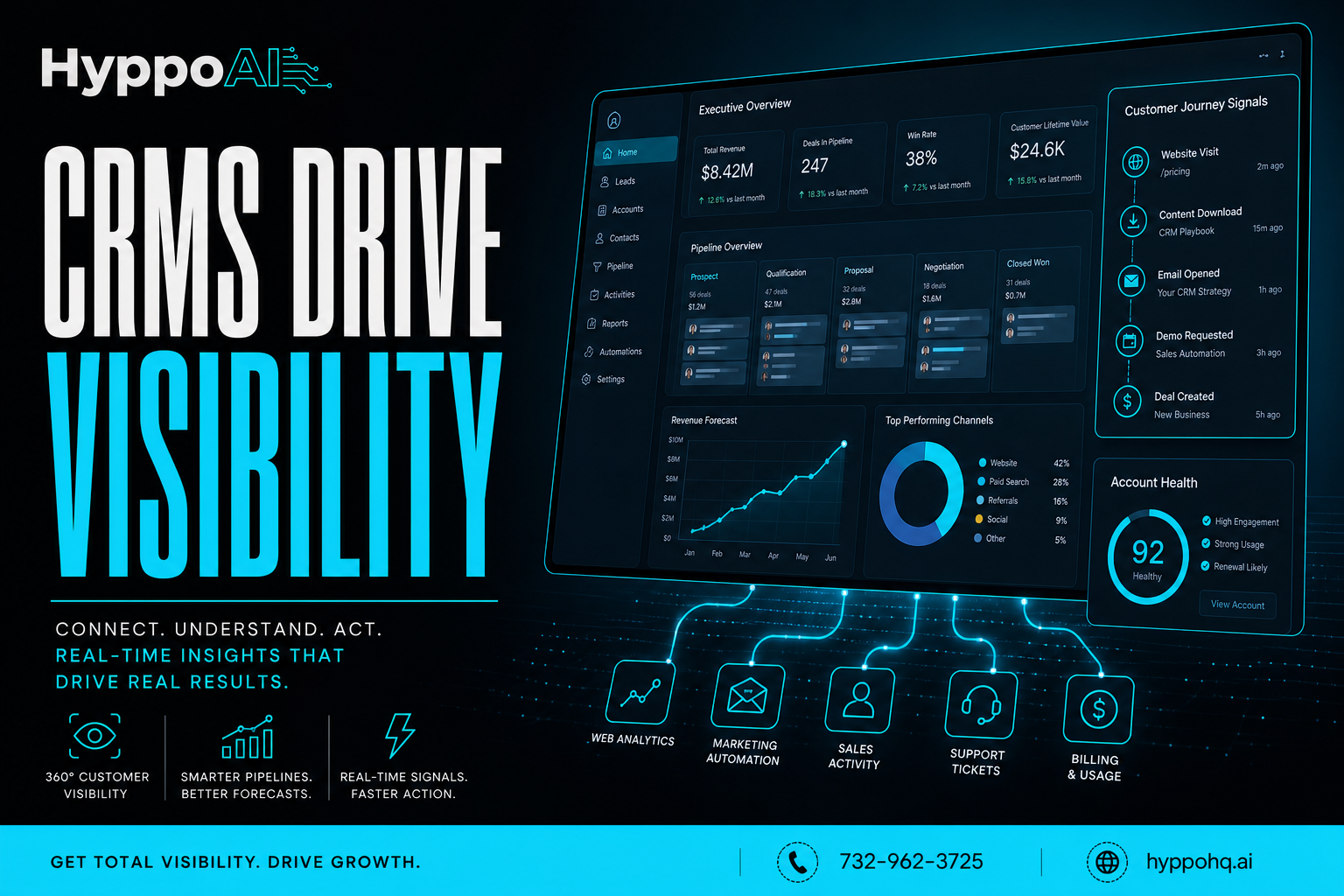
Why CRMs are about visibility, not just data storage
Most businesses do not struggle because they lack data. They struggle because they cannot see what the data means.
That is the real reason CRM systems matter.
A CRM is not valuable because it stores names, emails, and notes. Plenty of tools can do that. A CRM becomes valuable when it gives your team visibility into what is happening across sales, follow-up, service, and operations.
If your CRM is just a digital filing cabinet, it is underperforming.
For SMBs especially, visibility is the difference between reacting late and acting early. It helps owners spot bottlenecks, managers coach better, and teams follow through without things slipping through the cracks.
Data storage is the baseline, not the outcome
Every CRM stores information. That part is expected.
It can hold:
- Contact details
- Lead sources
- Deal stages
- Notes from calls and meetings
- Tasks and reminders
- Purchase or service history
But storage alone does not create momentum.
A business can have thousands of records sitting inside a CRM and still have no clear answer to simple questions:
- Which leads are most likely to close?
- Where are deals getting stuck?
- Which rep needs support?
- How long does follow-up actually take?
- Which marketing channels are producing real revenue?
- Which customers are at risk of going cold?
When those answers are hard to find, the issue is not a lack of data. It is a lack of visibility.
Visibility helps teams make faster decisions
Good operators do not want more dashboards just for the sake of dashboards. They want clarity.
Visibility means the right people can quickly see:
- What is happening now
- What needs attention next
- What is working
- What is being missed
That changes how a business runs.
Instead of digging through notes, exporting spreadsheets, or chasing updates in Slack and email, teams can work from a shared source of truth. That reduces delay, confusion, and guesswork.
For example, if a sales manager can see that demo-to-close rates are dropping, they can investigate immediately. If an owner can see that inbound leads are not being contacted within the first hour, they can fix the process before revenue is lost.
That is what a CRM should enable.
Visibility creates accountability
One of the biggest hidden benefits of a CRM is accountability.
Not in a heavy-handed way. In a practical way.
When pipeline stages are clear, tasks are assigned, and response times are visible, it becomes easier to see whether the process is healthy. Teams know what is expected. Managers know where support is needed. Owners stop relying on gut feel alone.
Without visibility, accountability becomes subjective.
With visibility, it becomes operational.
A visible pipeline is easier to improve
You cannot improve what you cannot see.
That applies directly to your pipeline.
If your CRM gives you a clear view of lead flow from first contact to close, patterns become obvious. You can identify:
- Stalled opportunities
- Weak handoffs
- Delayed follow-up
- Inconsistent qualification
- Lost leads with no documented reason
- Overloaded reps or underused capacity
These are not just reporting details. They are operational signals.
The more visible the pipeline is, the easier it becomes to improve conversion rates, shorten sales cycles, and create a more predictable process.
Visibility also improves customer experience
Customers feel disorganization quickly.
They notice when:
- They repeat information to multiple people
- Follow-up is delayed
- Promises are forgotten
- Appointments fall through
- No one seems to know the status of their issue
A CRM that provides visibility across the customer journey helps prevent those failures. Teams can see the full context of the relationship, not just isolated notes.
That leads to faster responses, better handoffs, and a more consistent experience.
For SMBs competing on service, that matters a lot.
Why SMBs often miss the point of CRM adoption
Many small and midsize businesses adopt a CRM because they know they should. But implementation often focuses on setup instead of usage.
The thinking goes something like this:
- Import contacts
- Create a few stages
- Give the team logins
- Call it done
That is not transformation. That is software installation.
The real value comes from designing the CRM around business visibility.
That means asking better questions:
- What decisions should this CRM help us make?
- What bottlenecks should it reveal?
- What actions should it trigger automatically?
- What metrics actually matter to our team?
- Where do leads, customers, or tasks commonly get lost?
When a CRM is built around those questions, it becomes a management system, not just a storage tool.
What visibility looks like in practice
A visibility-driven CRM does not have to be overly complex. In fact, simpler is often better.
What matters is that the system makes key information easy to act on.
Here are a few examples of useful visibility:
Lead response visibility
Can you see how fast new leads are being contacted?
If not, you may be losing opportunities without realizing it.
Pipeline health visibility
Can you see how many deals are sitting in each stage, and for how long?
If not, your forecast may be less reliable than it looks.
Follow-up visibility
Can you see which prospects have gone quiet and which tasks are overdue?
If not, revenue may be leaking through inconsistent execution.
Source visibility
Can you see which channels are generating qualified leads, not just form fills?
If not, marketing spend becomes harder to optimize.
Customer visibility
Can you see a full timeline of interactions, service issues, and next steps?
If not, customer experience becomes fragmented.
Where AI makes CRM visibility even stronger
This is where modern systems get interesting.
AI can help turn raw CRM activity into usable insight faster.
For SMBs, that can mean:
- Summarizing customer interactions
- Flagging stalled deals
- Identifying follow-up gaps
- Prioritizing leads based on behavior
- Surfacing trends across conversations and outcomes
- Automating routine updates so teams spend less time on admin
The point is not to add complexity. The point is to reduce friction.
When AI supports CRM visibility, teams spend less time logging and searching, and more time acting on what matters.
That is especially powerful for lean teams that need to move quickly.
How to tell if your CRM is doing its job
A simple test: can your CRM help you answer operational questions in minutes, not hours?
If the answer is no, it may be collecting data without creating visibility.
A strong CRM should help your business:
- See what needs attention now
- Understand where performance is slipping
- Improve follow-up consistency
- Align sales and service teams
- Make decisions with more confidence
That is the standard.
Not just record keeping. Operational clarity.
Final thought
CRMs are not about storing more information. They are about making the business easier to see.
When visibility improves, decision-making improves. Execution improves. Customer experience improves. And growth becomes easier to manage.
For SMBs, that shift matters more than ever.
If you are evaluating how your systems support sales, follow-up, and operations, HyppoAI helps businesses think more clearly about automation, AI, and visibility-first workflows. Visit https://hyppohq.ai or call +17329623725 to learn more.