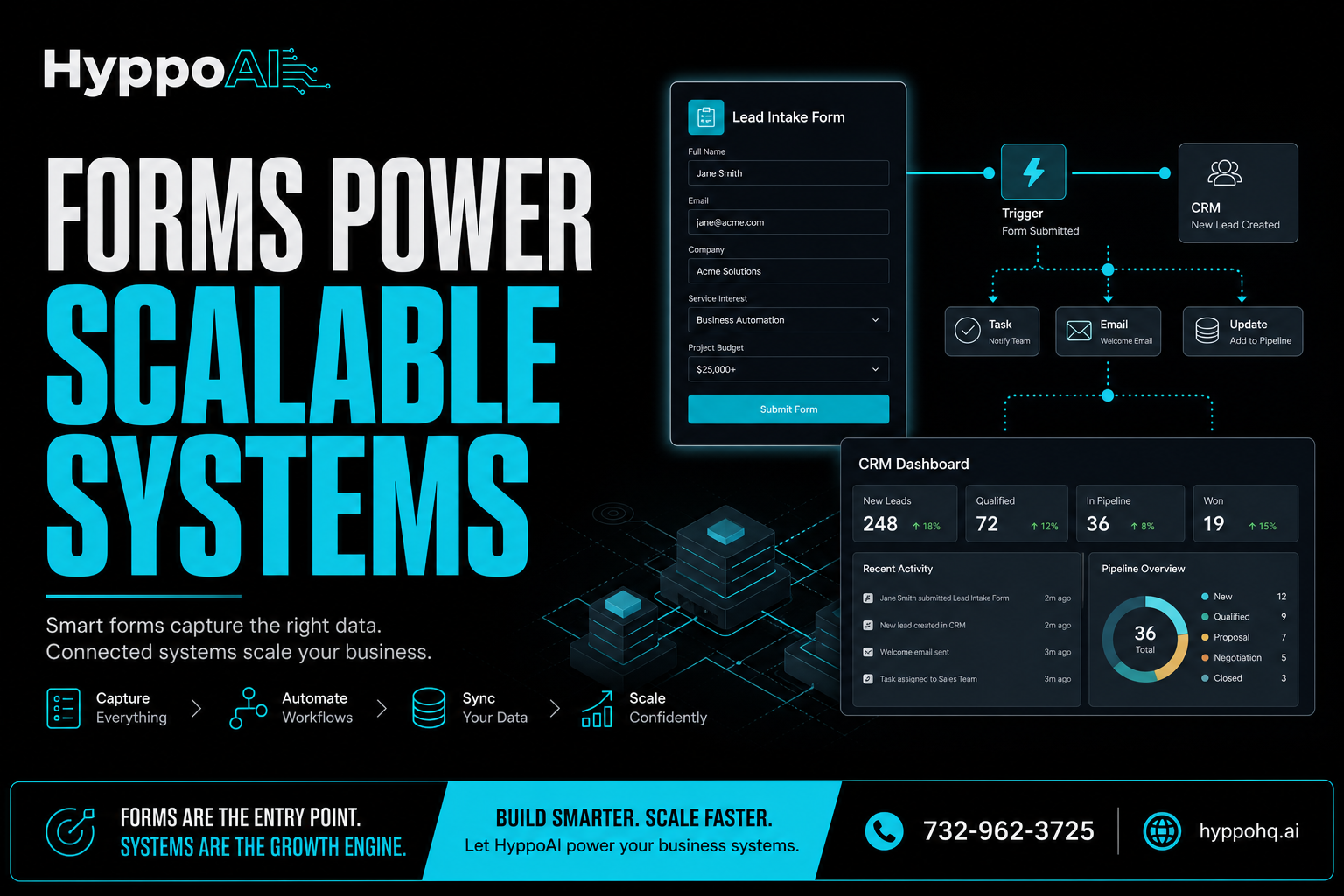
Why forms are the front door to systems that scale
Most businesses think of forms as simple data collection tools.
That is too small of a view.
Forms are the front door to systems. They are the point where people, information, and process first meet. If that first step is messy, every step after it gets slower, more expensive, and harder to manage.
For SMBs, this matters a lot. Growth does not usually break because of effort. It breaks because inputs are inconsistent, handoffs are unclear, and teams are forced to guess what should happen next.
A well-designed form fixes that.
It creates structure at the start, so the rest of the system can run with logic instead of manual cleanup.
Why forms matter more than most teams realize
Every system needs an entry point.
That entry point could be:
- A lead capture form
- A service request form
- An intake form
- A hiring application
- A support ticket form
- An internal approval form
In each case, the form is not just asking questions. It is defining the data the system will use.
If the form is vague, incomplete, or inconsistent, the downstream process suffers. Sales loses context. Operations chases missing details. Support wastes time clarifying basic information. Leadership gets poor reporting because the data was weak from the beginning.
When forms are built correctly, they do the opposite.
They standardize inputs, reduce ambiguity, and trigger the right next action automatically.
Forms turn human requests into system-ready data
People communicate in natural, messy ways.
Systems do not.
Systems need structured inputs to route tasks, assign owners, trigger automations, and generate useful reporting. Forms create that translation layer.
Instead of relying on emails, texts, DMs, or verbal requests, a form can capture the exact fields needed to move work forward.
That might include:
- Contact information
- Service type
- Budget range
- Priority level
- Location
- Timeline
- Required documents
- Consent or approval status
Once that information is captured in a consistent format, the rest of the workflow becomes easier to automate.
Clean inputs create better outputs
This is one of the most important ideas in operations.
Bad inputs create bad outputs.
If your team is constantly fixing typos, chasing missing details, or interpreting vague requests, the issue is often not the people. It is the front door.
A strong form improves:
- Speed of response
- Accuracy of routing
- Quality of reporting
- Customer experience
- Team efficiency
The more your business depends on repeatable execution, the more valuable forms become.
Forms reduce decision fatigue
Without forms, teams make too many small decisions manually.
They ask:
- What did this customer mean?
- Who should handle this?
- Is this urgent?
- Do we have everything needed to start?
- Should this go to sales, support, or operations?
Those micro-decisions add up fast.
Forms reduce that friction by forcing clarity upfront. They gather the right details in the right order, so the system can decide what happens next.
That is how businesses scale. Not by adding more chaos capacity, but by reducing unnecessary decisions.
Forms are the trigger point for automation
Automation only works when it has something reliable to act on.
Forms provide that reliability.
A submitted form can trigger actions like:
- Sending a confirmation email
- Notifying the right team member
- Creating a CRM record
- Opening a support ticket
- Scheduling a follow-up task
- Assigning a lead score
- Starting an onboarding workflow
- Updating a dashboard
Without a structured form, many of these actions require manual intervention.
That slows the business down and creates more room for mistakes.
The form is not the workflow. It starts the workflow.
This is where many teams get stuck.
They build a form and assume the job is done.
But the real value of a form is what it unlocks after submission. The form should connect to the system behind it.
That means every important form should answer three questions:
- What data do we need?
- What should happen next?
- Who needs visibility?
If those answers are clear, the form becomes a true operational asset instead of a static webpage element.
Good forms improve customer experience too
Customers do not want to repeat themselves.
They do not want to submit a request, then answer the same questions again by email or phone. That creates friction and lowers trust.
A good form makes the next step feel smooth.
It signals that the business is organized, responsive, and prepared.
That does not mean forms should be long or complicated. It means they should be intentional.
The goal is to ask for what is necessary, in a sequence that makes sense, with language that is easy to understand.
What strong forms usually include
Strong forms are usually:
- Clear about purpose
- Short where possible
- Specific about required fields
- Structured for routing and automation
- Easy to complete on mobile
- Connected to backend systems
- Designed to reduce follow-up questions
For SMBs, even small improvements here can create major gains in speed and consistency.
Forms create better visibility for leadership
Leaders need data they can trust.
If requests come in through scattered channels, reporting becomes unreliable. It is hard to answer simple questions like:
- Where are leads coming from?
- What services are most requested?
- How long does intake take?
- What issues create the most support volume?
- Where are handoffs breaking?
Forms solve part of this by creating standardized entry data.
That makes it easier to measure trends, identify bottlenecks, and improve systems over time.
This is especially important for growing SMBs. When volume increases, intuition becomes less useful than clean operational data.
Common mistakes businesses make with forms
Many forms underperform because they were built as isolated assets instead of system components.
Here are a few common mistakes:
Asking vague questions
If a field can be interpreted in multiple ways, the answers will be inconsistent.
Collecting too little information
Short forms can help conversion, but if they leave the team without enough context, they create work later.
Collecting too much information
If every form feels like a long application, completion rates can drop.
Not connecting forms to workflows
A form without follow-up logic is just a digital inbox.
Ignoring internal use cases
External lead forms matter, but internal forms for approvals, requests, and handoffs can be just as valuable.
How to think about forms strategically
Instead of asking, "Do we need a form?" ask better questions:
- What process starts here?
- What information is required for that process to run well?
- What decisions can be automated based on the answers?
- What team needs this data?
- What reporting should this form support?
That shift changes the role of the form.
It stops being a basic website feature and becomes part of your operating system.
The real takeaway
Forms are not admin work.
They are system design.
They shape the quality of your data, the speed of your workflows, the consistency of your customer experience, and the scalability of your operations.
If your business feels slower than it should, the problem may not be the team or the tools. It may be the front door.
Start there.
Review the forms that feed your business. Tighten the questions. Standardize the inputs. Connect them to the right systems. Build the logic behind the submission.
That is how you create workflows that scale.
If you want to build smarter intake flows, cleaner automations, and better operational systems for your business, visit https://hyppohq.ai or call +17329623725 to learn how HyppoAI can help.