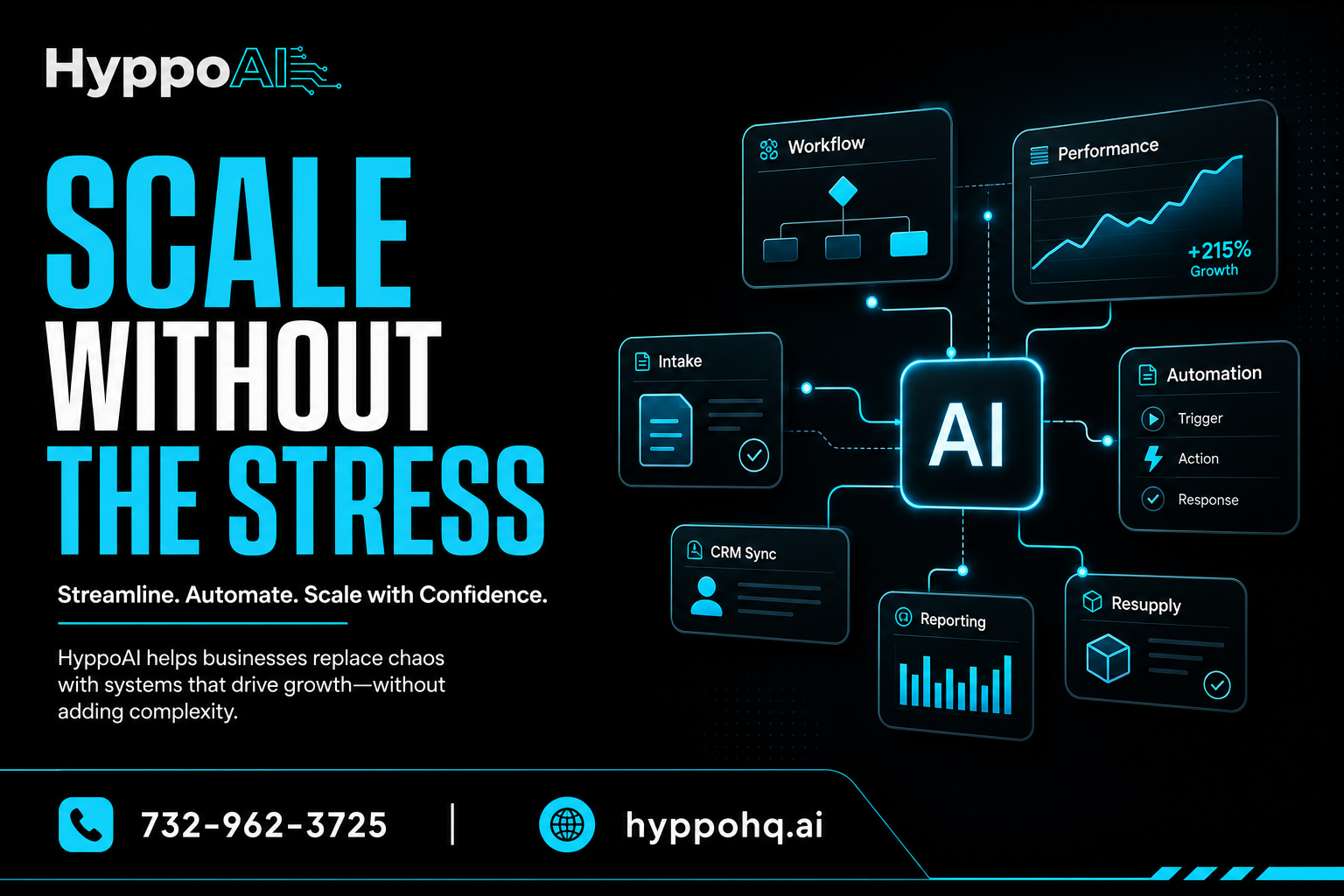
Why scaling a business without systems is so stressful
Growth sounds exciting from the outside. More customers, more revenue, more opportunity.
But inside the business, scaling without systems often feels like pressure, confusion, and constant firefighting.
If your team is growing but everything still depends on memory, manual work, and chasing updates, stress is not a sign that success is broken. It is usually a sign that your operations have not caught up with your growth.
For small and mid-sized businesses, this is one of the most common reasons scale feels harder than expected. The business is moving faster, but the structure underneath it is still fragile.
Why growth becomes stressful without systems
When a business is small, people can often compensate for missing processes.
A founder remembers every client detail. A manager manually follows up with leads. A team member knows where every file lives because they set it up that way.
That works for a while.
Then the business grows.
More customers come in. More conversations happen. More tasks pile up. More handoffs are required. Suddenly, what used to be manageable becomes messy.
Without systems, growth creates:
- More decisions that need to be made manually
- More repeated tasks that consume time
- More room for human error
- More dependency on specific people
- More delays in communication and follow-up
- Less visibility into what is actually happening
The result is predictable: stress increases as complexity increases.
The hidden cost of operating without systems
Most businesses do not feel the pain all at once. It shows up in patterns.
Everything depends on the owner
If every important decision, approval, or customer issue ends up back on the owner’s desk, the business is not scaling. The workload is.
That creates a bottleneck.
The owner becomes the system, which means growth is limited by one person’s time, attention, and energy.
Team members work hard but inconsistently
A good team can still struggle in a business with weak systems.
When there is no standard process for intake, follow-up, communication, or reporting, each person creates their own version. That leads to inconsistency, duplicated effort, and mistakes that should have been preventable.
Leads and opportunities slip through the cracks
One of the fastest ways to create stress is to generate demand without a reliable process to handle it.
If inbound messages, calls, appointments, and follow-ups are managed manually, missed opportunities become normal. The business spends money to create leads, then loses them in the gap between interest and response.
Simple tasks become daily friction
Without systems, even basic work becomes heavier than it should be.
Examples include:
- Manually assigning tasks
- Repeating the same customer responses
- Searching for information across tools
- Following up with no clear cadence
- Updating multiple systems by hand
None of these tasks seem huge on their own. Together, they create operational drag that drains the team.
Why systems reduce stress
Systems are not bureaucracy. They are how a business creates repeatable results without relying on constant improvisation.
A strong system answers questions before they become problems.
It defines:
- What happens first
- What happens next
- Who owns each step
- What tool supports the process
- What gets tracked and measured
That clarity lowers stress because people no longer have to reinvent the work every day.
Systems create predictability
When the team knows how leads are handled, how tasks are assigned, and how communication flows, the business becomes more stable.
Predictability reduces anxiety.
People can focus on execution instead of guessing.
Systems protect quality as volume increases
Scaling means more volume. More customers. More requests. More moving parts.
Without systems, quality usually drops as volume rises.
With systems, the business can absorb more activity while maintaining consistency. That is the difference between chaotic growth and controlled growth.
Systems make delegation possible
You cannot delegate effectively if the process only exists in someone’s head.
Documented workflows, automations, and clear handoffs make it easier to train, assign, and trust others with important work.
That is how owners get out of the weeds.
What systems matter most when scaling
Not every process needs to be rebuilt at once. Start with the areas that create the most friction or revenue loss.
Lead capture and follow-up
If a prospect reaches out, what happens next?
There should be a clear process for:
- Capturing the inquiry
- Logging it in the right system
- Sending an immediate response
- Assigning ownership
- Following up until a decision is made
This is one of the highest-impact places to introduce automation and consistency.
Customer communication
Customers should not have wildly different experiences based on who answers the phone or checks the inbox.
Create systems for:
- Common questions
- Appointment confirmations
- Status updates
- Missed call responses
- Re-engagement messages
This reduces confusion internally and builds trust externally.
Internal task management
As the team grows, work needs structure.
If tasks are being assigned casually through texts, calls, or memory, things will get missed.
Build a clear workflow for:
- Task creation
- Priority setting
- Ownership
- Deadlines
- Completion tracking
Reporting and visibility
Stress increases when leaders do not know what is working.
Basic reporting systems help answer questions like:
- How many leads came in this week?
- How fast did we respond?
- Where are deals getting stuck?
- Which tasks are overdue?
- What is consuming the team’s time?
Visibility creates better decisions.
Signs your business needs better systems now
If any of these sound familiar, your growth may be outpacing your operations:
- You feel busy all day but key work still gets missed
- Your team asks the same questions repeatedly
- Follow-up is inconsistent
- Important information lives in multiple places
- Customers experience delays or mixed communication
- You are hiring people to solve process problems
- Revenue is growing, but stress is growing faster
These are not just productivity issues. They are scaling issues.
How AI and automation can help
For SMBs, systems do not have to mean complicated enterprise software or months of implementation.
The right mix of AI and automation can remove repetitive work, improve response time, and create consistency without adding unnecessary overhead.
That can include:
- Automating lead responses
- Routing inquiries instantly
- Handling missed-call follow-up
- Standardizing customer communication
- Summarizing conversations and tasks
- Creating workflows that reduce manual handoffs
The goal is simple: reduce dependence on memory and manual effort.
When the business can respond, track, and execute more reliably, stress drops and capacity increases.
Scale should feel clearer, not heavier
A lot of business owners assume stress is just the price of growth.
It is not.
Some pressure is normal when a business expands. But constant chaos, bottlenecks, and reactive decision-making usually point to missing systems, not unavoidable success.
If you want to scale sustainably, build the structure that supports growth before the cracks get wider.
Systems create clarity. Clarity creates consistency. And consistency is what makes growth easier to manage.
If your business is growing but operations feel heavier every month, it may be time to simplify the way work gets done. HyppoAI helps SMBs use AI and automation to create smarter systems for scale. Visit https://hyppohq.ai or call +17329623725 to learn more.