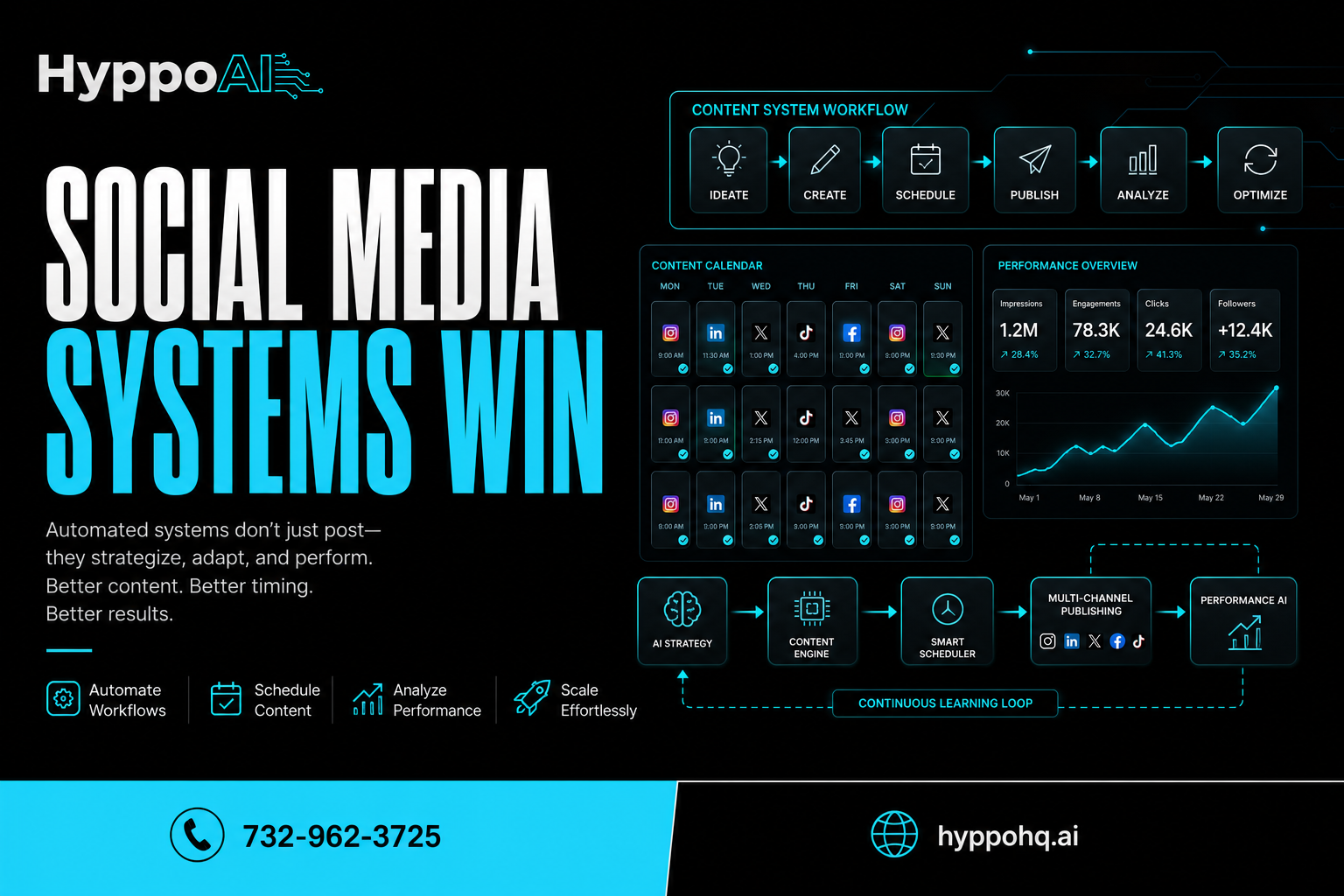
Why social media systems beat manual posting every time
Manual posting feels simple at first.
Open an app, write a caption, upload a photo, hit publish.
But for most small and midsize businesses, that routine becomes a bottleneck fast. It depends on memory, motivation, and whoever has a few spare minutes that day. That is not a growth strategy. It is a fragile habit.
Social media systems beat manual posting because systems create consistency, speed, and measurable results. Instead of rebuilding the process every day, you create a repeatable workflow that helps your business show up reliably and improve over time.
If your team is still posting manually whenever someone remembers, here is why a system is the smarter move.
Manual posting breaks under pressure
Manual posting usually works until business gets busy.
That is the problem.
The moment your team is handling customers, operations, hiring, and sales, social media becomes reactive. Posts go out late. Captions are rushed. Branding shifts. Good ideas get lost in text messages, notes apps, and half-finished drafts.
Common signs of a manual posting process include:
- Inconsistent posting frequency
- Last-minute caption writing
- Missed content opportunities
- No clear approval process
- Repeating the same ideas without a plan
- Little to no performance tracking
Manual posting also creates hidden costs. Even if it looks free, it consumes attention. Someone has to think about what to post, find the asset, write the copy, choose hashtags, format it, and publish it. Then the cycle starts over again the next day.
That constant context switching slows teams down.
Social media systems turn chaos into process
A system replaces random effort with a defined workflow.
Instead of asking, “What should we post today?” your team works from a plan. Content is organized in advance. Captions follow brand guidelines. Assets are stored in one place. Scheduling, approvals, and reporting all have a structure.
A social media system can include:
- A content calendar
- Caption templates
- Brand voice guidelines
- Hashtag libraries
- Creative asset folders
- Approval steps
- Scheduling tools
- Performance review checkpoints
This does not make your content robotic.
It makes your execution reliable.
The creative part still matters. The difference is that creativity now operates inside a framework that helps your business publish consistently without reinventing the process every time.
Consistency beats intensity
Many businesses confuse bursts of effort with momentum.
They post five times one week, disappear for two weeks, then start over again. That pattern hurts reach, weakens trust, and makes content harder to optimize.
Systems win because they support consistency.
Consistency matters on social media for a few reasons:
It builds audience trust
When people see your brand regularly, you stay top of mind. Familiarity creates credibility.
It gives platforms more data
Regular posting helps you learn what topics, formats, and messages perform best.
It reduces decision fatigue
You do not waste energy deciding from scratch every day.
It supports long-term growth
Steady output compounds. One post rarely changes a business. A strong system over months can.
A system helps your team maintain a realistic publishing pace that can actually be sustained.
Systems improve content quality
Manual posting often leads to rushed content.
When there is no process, quality depends on how much time and focus someone has in the moment. That usually means inconsistent messaging, weak hooks, and captions that do not match the brand voice.
With a system, quality improves because there is room for planning.
You can:
- Batch content creation
- Review captions before publishing
- Align posts to business goals
- Match content to campaigns or seasons
- Repurpose high-performing ideas
This creates stronger outputs without requiring more chaos.
A good system also protects brand consistency. For a growing company, that matters. Your audience should not feel like a different person is writing every post. A defined voice, clear messaging, and repeatable structure make your brand easier to recognize.
Systems save time across the whole team
Time savings are one of the biggest reasons social media systems beat manual posting.
Manual posting looks small in isolation. But across a month, the wasted time adds up.
Think about the repeated steps:
- Brainstorming topics from scratch
- Searching for images or videos
- Rewriting similar captions
- Getting approvals through scattered messages
- Logging in and posting manually
- Forgetting to track what worked
A system compresses all of that.
Batching alone can transform the workflow. Instead of touching social media every day, your team can plan, write, design, and schedule content in focused blocks. That is more efficient and usually produces better work.
For SMBs, this matters even more. Smaller teams do not have unlimited bandwidth. Systems help them compete without adding unnecessary overhead.
Better data leads to better decisions
Manual posting is often disconnected from reporting.
A post goes live, maybe someone checks likes, and then everyone moves on.
That is not enough to improve.
A system creates feedback loops. You can review performance consistently and answer practical questions like:
- Which topics get the most saves or shares?
- Which captions drive comments or replies?
- What posting times perform best?
- Which formats lead to clicks or leads?
- What themes should be repeated or retired?
When data becomes part of the workflow, content gets smarter.
Instead of guessing, your team can refine strategy based on actual results. That is how social media shifts from a task into an asset.
Systems scale, manual posting stalls
Manual posting depends too much on individuals.
If one person gets busy, takes time off, or leaves, the process falls apart.
Systems are different. They create operational stability.
That matters when your business starts growing. More offers, more campaigns, more team members, and more platforms all increase complexity. Without a system, growth creates confusion. With a system, growth becomes manageable.
Systems support delegation
Documented workflows make it easier to hand off tasks without losing quality.
Systems support automation
Scheduling, approvals, and content organization can be streamlined with the right tools.
Systems support expansion
A solid process can adapt as your content volume or channel mix increases.
This is the real advantage. Systems do not just help you post more. They help you operate better.
What a practical social media system looks like
You do not need a complicated stack to get started.
A practical system for an SMB can be simple and effective:
1. Start with content pillars
Choose 3 to 5 themes your brand will talk about regularly.
2. Build a monthly calendar
Map out topics, campaigns, and posting cadence in advance.
3. Create caption frameworks
Use repeatable structures for educational, promotional, and authority-building posts.
4. Organize assets centrally
Keep visuals, drafts, and approved brand elements in one place.
5. Schedule ahead
Use a scheduling tool so publishing does not rely on memory.
6. Review performance regularly
Track what works and adjust the system, not just the next post.
The goal is not perfection.
The goal is a process your team can repeat consistently.
The bottom line
Why do social media systems beat manual posting?
Because systems reduce friction, improve consistency, protect quality, save time, and make growth more predictable.
Manual posting is reactive. Systems are strategic.
If your business wants better results from social media, the answer is usually not to “try harder.” It is to build a workflow that removes guesswork and supports execution at scale.
That is where real momentum comes from.
If your team is ready to build smarter content operations with AI-powered support, HyppoAI can help. Visit https://hyppohq.ai or call +17329623725 to learn how better systems can simplify your social media workflow and support growth.