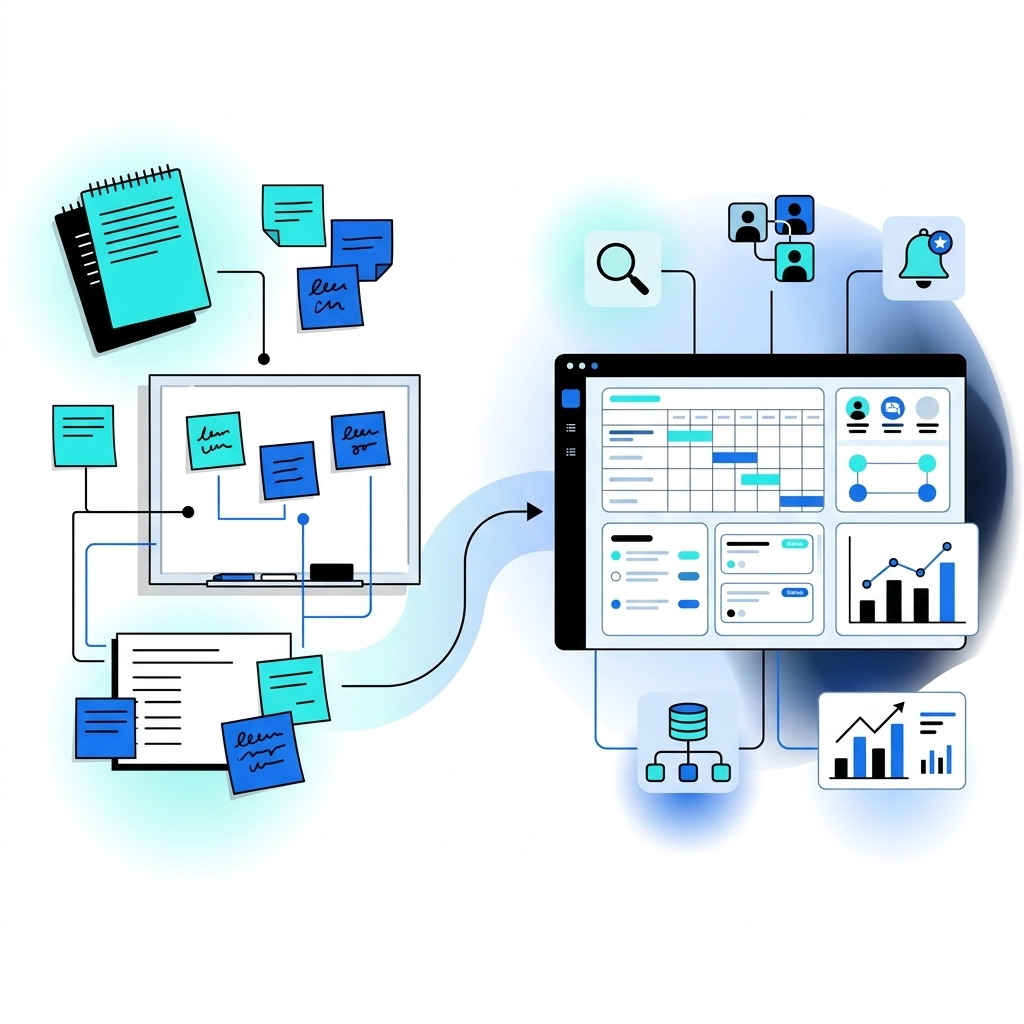
Why Sticky Notes and Notebooks Don't Scale for Modern Service Businesses
Why Sticky Notes and Notebooks Don't Scale for Modern Service Businesses
Many service businesses start with the same simple toolkit: a whiteboard, a pack of sticky notes, and a stack of notebooks. For a while, it works. You remember most things, your team is small, and important details live in your head.
As the business grows, those same tools start to show their limits. Calls are missed, follow-ups fall through, and no one is completely sure which version of a note is correct. This is not a failure of discipline; it is a limitation of the system.
This article explains why sticky notes and notebooks don't scale, what actually changes as a service business grows, and how digital systems, automation, and AI can support more reliable operations without overcomplicating your day.
The Hidden System Behind Sticky Notes
On the surface, a sticky note is just a reminder. In practice, it is part of a lightweight operations system that depends heavily on people's memory and judgement.
When you use sticky notes or notebooks to run your work, you are relying on:
- Personal memory: You remember what each note means and when to act on it.
- Physical location: Notes on your monitor or notebook pages act as a visual queue for priorities.
- Informal rules: You just know that the pink notes are urgent or that the left page is for today and the right page is for later.
This can feel efficient because it is flexible and familiar. The challenge is that this system is mostly invisible and lives in people's heads. That makes it difficult to share, repeat, or improve when the team or workload grows.
What Changes as a Service Business Scales
Sticky notes and notebooks start to struggle not because they are bad tools, but because the business context changes. As a service company grows, several things shift at the same time.
1. More people touch the same work
At the beginning, one person might handle sales, delivery, and customer follow-up. A note on their desk is usually enough. Once the team grows, the same job can involve multiple roles: sales, scheduling, field staff, billing, and customer support.
Now the question becomes: who owns the note, where does it live, and who updates it? Paper tools are not designed for shared ownership and real-time updates.
2. Volume and complexity increase
Going from 10 to 100 active customers is not just 10 times as many notes. It is a different type of problem. You now have:
- More overlapping tasks and due dates
- More exceptions and special cases to remember
- More dependencies between steps and team members
A notebook page can capture information, but it does not help you see patterns, bottlenecks, or risks across all customers at once.
3. Customers expect consistent, predictable experiences
In early stages, you may rely on personal relationships and quick fixes. As you grow, customers expect consistency: the same level of service regardless of which team member they interact with.
Consistency requires standard processes, shared information, and reliable follow-up. Systems built on sticky notes and personal memory make consistency harder to maintain, especially when someone is out sick or leaves the company.
Operational Limits of Sticky Notes and Notebooks
1. They are not searchable or filterable
Finding a specific note in a stack of notebooks or across office walls is slow and error-prone. You cannot easily search for all customers with open estimates, all jobs scheduled this week, or all follow-ups due today.
2. They do not support real-time collaboration
Paper is inherently single-user. A note can only exist in one place at one time. If one person has the notebook in a truck, the rest of the team does not have access to the information inside.
3. They offer no built-in automation
Sticky notes cannot remind you automatically when a follow-up is due, update a status based on an event, or send a confirmation message to a customer. Every action depends on someone noticing the note and remembering what to do next.
4. They do not create structured data
Most paper notes mix tasks, ideas, and customer details in the same space. Over time, this becomes difficult to analyze or reuse. Digital systems that capture structured data make it much easier to see trends, refine processes, and apply automation or AI.
How Digital Systems Improve on Paper Tools
1. Centralized, shared information
Customer details, job status, and internal notes can live in a shared system rather than scattered across multiple notebooks. This allows different team members to pick up work without starting from scratch or asking for background repeatedly.
2. Clear workflows and statuses
Digital systems can represent work as a series of stages (new lead, quoted, scheduled, completed, invoiced). This makes it easier to see where each customer stands and where work might be stuck.
3. Built-in reminders and triggers
Once work lives in a digital environment, basic automation becomes possible. Common examples include reminders for follow-ups after a quote is sent, notifications when a job is assigned or rescheduled, and alerts if a task has been in the same status for too long.
4. Data that supports AI and advanced automation
As your operations become more structured and digital, you create a foundation for AI tools to add value: summarizing complex job histories, highlighting unusual patterns, suggesting next best actions based on similar past jobs.
Transitioning Away from Sticky Notes Without Overwhelm
Recognizing that sticky notes and notebooks do not scale does not mean you need to abandon them entirely or adopt a large, complex platform overnight. Many teams continue to use paper for quick thoughts or on-the-go notes while running their core operations in digital systems.
The key idea is to separate temporary, personal reminders from long-term, shared operational data. Paper can still work well for the first category. The second category benefits from structure, access control, and automation that only digital systems can provide.
Bringing AI and Automation Into the Picture
Once your workflows and data move beyond sticky notes, AI and automation tools can support your team in practical ways: automatically logging and categorizing inbound inquiries, generating follow-up reminders based on job status and customer history, and summarizing conversations so team members can quickly understand context before the next interaction.
These capabilities are not about replacing humans. They are about reducing manual, repetitive tasks and improving consistency, so people can spend more time on problem-solving and customer relationships.
Conclusion: From Personal Memory to Shared Systems
Sticky notes and notebooks are effective tools for individual memory, but they do not scale well for teams, complex workflows, or growing customer bases. Shifting core operations into digital systems creates a foundation for more reliable execution, clearer visibility, and practical use of automation and AI.
If you would like to explore how AI-enabled systems and automation might support your specific workflows, you can learn more or connect with the HyppoAds team at hyppohq.ai/contact.