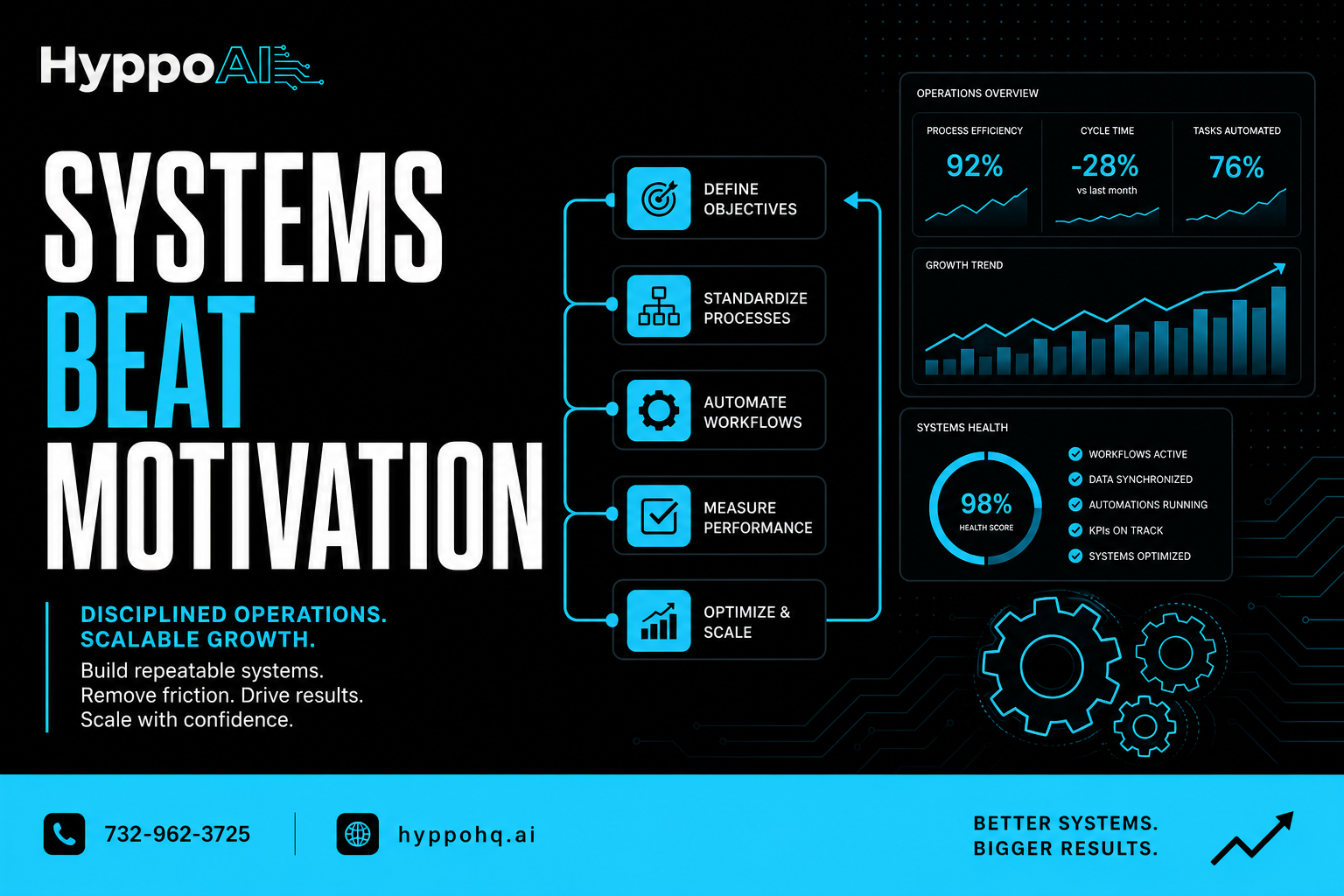
Why systems matter more than motivation for SMB growth
Motivation feels powerful in the moment.
It can get a team fired up, help launch a new initiative, or push a business owner through a long week. But motivation is unreliable. It rises and falls with stress, energy, time, and distractions.
Systems are different.
Systems do not depend on how inspired you feel today. They create repeatable outcomes, reduce friction, and make growth possible without constant manual effort. For small and midsize businesses, that difference matters a lot.
If you want predictable performance, better follow-up, and more room to scale, systems will always matter more than motivation.
Motivation is temporary, systems are repeatable
Most businesses do not struggle because people do not care. They struggle because too much depends on memory, urgency, and individual effort.
A motivated employee might remember to follow up with every lead this week. Next week gets busy, calls are missed, messages go unanswered, and opportunities slip away.
That is not a motivation problem. It is a systems problem.
A system creates a standard process that works even when the day gets chaotic. It turns good intentions into consistent execution.
Examples include:
- Automatic lead capture from forms and calls
- Instant follow-up messages after an inquiry
- Call routing and appointment scheduling workflows
- CRM updates without manual data entry
- Internal task assignments triggered by customer actions
When the process is built correctly, the business performs better without needing a daily motivational reset.
Systems reduce decision fatigue
Business owners and managers make hundreds of decisions every week. When every task requires someone to stop, think, remember, and choose the next step, performance slows down.
Systems reduce that burden.
Instead of asking:
- Who is following up with this lead?
- Did anyone answer that missed call?
- Was the estimate sent?
- Did the customer get a reminder?
- Has this contact been logged correctly?
A strong system answers those questions automatically.
That matters because decision fatigue is real. The more manual judgment your routine operations require, the more likely things are to get delayed, missed, or done inconsistently.
Systems protect focus. They free your team to spend more time on work that actually needs human attention.
Growth breaks businesses that rely on motivation alone
What works at a small scale often fails under pressure.
A team can survive on hustle for a while. A founder can manually monitor leads, answer after-hours messages, and keep operations moving through sheer effort. But once volume increases, motivation stops being enough.
More leads, more calls, more appointments, and more customer touchpoints create complexity. Without systems, that complexity turns into bottlenecks.
Common signs include:
- Slower response times
- Missed calls and lost leads
- Inconsistent customer experiences
- Team confusion around ownership
- Delays in scheduling or follow-up
- Revenue leakage from simple process gaps
Systems are what make growth sustainable. They create structure so increased demand does not automatically create operational chaos.
Systems create trust internally and externally
Customers trust businesses that respond quickly, communicate clearly, and follow through.
Teams trust businesses that make expectations clear and remove unnecessary friction.
Both forms of trust come from systems.
When a customer calls after hours and receives a prompt, helpful response, that feels professional. When a lead gets immediate acknowledgment instead of silence, that builds confidence. When reminders, updates, and next steps happen on time, the business feels organized.
Internally, systems help teams understand what happens next. They reduce confusion, support accountability, and make performance easier to measure.
Motivation may improve effort. Systems improve reliability.
AI makes systems faster to build and easier to run
For SMBs, one of the biggest barriers to better systems has always been time. Owners know they need better processes, but building them manually can feel overwhelming.
This is where AI changes the equation.
AI can help businesses create systems that respond faster, operate longer, and handle repetitive tasks with less manual input. That does not replace people. It helps people work inside a stronger framework.
Practical AI-supported systems can include:
Lead response automation
When a new lead comes in, AI can trigger immediate replies, route inquiries, and make sure no opportunity sits untouched.
AI reception and call handling
If your team misses calls, AI voice systems can answer, collect details, and direct the customer to the right next step.
Follow-up workflows
Instead of relying on staff to remember every outreach point, AI can support consistent follow-up across calls, texts, and other channels.
Data capture and organization
AI can help log interactions, summarize conversations, and keep records cleaner across your systems.
Appointment and reminder flows
Scheduled touchpoints can happen automatically, reducing no-shows and improving the customer experience.
The key point is simple: AI is most valuable when it strengthens systems, not when it acts as a novelty.
The best businesses do not ask people to remember everything
If a process is important, it should not live only in someone’s head.
That applies to:
- Lead intake
- Customer communication
- Scheduling
- Follow-up
- Handoffs between team members
- Status tracking
- Reporting
When critical steps depend on memory, inconsistency is inevitable. Even strong teams miss things when the process is unclear or overly manual.
Systems create a dependable operating model. They define what happens, when it happens, and who owns it.
That is how businesses move from reactive to proactive.
Motivation still matters, but it is not the foundation
This is not an argument against motivation.
Motivation helps people start. It can energize a sales push, support change, and create momentum during important moments. But it is not a durable operating strategy.
The foundation of a strong business is not how inspired the team feels on a given day. It is whether the business has systems that keep performance steady when things get busy, messy, or unpredictable.
The real goal is to build an environment where people do not need heroic effort to produce solid results.
That is what systems do.
They make consistency normal.
How to know where your business needs better systems
If you are not sure where to start, look for repeated friction.
Ask questions like:
- Where do leads get delayed or ignored?
- What tasks are still being handled manually every day?
- Which customer interactions depend too much on one person?
- Where do missed calls or slow responses hurt revenue?
- What processes become unreliable when the team gets busy?
Those pressure points usually reveal where systems will have the biggest impact.
In many SMBs, the first wins come from improving communication and follow-up. When response times improve and fewer leads fall through the cracks, the business feels the difference quickly.
Build for consistency, then scale
The businesses that scale well are rarely the ones with the most motivated teams every single day. They are the ones with the clearest systems.
They know how leads are handled. They know what happens after a missed call. They know how customers move from first contact to booked appointment to completed service.
That clarity creates leverage.
When systems are in place, growth becomes more manageable. Training gets easier. Reporting improves. Customer experience becomes more consistent. And the team spends less time putting out fires.
That is why systems matter more than motivation.
Motivation can spark action.
Systems make action repeatable.
If your business is ready to reduce missed opportunities and build smarter workflows with AI, HyppoAI can help. Visit https://hyppohq.ai or call +17329623725 to learn how better systems can support more consistent growth.