Why voice AI needs guardrails to work well
Voice AI can be fast, helpful, and scalable. But without guardrails, it can also become inconsistent, risky, and frustrating for customers.
That is why the best voice AI systems are not built to "do everything." They are built to do the right things, in the right situations, with clear boundaries.
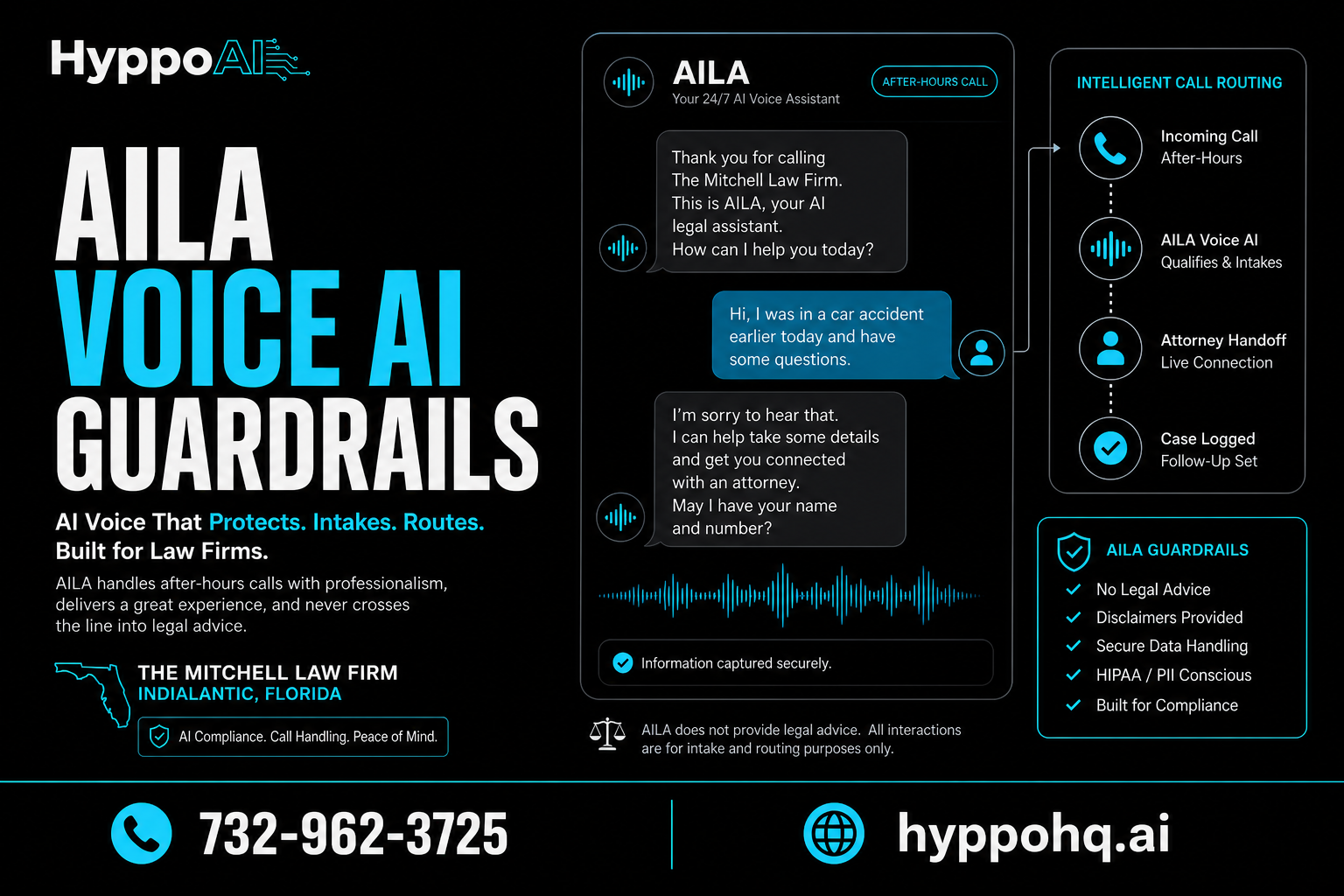
At HyppoAI, this matters even more when voice AI is used in real businesses with real stakes. A strong example is AILA, the Artificial Intelligence Legal Assistant that handles after-hours calls for The Mitchell Law Firm in Indialantic, Florida. In legal settings, guardrails are not a nice-to-have. They are essential.
What guardrails mean in voice AI
Guardrails are the rules, limits, and routing logic that keep an AI system operating safely and effectively.
In practice, guardrails help voice AI:
- stay within its intended role
- avoid making unsupported claims
- escalate sensitive situations to a human
- collect information consistently
- protect the customer experience
- reduce business risk
A lot of people think better AI means fewer limits. In reality, better AI usually means smarter limits.
When voice AI has guardrails, it becomes more reliable. It knows what it should handle, what it should not handle, and when to hand the conversation off.
Why voice AI fails without boundaries
A voice AI system without clear constraints can create problems quickly.
It can sound confident when it should be cautious
AI is designed to respond. If you do not define what it can and cannot say, it may answer questions outside its scope. That is especially dangerous in industries like legal, medical, and financial services.
It can create compliance and liability issues
If a system drifts into advice, interpretation, or promises the business cannot support, the risk goes up. The more regulated the industry, the more important the boundaries.
It can frustrate callers
Customers do not just want fast responses. They want correct responses. If the AI gives vague, irrelevant, or overly broad answers, trust drops fast.
It can miss the real goal of the call
Sometimes the goal is not to answer every question. Sometimes the goal is to capture key details and route the caller to the right person. That is where guardrails create real business value.
Practical guardrails in law office voice AI
Law offices are one of the clearest examples of why voice AI needs structure.
For a legal practice, an after-hours AI assistant can be extremely useful. It can answer the phone, gather intake details, identify urgency, and make sure no lead goes cold overnight or on the weekend.
But it should not cross the line into legal advice.
That is exactly the kind of practical guardrail that matters.
With AILA, the Artificial Intelligence Legal Assistant handling after-hours calls for The Mitchell Law Firm in Indialantic, Florida, the value is not that the AI acts like a lawyer. The value is that it supports the firm in a controlled, useful way.
Example: Do not give legal advice
A legal caller may ask:
- Do I have a case?
- What should I say to insurance?
- Should I sign this document?
- What are my rights in this situation?
Those are not questions an AI assistant should answer as legal advice.
A well-guardrailed system should instead:
- acknowledge the question clearly
- avoid making legal judgments
- explain that an attorney should review the matter
- collect relevant details for follow-up
- route the caller to a lawyer directly when appropriate
That is not a limitation of the system. That is the system working correctly.
Example: Route to a lawyer directly
Another practical guardrail is escalation.
If the caller describes a time-sensitive issue, a serious injury, an active dispute, or asks for legal direction, the AI should not try to improvise. It should route the matter to a lawyer or the proper next step immediately.
That can include:
- flagging urgent matters
- transferring to the right contact
- scheduling a callback
- capturing structured intake notes for the legal team
- notifying the firm based on priority rules
The best voice AI does not replace professional judgment. It protects it.
Guardrails improve performance, not just safety
Some businesses hear the word "guardrails" and think restrictions. But the real outcome is better performance.
Here is why.
Better consistency
When the AI follows a defined framework, callers get a more uniform experience. That means less confusion and more dependable outcomes.
Better data capture
Guardrails help the system ask the right questions in the right order. Instead of rambling, it gathers usable information.
Better handoffs
A smooth transfer is often more valuable than a weak answer. Clear escalation logic gets the caller where they need to go faster.
Better trust
People trust systems that are transparent about what they can do. A voice assistant that stays in its lane often feels more professional than one that tries to answer everything.
What good voice AI guardrails look like
If you are evaluating voice AI for your business, here are some signs the system is built the right way.
Defined scope
The AI should have a clear job description. It should know the types of questions it can handle and the ones it cannot.
Escalation rules
There should be explicit triggers for transferring to a human, creating a callback, or marking a conversation as urgent.
Approved language
For sensitive industries, responses should be structured around safe, approved wording rather than open-ended improvisation.
Role-based behavior
An AI receptionist, intake assistant, and support agent should not all behave the same way. The role determines the boundaries.
Logging and review
Businesses should be able to review interactions, spot patterns, and refine the system over time. Guardrails are not static. They improve with real usage.
Why this matters for SMBs
Small and midsize businesses often need automation the most. They miss calls after hours. They lose leads. They struggle to staff every touchpoint.
Voice AI can help solve that.
But SMBs also cannot afford preventable mistakes. A bad interaction can cost revenue, reputation, and time. That is why practical guardrails matter so much. They make automation usable in the real world.
For a law office, that means the AI helps capture opportunity without stepping into legal advice. For other service businesses, it may mean qualifying leads, answering common questions, and escalating edge cases fast.
The principle is the same: useful AI is controlled AI.
The bottom line
Voice AI works well when it has boundaries.
Guardrails are what turn a flashy demo into a dependable business tool. They help the system stay accurate, protect the business, and create better caller experiences.
In law offices, the need is even more obvious. AILA, the Artificial Intelligence Legal Assistant supporting The Mitchell Law Firm's after-hours calls in Indialantic, Florida, is a practical example of how guardrails make voice AI useful. It can help intake and routing, while making sure the AI does not give legal advice and directs callers to a lawyer when needed.
That is what good implementation looks like.
If you are exploring voice AI for your business, HyppoAI can help you build systems that are fast, practical, and designed with the right guardrails from day one. Visit https://hyppohq.ai or call +17329623725 to learn more.