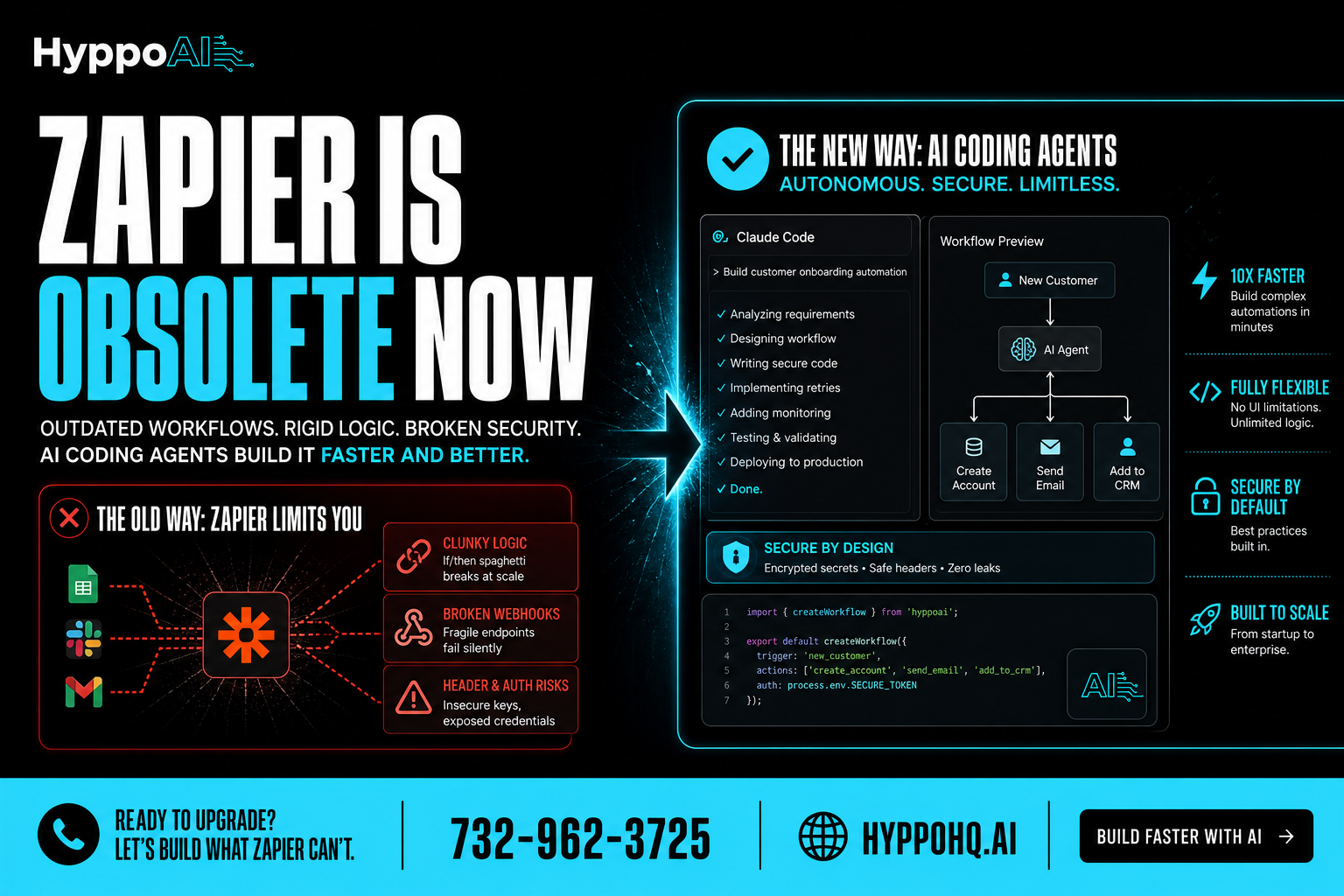
Why Zapier is not useful in the modern AI era
Zapier played an important role in making automation accessible. For years, it was the default recommendation for connecting apps, moving data, and reducing manual work.
But the market has changed.
In the modern AI era, businesses are no longer limited to rigid if-this-then-that workflows. AI coding agents, custom integrations, and more flexible orchestration tools have raised the bar. What once felt convenient now often feels restrictive, expensive, and surprisingly fragile.
If you are evaluating automation for a small or midsize business, it is worth asking a harder question: is Zapier still the right starting point, or is it now a legacy approach to a newer problem?
Zapier was built for a different generation of automation
Zapier was designed around app-to-app triggers and actions. That model made sense when most teams just needed simple handoffs, like:
- Send a Slack message when a form is submitted
- Add a lead to a CRM
- Create a row in a spreadsheet
- Forward data between SaaS tools
That is useful for lightweight tasks.
The problem is that modern business automation is no longer just about moving data from one app to another. Today, companies want systems that can:
- reason through edge cases
- transform messy inputs
- make context-aware decisions
- interact with APIs dynamically
- generate content, summaries, and responses
- adapt without rebuilding an entire workflow
Zapier can imitate some of this with enough steps, filters, paths, and workarounds. But that is exactly the issue: the logic gets clunky fast.
The logic becomes hard to manage
One of the biggest weaknesses of Zapier is how quickly simple workflows turn into sprawling chains of brittle logic.
What starts as a straightforward automation often becomes a maze of:
- multi-step zaps
- conditional branches
- formatter utilities
- webhook actions
- manual field mapping
- task-based workarounds
This creates several problems.
It is hard to debug
When something breaks, it is not always obvious why. You may need to inspect multiple steps, app responses, field mappings, and conditional rules just to find the failure point.
It is hard to scale
As your process becomes more nuanced, the workflow often becomes more fragile. Adding one more condition can affect several downstream actions.
It is hard to maintain
Business processes change. APIs change. Team members change. A workflow that only makes sense to the person who originally built it is not a strong operational system.
In short, Zapier often gives non-technical teams the power to build automation, but not always the structure to maintain it well over time.
Webhook security is weaker than many teams expect
Security should not be treated as an afterthought, especially when automations handle customer data, internal operations, or sensitive workflows.
A common concern with inbound webhooks is authentication. If a platform makes it difficult to secure inbound webhook endpoints with proper header-based authentication, that creates unnecessary risk and complexity.
For many modern teams, this is a red flag.
Why? Because secure integrations should support stronger, clearer patterns for verifying requests. If your workflow depends on exposed webhook URLs without robust native controls, you are forced into compensating workarounds instead of relying on a secure-by-design approach.
That may be acceptable for low-stakes experiments. It is not ideal for serious business infrastructure.
AI coding agents change the economics of automation
This is where the conversation really shifts.
In the past, Zapier won because custom automation felt too expensive, too slow, or too technical. Today, AI coding agents have changed that equation.
Tools like Claude Code and similar AI-assisted development workflows make it far easier to build custom automations that are:
- more flexible
- easier to tailor to your exact process
- more secure
- easier to integrate with internal systems
- not constrained by a fixed library of app actions
That matters because anything you can build in Zapier can often be built in a more durable way with AI-assisted coding, especially when the workflow is even moderately complex.
Instead of forcing your business process into Zapier's structure, you can create automation around the way your business actually operates.
Custom AI-driven automation is often a better fit
Custom does not always mean massive or expensive.
With the right AI-enabled workflow, businesses can build lean automation systems that do more than pass data around. They can:
- monitor inboxes and summarize messages
- enrich lead data from multiple sources
- route requests based on intent and urgency
- generate responses or internal notes
- sync systems with custom business logic
- validate, clean, and transform data before it moves
This is where AI-native automation stands apart.
Instead of stacking dozens of Zapier steps together, you can centralize logic in a cleaner, more adaptable system. That often results in fewer moving parts and better long-term reliability.
Zapier can still work for very simple tasks
To be fair, Zapier is not useless in every situation.
If you need a quick, low-risk automation for a very simple use case, it can still be a reasonable option. For example:
- posting a notification to a chat app
- copying a form submission into a spreadsheet
- sending a basic follow-up email
But that is a much narrower use case than it used to be.
The issue is not whether Zapier can automate something. The issue is whether it is the best foundation for modern automation strategy.
For many SMBs, the answer is increasingly no.
What SMBs should consider instead
If you are choosing an automation approach today, focus on the qualities that matter most over time:
Flexibility
Can the system adapt as your business process evolves?
Security
Can you implement proper authentication, validation, and access control without hacks?
Maintainability
Will your team understand and manage the workflow six months from now?
Intelligence
Can the automation handle ambiguity, summarize information, and make context-aware decisions?
Cost efficiency
Are you paying for task volume and workaround complexity, or investing in a system that fits your workflow better?
These questions often lead businesses away from rigid no-code chains and toward AI-assisted custom solutions.
The real takeaway
Zapier helped define an earlier era of automation. But the modern AI era demands more than chained triggers and patchwork logic.
When workflows become clunky, security controls feel limited, and AI coding agents can build better alternatives faster, it becomes harder to justify Zapier as the default starting point.
For SMBs especially, the opportunity is not just to automate tasks. It is to design smarter systems that reflect how the business actually works.
That is the difference between basic automation and modern AI operations.
If your team is rethinking automation, HyppoAI helps SMBs design practical AI systems that go beyond brittle no-code workflows. Visit https://hyppohq.ai or call +17329623725 to explore a more modern approach.